Clear Sky Science · en
Investigating the effects of Fe, Ni, or Cu additions on the microstructure and mechanical properties of W₂CoB₂ cermets
Why tougher tool materials matter
Modern factories rely on cutting tools and molds that must slice, press, and shape hard metals and composites for hours without failing. These tools are often made from advanced "cermets"—hybrids of ceramics and metals—that can be extremely hard but also brittle, like glass. This paper explores how small changes in the metallic ingredients of a promising cermet called W₂CoB₂ can make these tools not only harder, but also tougher and more resistant to wear, potentially extending their service life and reducing manufacturing costs.
What this special material is made of
W₂CoB₂ belongs to a family of ceramics called ternary borides, known for high hardness, resistance to wear, and stability at high temperature. On their own, these materials can crack easily, so they are combined with a metallic binder—here based on cobalt—to create a cermet: hard ceramic particles supported and glued together by a metal network. The authors asked a focused question: if they mix in iron (Fe), nickel (Ni), or copper (Cu) along with cobalt in the binder, how does that change the internal structure and, in turn, the strength and durability of the material? Their goal was to find a combination that keeps the extreme hardness of W₂CoB₂ while making it less likely to crack and wear away in service.
Peering into the atomic glue
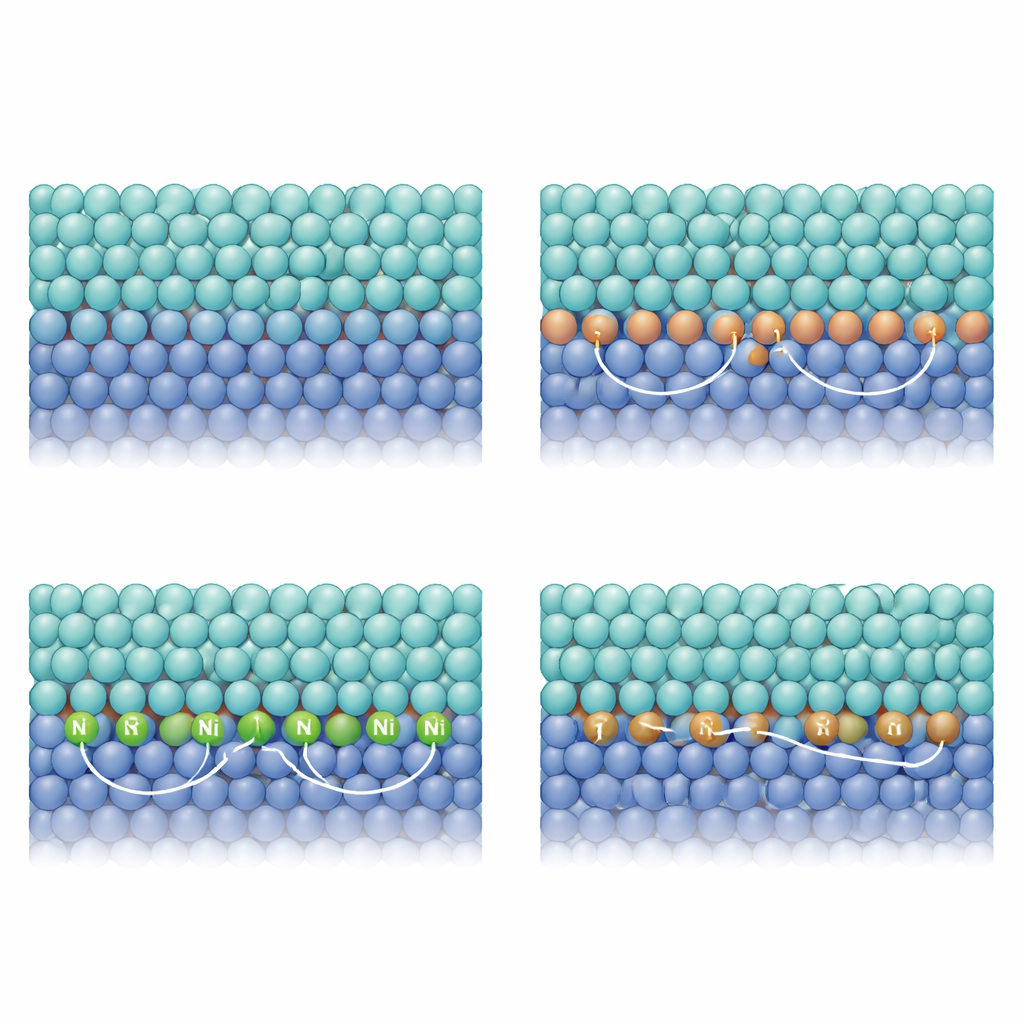
To understand what happens at the smallest scales, the team first used computer simulations based on quantum mechanics. These calculations modeled the interface where the hard W₂CoB₂ phase meets the metallic binder made of cobalt mixed with Fe, Ni, or Cu. By calculating how strongly the two phases stick together and how electrons are shared across the boundary, they could estimate which added element best strengthens this atomic "glue." The simulations showed that adding Fe or Ni increases the bonding energy at the interface—meaning the ceramic and metal are held together more firmly—while Cu actually weakens the interface. Electronic structure analyses, which track how electrons fill different energy levels, confirmed that Fe and Ni promote richer bonding states at the boundary, whereas Cu leaves a more brittle, crack-prone interface.
Building and testing real samples
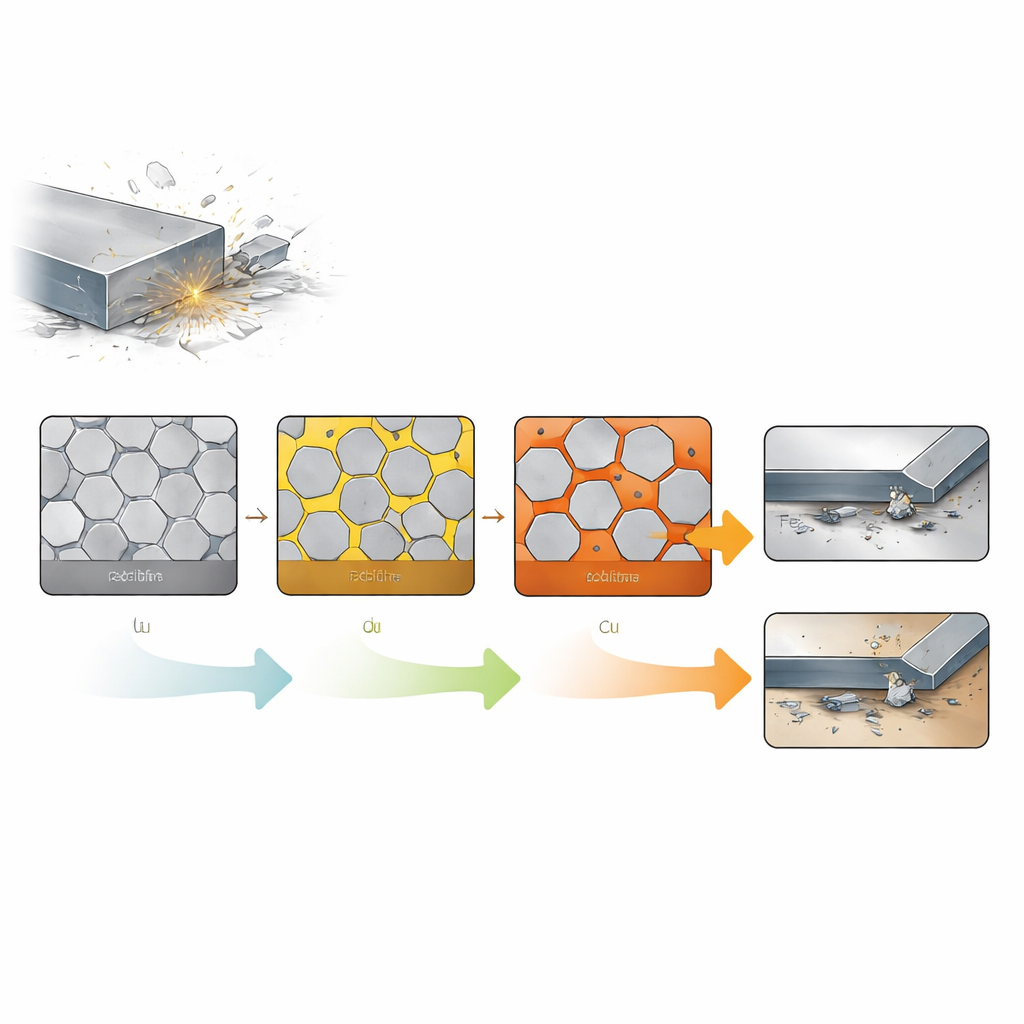
Next, the researchers produced real cermet samples using vacuum liquid-phase sintering, a high-temperature process that melts the metal binder so it can infiltrate and bond the ceramic particles. They prepared four versions: a baseline W₂CoB₂–Co cermet, and three others where cobalt was mixed in equal mass with Fe, Ni, or Cu. Under the microscope, all samples showed a network of hard grains surrounded by a metal-rich binder. With Fe or Ni additions, some hard grains grew into elongated shapes and the binder contained fine particles, indicating a strong interaction between the added metals and the existing phases. With Cu, tiny carbide particles appeared in the binder, slightly refining the structure but not changing the overall arrangement as much. Chemical mapping confirmed that Fe and Ni partly entered the hard phase as well as the binder, while Cu stayed mostly in the metal regions.
Hardness, toughness, and sliding wear
The team then measured three key properties: hardness (resistance to indentation), fracture toughness (resistance to crack growth), and wear behavior under sliding contact. Compared with the baseline, Fe increased toughness the most but slightly reduced hardness, reflecting the growth of larger, more crack-deflecting grains. Ni provided the best overall balance, raising hardness by about 7% and toughness by nearly 18%. Cu gave a modest boost to both hardness and toughness by creating many small hard particles that block crack motion, but did not match the performance of Ni. In sliding tests against a hard counterface, all three added metals reduced friction and wear compared with the original cermet. The Ni-containing sample showed the lowest friction, as debris from the metal binder oxidized and spread over the surface to form a thin protective layer that smoothed the contact.
What this means for real-world tools
Put simply, the study shows that carefully choosing the metallic ingredients in a cermet can tune how well the ceramic and metal portions stick together, which in turn controls how easily cracks start and spread. Fe and Ni make the interface more cooperative at the electronic level, helping the material absorb stress without shattering, while Cu tends to leave a more brittle joint. Among the tested options, adding Ni to W₂CoB₂–Co cermets stands out: it keeps the material very hard, makes it more resistant to cracking, and improves its sliding wear performance. These insights offer practical guidance for designing longer-lasting cutting tools and molds, and demonstrate how atomic-scale calculations can successfully predict which alloy tweaks will pay off in heavy-duty industrial applications.
Citation: Zhu, X., Pan, Y., Ke, D. et al. Investigating the effects of Fe, Ni, or Cu additions on the microstructure and mechanical properties of W₂CoB₂ cermets. Sci Rep 16, 10427 (2026). https://doi.org/10.1038/s41598-026-41181-3
Keywords: cermets, wear resistance, fracture toughness, tool materials, metal–ceramic composites