Clear Sky Science · en
Monitoring blast wave evolution and propagation using coupled visual recording and pressure measurements
Why blast waves matter to everyday life
Explosions are not just the stuff of action movies; they shape how we mine raw materials, build tunnels, design safer vehicles, and protect soldiers and civilians from attacks. Whenever an explosive charge goes off, it sends out a powerful pressure wave that can shatter concrete, damage equipment, or injure people. This study takes a close, frame‑by‑frame look at how such blast waves grow and travel through the air, combining high‑speed video with precise pressure measurements to better understand and predict their effects.
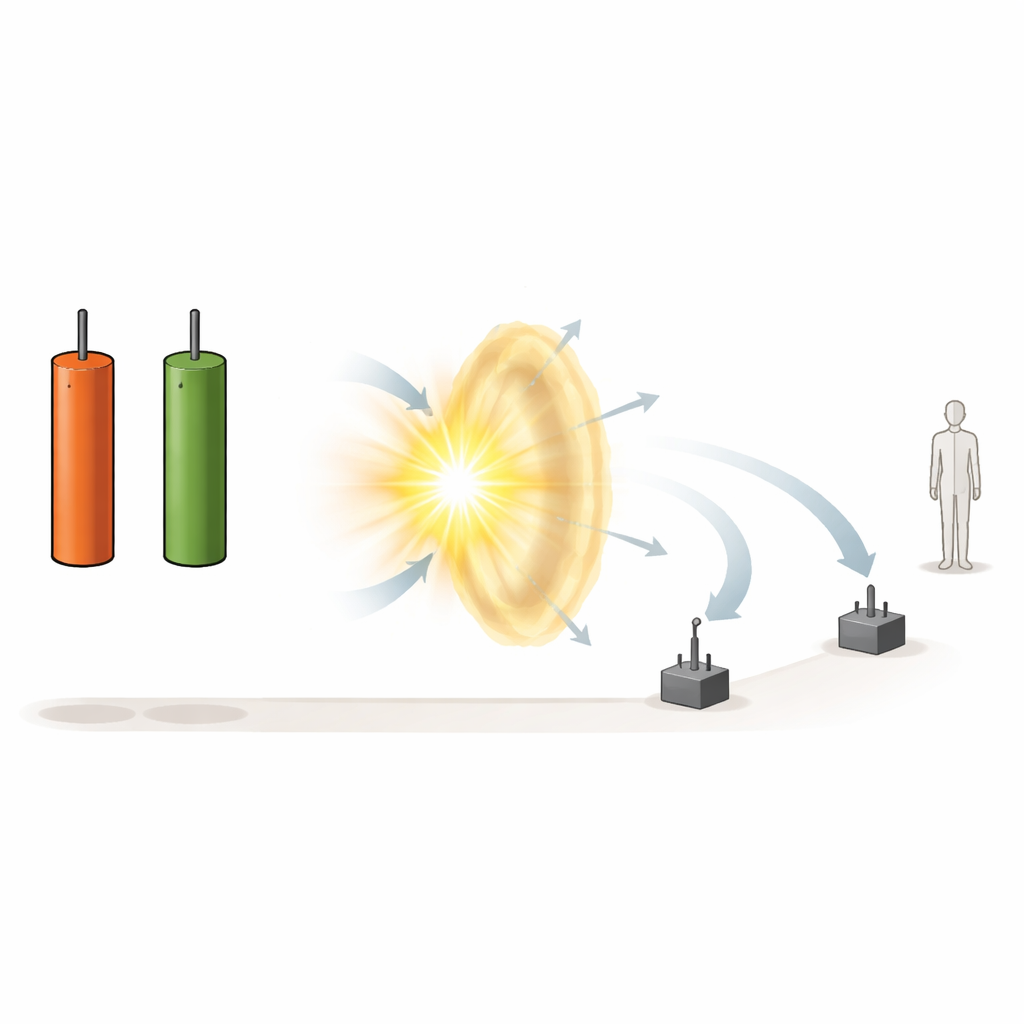
Two different charges, one careful test setup
The researchers focused on two widely used industrial explosives: Ammonal, which contains ammonium nitrate and aluminum powder, and Heksoflen, a plastic‑bonded explosive based on the powerful ingredient RDX. They packed each material into identical plastic tubes, hung the charges about a meter above the ground, and fired them using a small booster charge and an electric detonator. To capture what happened next, they used four probes inside each charge to track how fast the detonation raced along, three pressure sensors at set distances to record the blast, and a high‑speed camera taking thousands of images per second from about 50 meters away.
What the camera revealed about the fireball
By stepping through the high‑speed videos, the team could see the explosion unfold in ways that numbers alone cannot show. For Ammonal, the bright combustion zone stayed relatively compact. Within about one and a half thousandths of a second, gases and fine solid particles rushed out, quickly hiding the active burning region behind a cloud of dust and smoke that lingered over the site. Heksoflen behaved very differently. Its glowing fireball expanded much farther and for more than four thousandths of a second before slowly shrinking and rising. As the hot gases lifted, the camera even captured swirling twin vortices—large rotating structures in the air—that gradually faded with time. These visual differences hinted that the two explosives were releasing their energy in distinct ways.
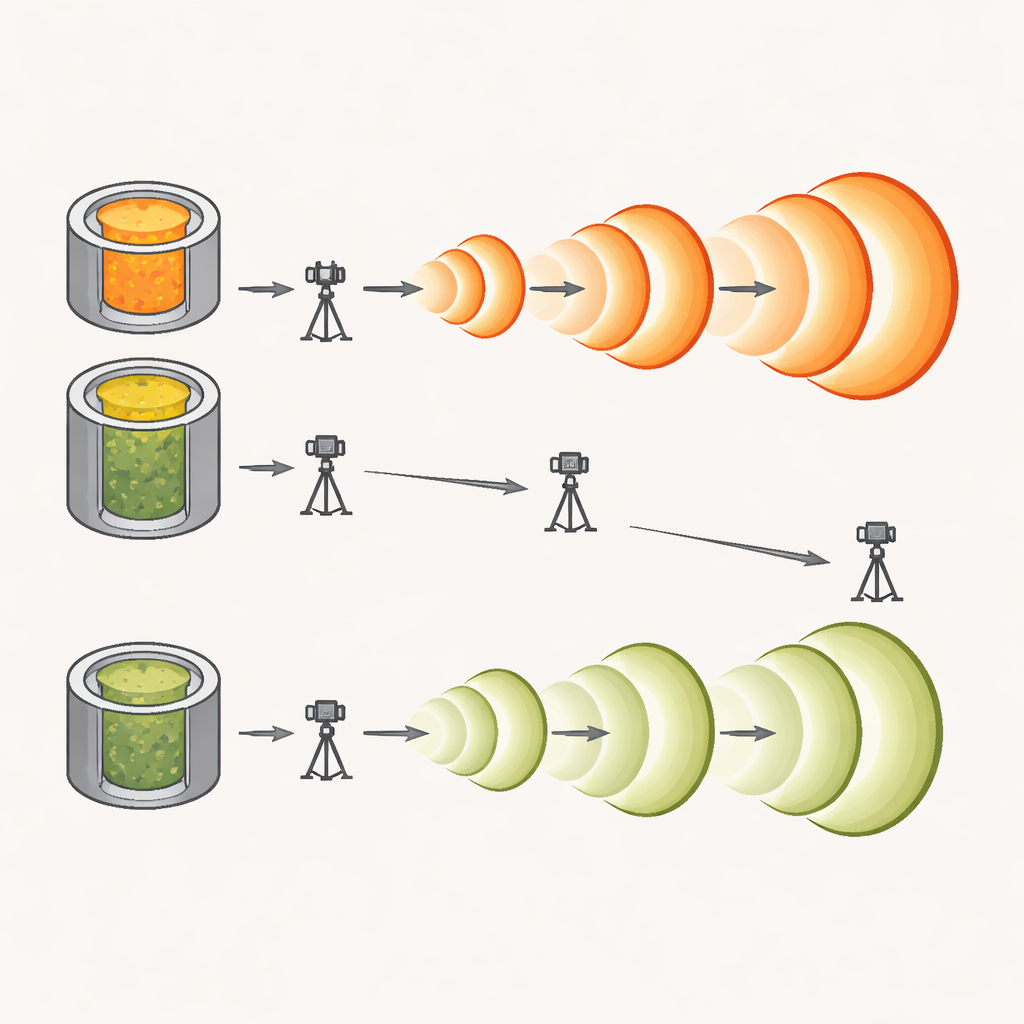
Measuring speed and strength of the blast
The instruments confirmed and quantified what the eye could only suggest. Inside the charges, the detonation in Heksoflen raced about two and a half times faster than in Ammonal, a sign of a much more energetic reaction. Out in the air, both explosives launched a blast wave that started at hundreds of meters per second and then slowed toward the speed of sound as it moved away. The pressure sensors showed that, at the closest point, Heksoflen produced about one and a half times higher peak pressure and one and a half times larger impulse—the overall push delivered by the wave—than Ammonal. As expected, both peak pressure and impulse dropped steadily with distance, but the stronger explosive stayed dominant at every sensor.
Turning complex blasts into simple rules
Because it is impractical to repeat such tests at every possible distance and in every weather condition, engineers often rely on formulas to estimate blast loads. The authors used their measurements to calibrate a simple relationship that links peak pressure to three things: how much explosive is used, how far away you are, and a single constant that depends on the type of explosive. By plotting their data and fitting straight lines, they extracted these constants separately for Ammonal and Heksoflen. When they then used the resulting equations to predict pressures at different scaled distances, the calculations matched the measured values closely, even though the charges were cylindrical rather than spherical, which usually complicates matters.
What this means for safety and design
For non‑specialists, the key takeaway is that not all explosions of the same size are equally dangerous: the chemical makeup of the charge strongly changes how intense the blast wave is and how long its effects last. By combining high‑speed imaging with sensors, this study shows that you can watch the blast wave advance, measure its punch, and then boil that behavior down into simple rules that fit on a single line of math. Those rules, tuned separately for different explosives, can help planners estimate safe stand‑off distances, design structures and protective gear, and assess the risks posed by both industrial charges and improvised devices without having to test every scenario in the field.
Citation: Sławski, S., Polis, M., Krzystała, E. et al. Monitoring blast wave evolution and propagation using coupled visual recording and pressure measurements. Sci Rep 16, 14204 (2026). https://doi.org/10.1038/s41598-026-41174-2
Keywords: blast waves, explosives, pressure measurement, high-speed imaging, explosion safety