Clear Sky Science · en
NeuroPlayNet: a multimodal AI framework for real-time cognitive-aware strategy optimization in professional basketball
Smarter sidelines for fans and players
Imagine watching a basketball game where every substitution, defensive switch, and last second shot is guided by an invisible assistant that understands not just the numbers on the scoreboard, but how tired, stressed, and physically strained each player really is. NeuroPlayNet is a new artificial intelligence framework that tries to be exactly that kind of assistant, blending video, body sensors, and even brain signals to help coaches make better, safer, and more informed decisions in real time.
From box scores to rich live data
For decades, basketball strategy has leaned on box scores and after game breakdowns. These tools are useful, but they do not help much when a coach has only seconds to decide whether to rest a star or change a defensive scheme. Recent technology has flooded the sport with new information: cameras track every movement on the court, wearable devices record acceleration and heart rate, and researchers can estimate mental fatigue from electrical activity measured on the scalp. NeuroPlayNet brings these pieces together, treating the game as a living system where physical effort, game context, and mental strain all shape what happens next. 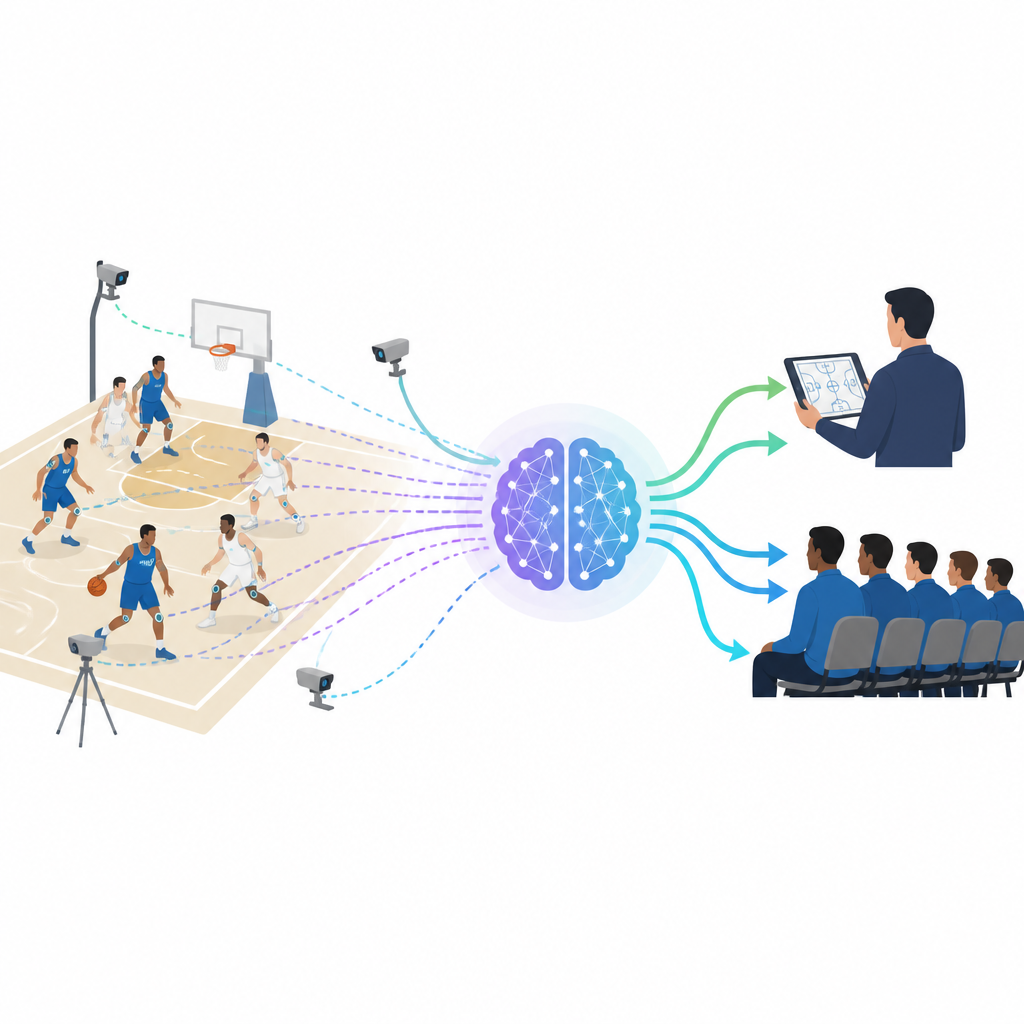
How the digital assistant sees the game
The system starts by collecting three main types of signals. Motion sensors worn by players describe how fast they move, how hard they cut, and how their bodies are loading with each play. Multi camera vision tracks player and ball positions across the floor. Brain inspired readings are processed to estimate how mentally taxed or stressed each athlete is. These streams are cleaned, aligned in time, and merged so that the AI can view a single moment as a blend of where everyone is, how their bodies are responding, and how their minds are holding up.
Teaching the system basketball sense
Instead of being a black box that only learns from patterns, NeuroPlayNet is taught basketball concepts as well. It maintains a map of common plays, defensive formations, player roles, and their relationships. A learning engine then connects this map with the live data, updating its understanding as the game unfolds. The AI is trained to choose actions such as when to substitute a player, how to adjust the defense, or which lineup to favor, with rewards that balance four goals: scoring, winning, protecting players from injury, and supporting long term development. Coaches can nudge these priorities so the system gradually adapts to their style.
What the numbers say on the court
To test NeuroPlayNet, the authors combined detailed NBA broadcast data from several seasons with realistic simulations and carefully modeled brain signal data. Against ten existing analytics tools, the new system forecast whether shots would go in more accurately, improved win probability forecasts, and suggested substitutions that lowered estimated injury risk by nearly one fifth while keeping performance levels high. It met strict speed limits too, generating recommendations in under a third of a second with video like smoothness, and coaches who tried the interface in simulated games rated its clarity and usefulness highly. 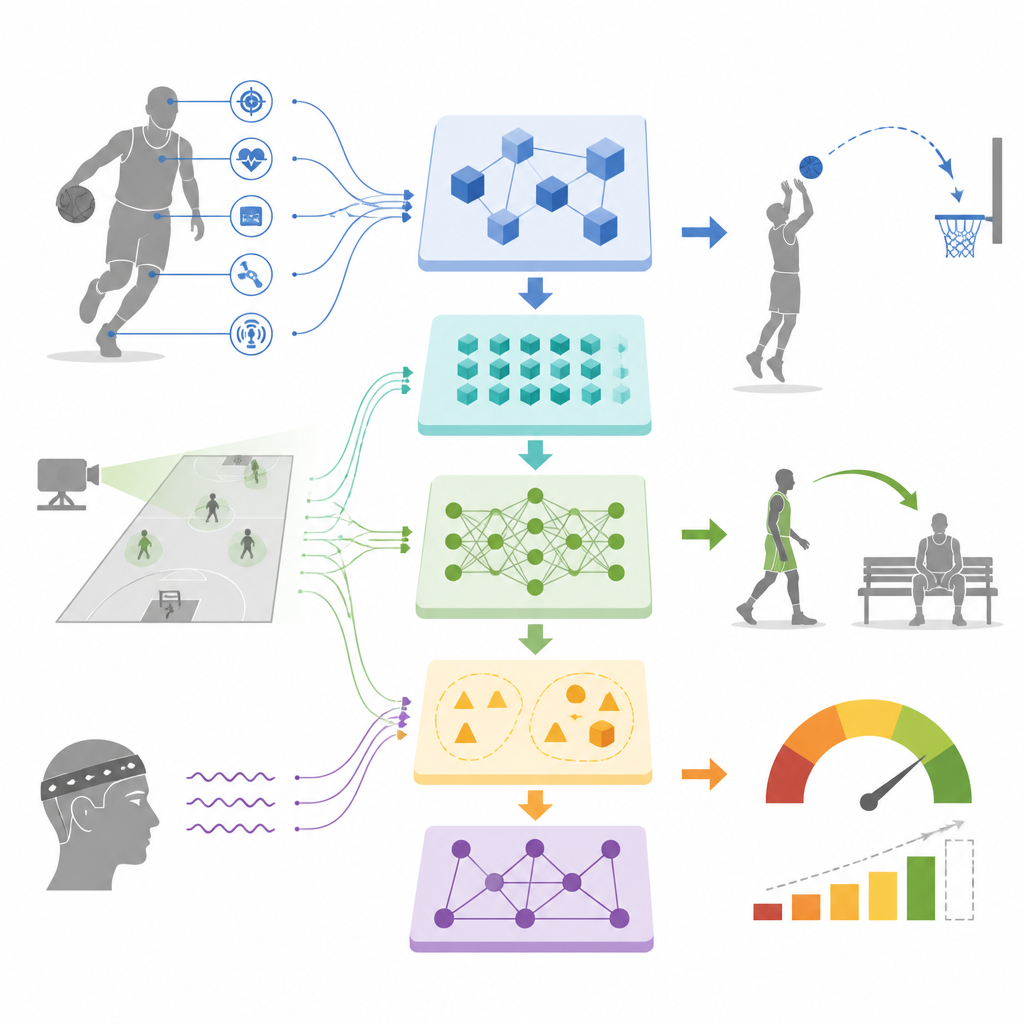
Why this matters for the future of the game
For everyday fans, NeuroPlayNet hints at a future where the drama of late game decisions is informed not only by gut feeling, but also by a rich picture of player health and hidden fatigue. For teams and leagues, it suggests a path toward seasons where stars sit out fewer games due to preventable injuries, and strategy debates can be grounded in shared, transparent evidence. While the current work is still based largely on controlled tests and partly synthetic brain data, it sketches a clear route toward real arenas where human intuition and machine insight work together to keep the sport both thrilling and safer.
Citation: Liang, Y., Guo, X., Zhang, J. et al. NeuroPlayNet: a multimodal AI framework for real-time cognitive-aware strategy optimization in professional basketball. Sci Rep 16, 15085 (2026). https://doi.org/10.1038/s41598-026-41140-y
Keywords: basketball analytics, sports AI, player fatigue, injury prevention, real-time strategy