Clear Sky Science · en
Non-linear relationships between auditory mismatch responses and the inharmonicity of complex sounds
Why the brain cares about messy sounds
Everyday listening is full of rich, layered sounds: voices in a crowd, musical instruments in an orchestra, birds in a forest. Many of these sounds are “harmonic,” meaning their ingredients line up in an orderly way that our ears and brain can easily interpret as pitch. But real life also contains messier, less orderly sounds. This study asks a deceptively simple question: as sounds become more disorganized, at what point does the brain stop reliably noticing when something in the pattern changes?
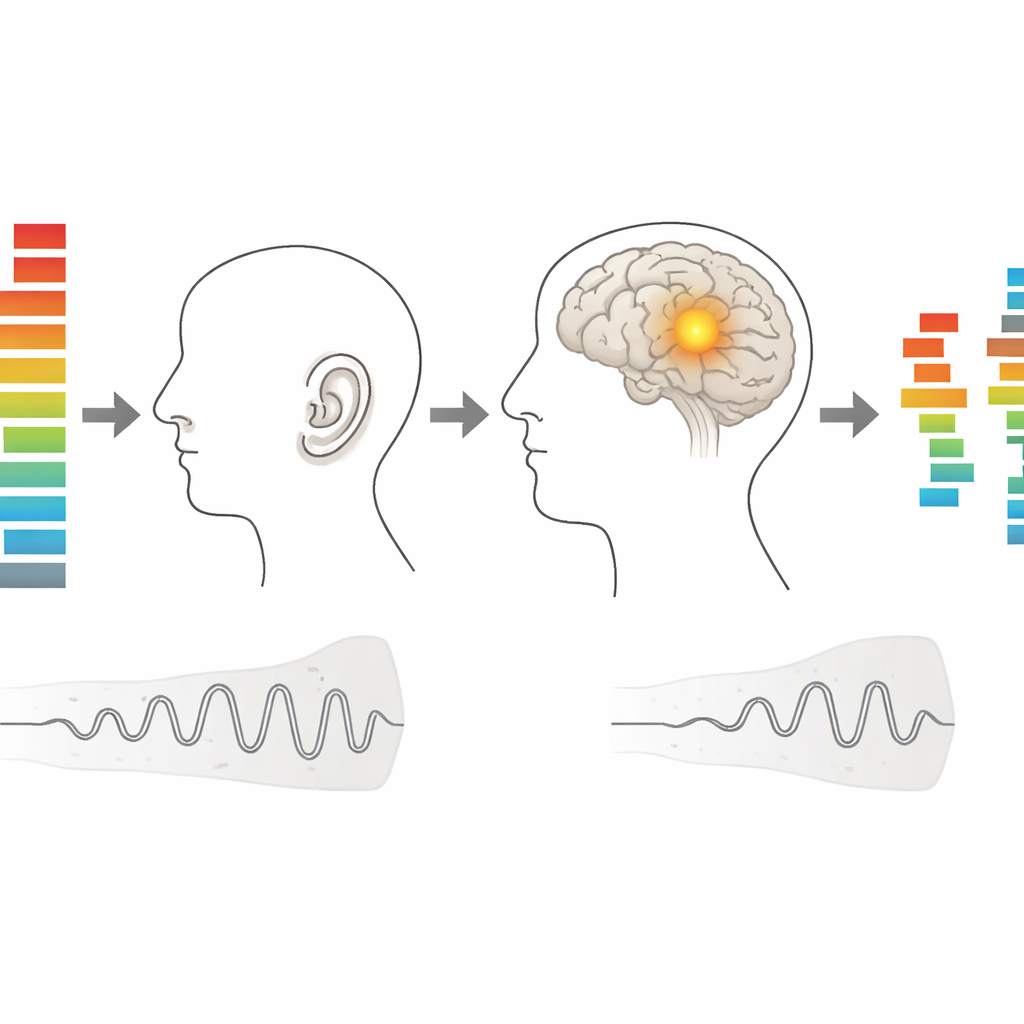
Orderly tones versus jumbled tones
When a complex tone is harmonic, its building blocks—pure frequencies—are neatly spaced as multiples of a single base frequency, which we hear as pitch. In “inharmonic” tones, those building blocks are randomly shifted, creating a more chaotic sound. Harmonic sounds are easier to pick out in noise and to remember, while heavily inharmonic sounds make pitch discrimination much harder. The authors built on this idea by gradually adding different amounts of random “jitter” to synthetic sounds, creating a smooth range from perfectly harmonic to strongly inharmonic, and then asking how the brain’s automatic change-detection system reacted across this range.
Listening in the background
The researchers recorded brain activity with EEG while 35 volunteers passively listened to sequences of brief tones. Using a “roving” design, the pitch of the tones stayed the same for a while, then suddenly jumped to a new value. The first tone after each jump violated the listener’s expectations and typically triggers a brain signal known as mismatch negativity (MMN), followed by a later signal called P3a that reflects an automatic shift of attention. Crucially, the physical loudness and general makeup of the tones were matched; only the regularity of the internal frequency pattern—the level of inharmonicity—systematically varied across conditions.
Where the brain’s alarm suddenly fades
One prediction from popular “predictive processing” theories is that as sounds become harder to predict (more inharmonic), the brain should steadily down-weight its error signals, leading to a smooth, roughly linear decline in MMN size. Instead, the data told a different story. MMN amplitudes were similar for harmonic and mildly inharmonic sounds and only dropped sharply once inharmonicity crossed a certain threshold. Statistical modeling showed that a sigmoid (S-shaped) curve described this relationship better than linear or more flexible polynomial models. The turning point occurred between the midrange jitter conditions, exactly where the sound’s internal structure became too scrambled for the auditory system to reliably extract a clear pitch.
A sweet spot for automatic attention
The later P3a response behaved differently. Rather than simply shrinking with more inharmonicity, it followed an inverted-U shape: small for very orderly sounds, peaking at moderate levels of inharmonicity, and then declining again for the most disorganized tones. This suggests that the brain’s automatic attention system is most strongly engaged when pitch changes are still just about detectable but already demanding more computational effort. A separate behavioral experiment, in which volunteers actively judged whether the second of two tones was higher or lower than the first, pointed to a similar threshold: pitch discrimination became unreliable at roughly the same inharmonicity level where MMN started to collapse.
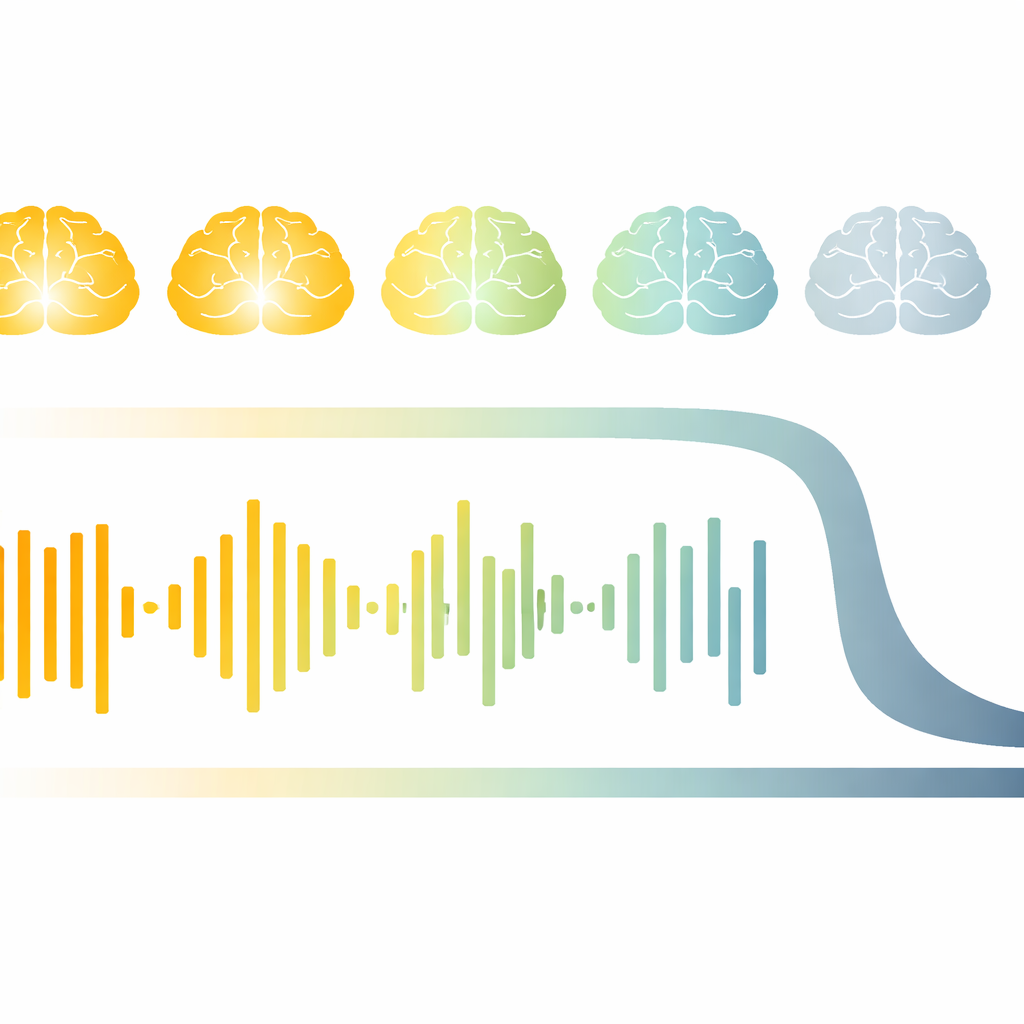
What this means for how we hear
Taken together, the findings indicate that the brain’s early change-detection system handles harmonic and mildly distorted sounds in much the same way, but once the internal structure of a sound becomes too irregular, the brain can no longer reliably build a stable pitch representation—its automatic “alarm” for pitch changes effectively switches off. This threshold-like behavior fits with the idea that our auditory system depends on extracting a single underlying pitch from complex sounds and struggles when that task becomes impossible. At the same time, because some more gradual models also fit the data better than a no-effect model, the results do not rule out subtler forms of precision-weighting in the brain’s predictive machinery. Instead, the study provides a clear descriptive map of how increasing spectral disorder in sounds is mirrored by abrupt changes in the brain’s mismatch responses, helping to pinpoint where orderly hearing gives way to perceptual confusion.
Citation: Brzezińska, A., Witkowski, B., Basińska, M. et al. Non-linear relationships between auditory mismatch responses and the inharmonicity of complex sounds. Sci Rep 16, 11836 (2026). https://doi.org/10.1038/s41598-026-41129-7
Keywords: auditory perception, pitch, harmonicity, mismatch negativity, predictive processing