Clear Sky Science · en
Experimental validation of MRAS sensorless direct torque control using ANN for induction motors in a pumping system
Smarter pumps for saving energy
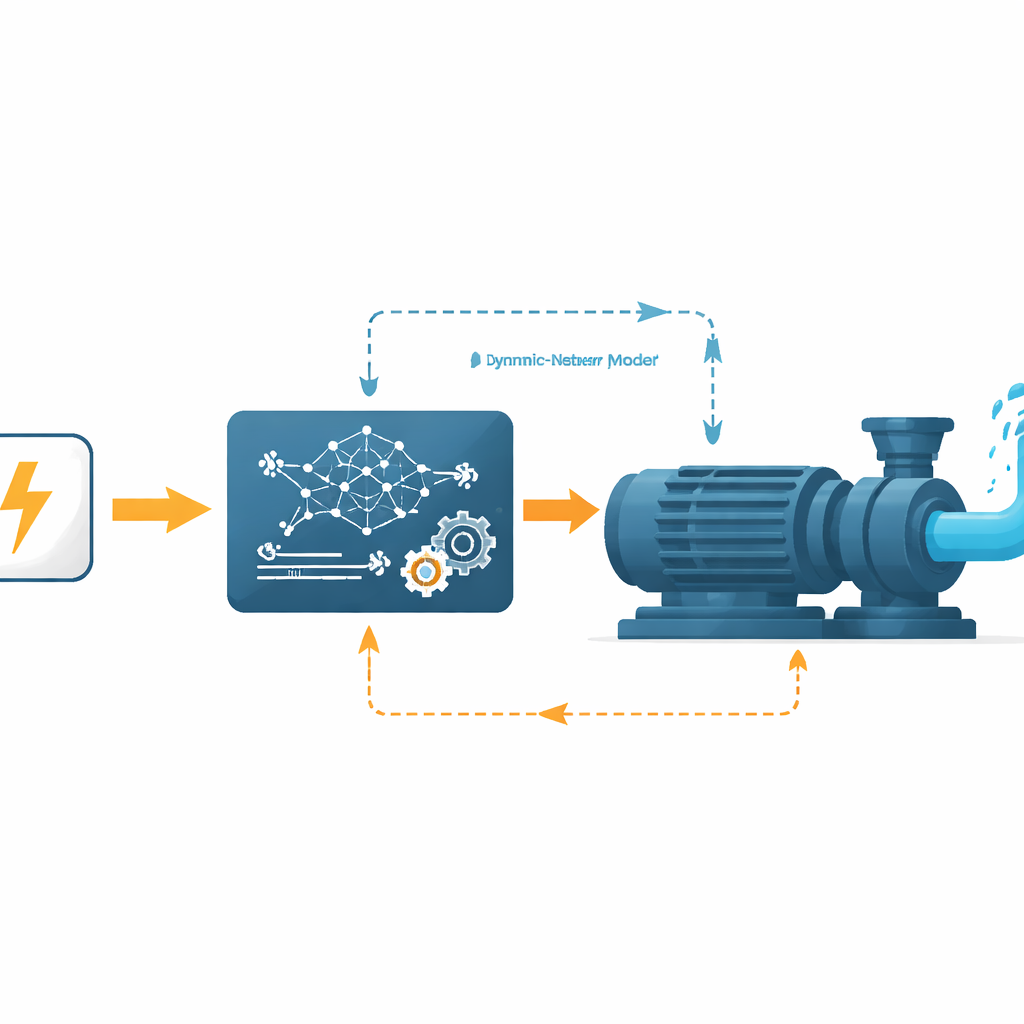
Electric pumps quietly move vast amounts of water in cities, farms, and factories, yet the motors that drive them can waste energy and wear out early if their torque and speed are not controlled carefully. This paper presents a new way to run common industrial motors in pumping systems without using fragile mechanical speed sensors, while still keeping the pump responsive, efficient, and gentle on equipment. By blending a long‑used motor control method with modern artificial intelligence, the authors show how to cut energy losses and improve performance in realistic laboratory tests.
Why ordinary motors are hard to control well
The work focuses on induction motors, the rugged “workhorses” of industry that power everything from elevators to irrigation pumps. These machines are cheap and reliable but difficult to control precisely because their internal behavior is nonlinear and some key quantities, such as the magnetic flux in the rotor, cannot be measured directly. A popular strategy called Direct Torque Control (DTC) tackles this by acting almost directly on the power electronics feeding the motor, giving very fast torque response and good operation at low speeds. However, classic DTC relies on speed sensors and simple on–off logic, which can cause sizable torque ripples, electrical noise, vibration, and added hardware cost.
Taking away sensors without losing control
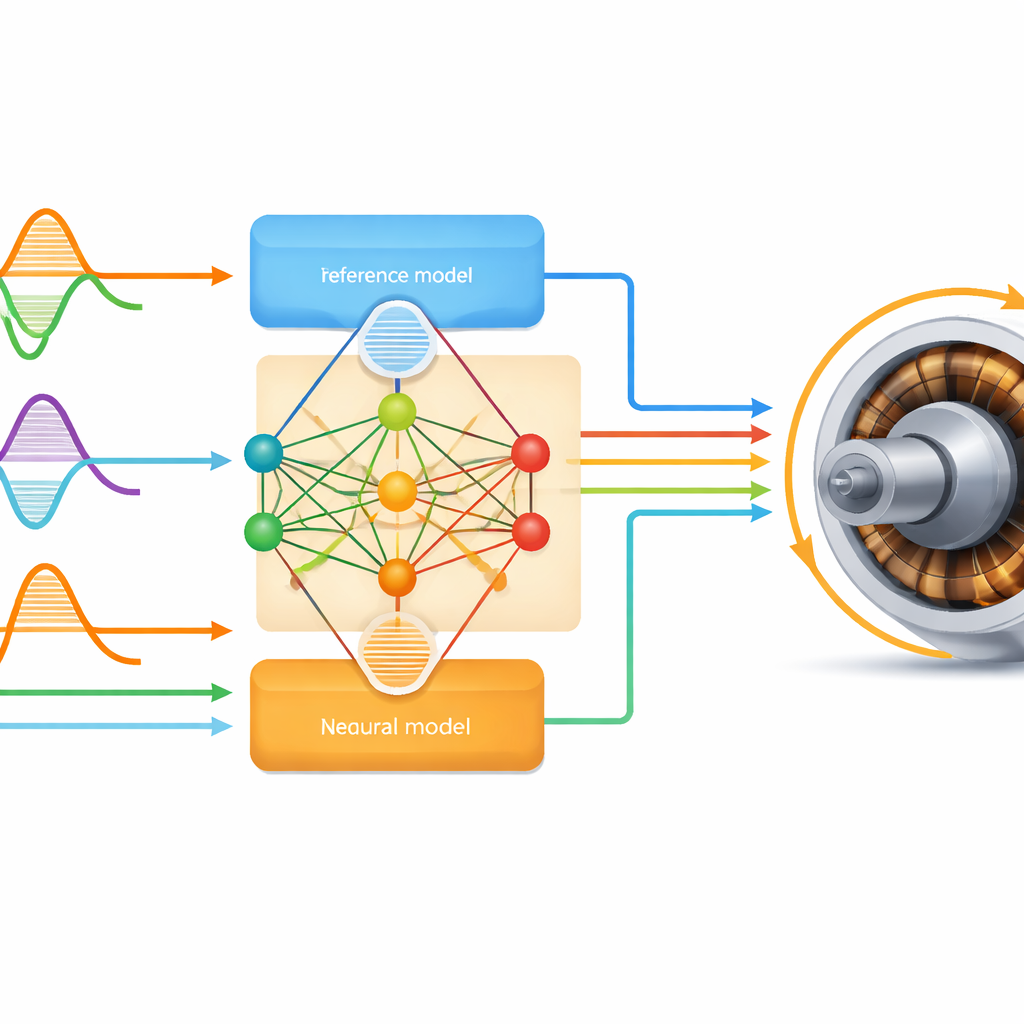
To remove mechanical speed sensors, engineers often estimate speed from electrical measurements instead. One widely used method, the Model Reference Adaptive System (MRAS), runs two parallel models of the motor: a reference model that does not depend on speed, and an adjustable model that does. By comparing their outputs, the algorithm can infer the motor’s actual speed. MRAS is attractive because it is relatively simple and computationally light, but it performs poorly at very low speeds and is sensitive to changes in motor parameters such as resistance and temperature. When MRAS is combined with DTC, these limitations tend to increase torque ripples and distort the switching patterns that drive the motor.
Letting neural networks choose the switches
The authors propose a hybrid control method they call DTC‑ANN+MRAS, in which artificial neural networks take over several key decision‑making blocks inside the DTC scheme. Instead of using fixed hysteresis comparators, a basic proportional‑integral speed controller, and a hand‑crafted switching table, the system uses trained neural networks to compute how the inverter switches should be fired to keep torque, flux, and speed near their targets. The MRAS block still estimates speed from measured voltages and currents, but its output feeds the neural controllers, which have learned from simulation data how to counteract the estimation errors and parameter changes that would otherwise degrade performance.
From computer model to real hardware
The team first built detailed mathematical models of the induction motor, the power inverter, and a centrifugal pump whose load increases with speed. They then implemented several control strategies in MATLAB/Simulink and tested them both in simulation and on a dSPACE DS1104 real‑time control board driving a 1.5 kW laboratory motor. Four approaches were compared: conventional DTC, DTC improved with neural networks (DTC‑ANN), DTC with MRAS speed estimation (DTC‑MRAS), and the full hybrid DTC‑ANN+MRAS proposed in this paper. Performance was evaluated using response time to speed changes, the size of torque ripples, and the total harmonic distortion (THD) in the motor current, a key indicator of electrical “cleanliness” and efficiency.
What the experiments revealed
Results show that adding neural networks alone already improves classic DTC: response time drops from 0.80 to 0.72 seconds and torque ripple and current distortion are significantly reduced. Simply bolting MRAS onto DTC, however, actually worsens current quality, raising THD from 9.76% to 11.40% and increasing torque ripple, even though speed estimation becomes sensorless. The hybrid design that combines MRAS with neural control recovers these losses and goes further: response time shortens to 0.58 seconds, torque ripple falls compared with DTC‑MRAS, and THD is lowered from 11.40% to 7.80%. In pumping scenarios, the controller maintains smooth speed over a wide range of loads (−10 to 10 N·m) and speeds (−157 to 157 rad/s), keeping water flow stable while reducing electrical and mechanical stress.
What this means for real‑world pumping systems
For non‑specialists, the message is that the authors have devised a way to run standard industrial pumps more efficiently and reliably without relying on delicate speed sensors. By allowing a neural network to learn how best to fire the motor’s power switches, while an adaptive model estimates speed from simple electrical measurements, the system delivers faster response, cleaner currents, and smaller torque fluctuations than several established alternatives. The study suggests that intelligent, sensorless control could cut energy use in pumping systems by around 15%, extend equipment life, and lower maintenance costs, with future refinements using other optimization techniques promising further gains.
Citation: Ech-chaouy, H., Derouich, A., Mahfoud, S. et al. Experimental validation of MRAS sensorless direct torque control using ANN for induction motors in a pumping system. Sci Rep 16, 10434 (2026). https://doi.org/10.1038/s41598-026-41127-9
Keywords: sensorless motor control, induction motor drives, neural network control, pumping systems, energy-efficient drives