Clear Sky Science · en
Experimental, spectroscopic, thermodynamic, and DFT study of a novel cyanomethylchrome nopyridinecarbonitrile (CCPC)
New Molecule, Big Possibilities
Chemists are constantly searching for small molecules that can both interact safely with the human body and respond cleverly to light and electricity. In this study, researchers created a brand‑new ring‑shaped molecule, nicknamed CCPC, and then probed it from every angle using both lab experiments and advanced computer simulations. Their goal was to understand how this molecule is built, how stable and reactive it is, how it behaves under light, and whether it might someday serve as a building block for medicines or high‑tech optical devices.
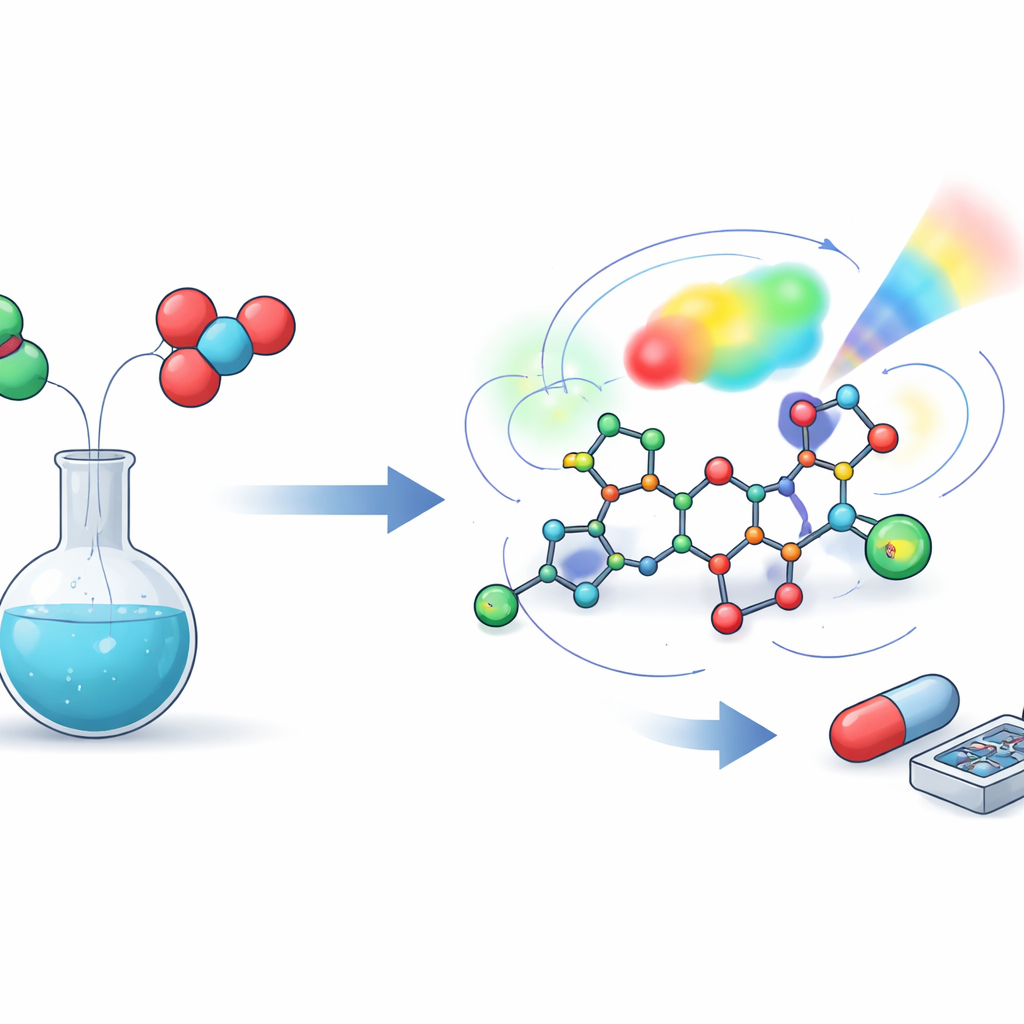
Building a New Ring System
The team started from a known family of compounds called chromones, which occur in many plants and are behind a variety of biological activities, from anti‑inflammatory to anticancer effects. By reacting a chromone‑based starting material with a simple partner called cyanoacetamide in warm alcohol and a mild base, they triggered a domino sequence of bond‑making and bond‑breaking steps. This “cascade” process first adds one molecule to another, then opens one of the rings, and finally recloses it in a new way to give CCPC, a tightly fused ring system decorated with carbon–nitrogen groups. The researchers confirmed that they had indeed made the intended structure by measuring its mass, infrared spectrum, and nuclear magnetic resonance (NMR) signals, all of which matched the atomic layout they predicted.
Looking Inside with Computation
To go beyond a static picture of the atoms, the scientists used quantum‑chemical calculations, a kind of virtual microscope that treats electrons according to the rules of quantum mechanics. These calculations revealed the shapes and energies of the outermost electron clouds that control how CCPC reacts and absorbs light. By comparing the highest occupied and lowest empty electron states, they could estimate how easily the molecule can be excited or participate in reactions. Maps of the electrostatic potential—essentially, how positive or negative different regions of the molecule are—highlighted where incoming reagents or biological partners would most likely attach. These maps also supported the detailed reaction path that converts the starting materials into the final ring system.
Testing Vibrations, Light Response, and Stability
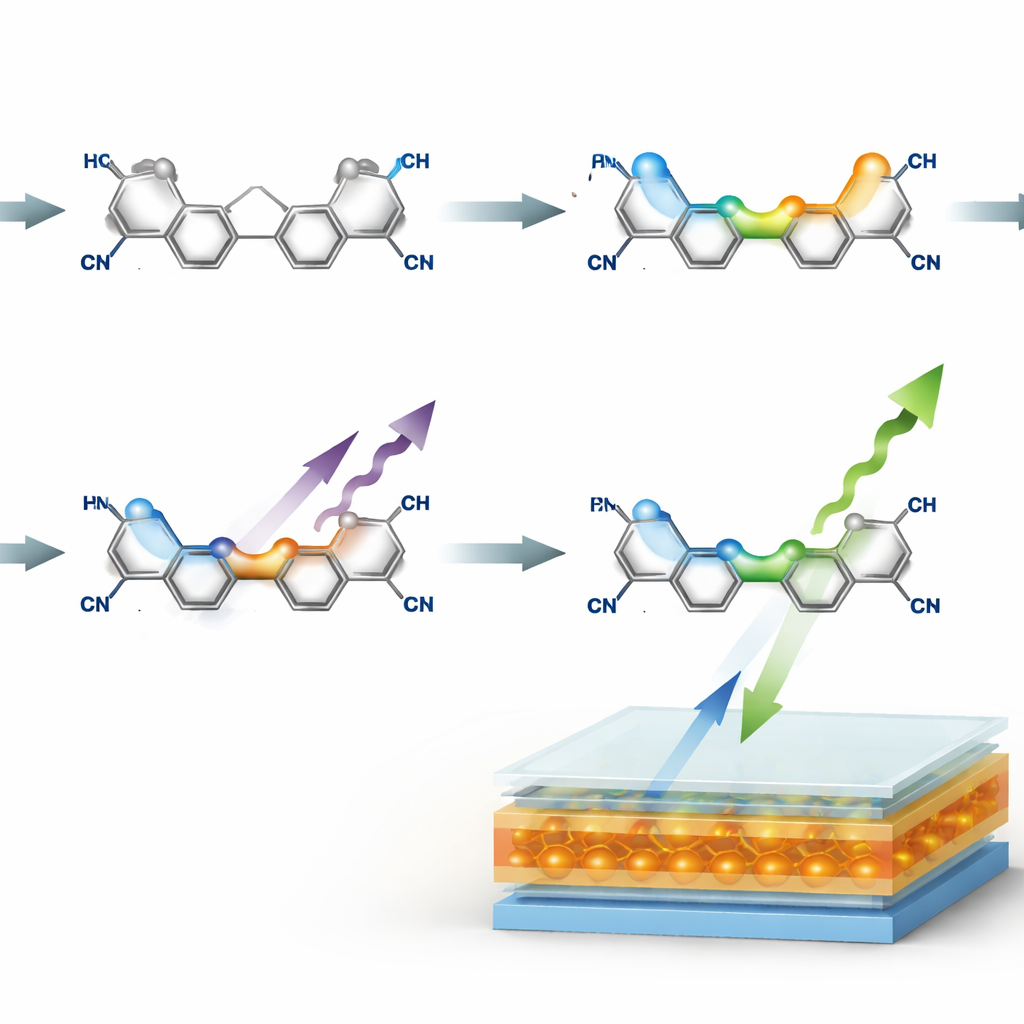
Back in the lab, the group measured how CCPC’s chemical bonds vibrate using infrared spectroscopy and how its atoms resonate in a magnetic field using NMR. They then used the same computational methods to predict these signatures and found excellent agreement between theory and experiment, giving them confidence in their structural model. They also calculated how CCPC absorbs ultraviolet and visible light in different liquids. The simulated spectra tracked the measured ones closely and showed that the main light‑driven process involves shifting electrons from one part of the molecule to another. In more polar solvents, this shift becomes easier, slightly changing the color and strength of the absorption. Further analysis indicated that CCPC has strong nonlinear optical behavior: under intense light, it should be able to double the frequency of the incoming beam, a property that is valuable in lasers and signal‑processing devices.
From Reaction Pathways to Drug‑Like Traits
The researchers also explored how CCPC might break apart or rearrange by following its reaction pathway on a computed energy landscape. They found several possible routes, each with its own energetic barrier, and showed that subtle changes in the surrounding solvent can speed up or slow down these processes. Using standard in‑silico tools commonly applied in early drug discovery, they checked whether CCPC fits within guidelines for molecules that are likely to be well absorbed and tolerated in the body. According to these criteria, CCPC has a suitable size, balance of water‑loving and fat‑loving character, and limited flexibility, all of which point toward reasonable oral availability if it were ever developed as a medicine.
What It All Means
Taken together, the work delivers a complete portrait of CCPC: how it is made, how its atoms and electrons are arranged, how it responds to light and heat, and how it might behave in a biological setting. The molecule emerges as both electronically robust and highly responsive, with promising optical properties and a profile that fits established “drug‑likeness” rules. While no biological tests were performed yet, this combined experimental and computational approach lays the groundwork for turning CCPC and related compounds into future drug candidates or components in optical and electronic technologies.
Citation: Badran, AS., Ibrahim, M.A. & Halim, S.A. Experimental, spectroscopic, thermodynamic, and DFT study of a novel cyanomethylchrome nopyridinecarbonitrile (CCPC). Sci Rep 16, 10899 (2026). https://doi.org/10.1038/s41598-026-41126-w
Keywords: chromone, heterocycle, nonlinear optics, drug-likeness, DFT simulation