Clear Sky Science · en
Gear fault diagnosis of wind turbine drivetrains using multi-source information fusion and ensemble learning in a simulation bench study
Keeping Wind Turbines Turning
Modern wind farms rely on huge gearboxes hidden inside each turbine to turn slow, gusty wind into steady electricity. When those gears wear out or crack, turbines must be shut down for repair, costing time, money, and clean power. This study presents a smarter way to “listen” to the mechanical heartbeat of a wind turbine and spot gear problems early, even when the machine is spinning at constantly changing speeds and surrounded by noise.
Why Gear Health Matters
Gearboxes sit between the rotor blades and the generator, handling strong and ever-changing loads from the wind. They are also among the most failure-prone parts of a turbine and can account for most of its mechanical downtime. Traditional monitoring tools look at a single vibration signal and apply fixed filters, which works reasonably well in steady laboratory conditions. Out in the field, however, rotor speed rises and falls with every gust, shifting the telltale vibration signatures of damage. At the same time, environmental noise can easily bury the subtle signs of a crack or missing tooth, making early diagnosis difficult.
A Smarter Listening Loop
To tackle this, the authors designed a “closed-loop” signal treatment chain that ties together speed and vibration in real time. First, they smooth the raw speed data from an encoder using a Gaussian filter, which removes sudden spikes but keeps the true trend of how fast the shaft is turning. That clean speed profile is then used to continuously retune a band-pass filter applied to the vibration signal, so the filter always follows the changing gear mesh tones where fault information lives. After this targeted filtering, a mathematical trick called envelope analysis isolates the repeating impact pattern produced when a damaged tooth strikes its partner, turning a messy vibration trace into a much clearer picture of gear health. This loop—speed smoothing, dynamic filtering, and envelope extraction—works together so that each step supports the next rather than acting in isolation. 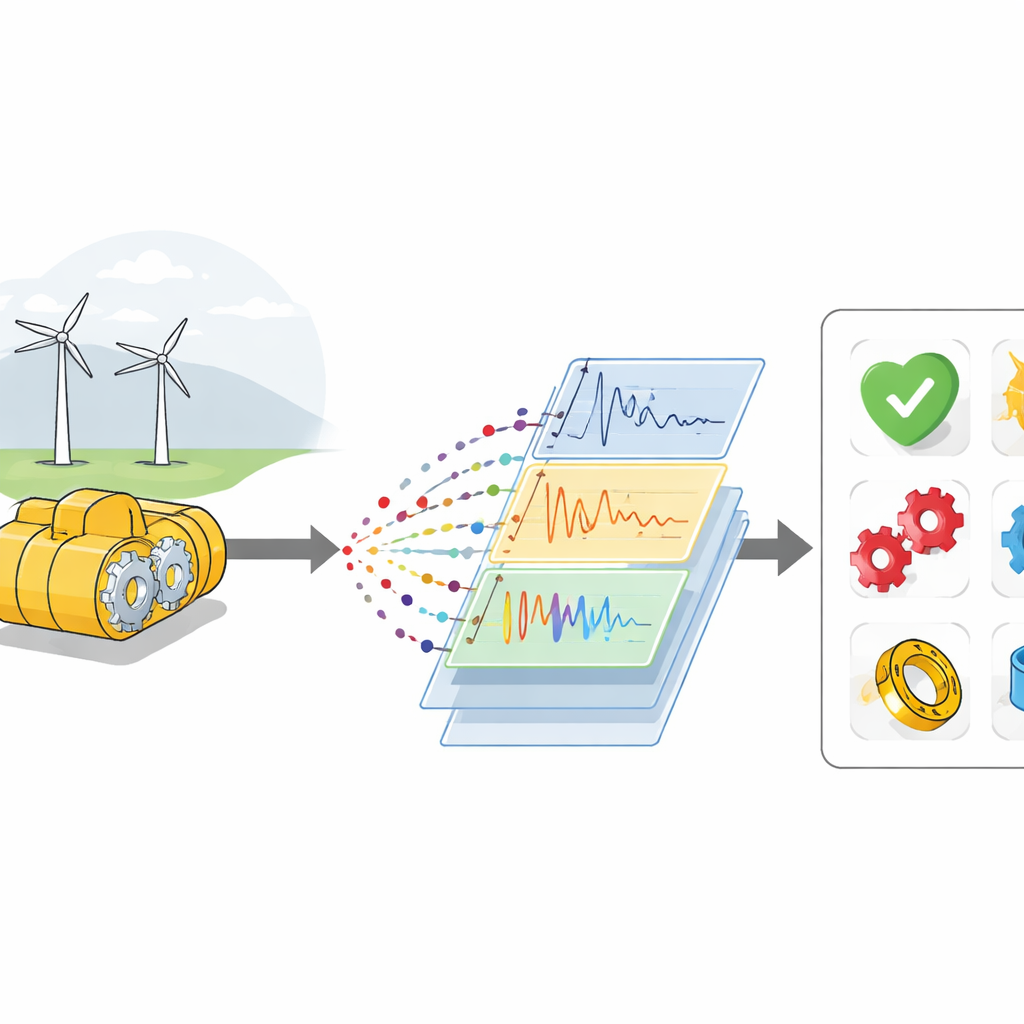
Blending Many Clues Into One Picture
Listening well is only half the challenge; the other half is interpreting what is heard. The team gathered signals from two vibration sensors mounted at right angles on the gearbox housing, along with the rotational speed, using an open planetary gearbox test bench that mimics a wind turbine drivetrain. They tested five gear states, ranging from healthy teeth to broken, worn, cracked, and missing teeth, and ran the system at eight different speeds. From these signals they extracted a rich set of measurements: simple statistics such as averages and peaks, how the energy is spread across different frequencies, more refined “wavelet packet” energy measures that capture brief bursts, and gear-specific signatures linked to how the teeth mesh.
Teaching the Algorithm to Separate Fault Types
Rather than feed all of these raw measurements directly to a classifier, the authors used a supervised dimensionality reduction method called Linear Discriminant Analysis. In plain terms, this step projects the many input features into a smaller set of combined features that are chosen to pull different fault types apart while keeping samples of the same type close together. This approach uses knowledge of the true fault labels during training, unlike popular unsupervised tools that only look for overall variance patterns. The study shows that this step makes the different gear problems far more distinct in the reduced feature space than competing methods. After that, four different machine learning models—Support Vector Machines, k-Nearest Neighbors, Random Forests, and Naive Bayes—are trained to recognize the fault categories.
Many Minds Are Better Than One
To avoid relying on the limitations of any single algorithm, the authors combine these four models into an “ensemble” that votes on the final diagnosis. Each model’s vote is weighted by how accurate it proved to be on validation data, so better performers carry slightly more influence. Tested on the planetary gearbox dataset, the full pipeline—closed-loop preprocessing, multi-signal feature fusion, supervised feature reduction, and weighted ensemble—achieved about 98.8% correct identification of the five gear states under variable speed conditions. This outperformed using any single signal source, using only one classifier, or even two widely used deep learning models, while remaining more transparent about which physical features drive the decision. 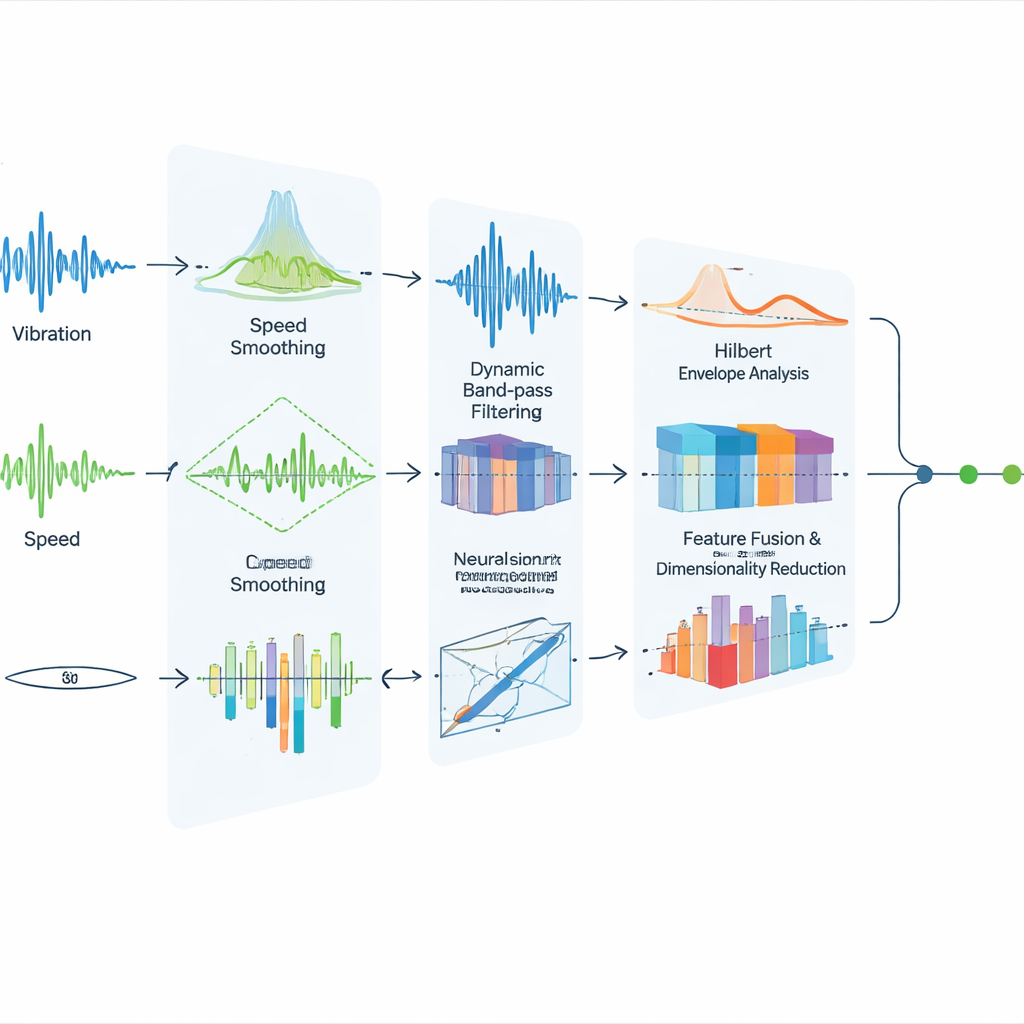
What This Means for Wind Power
In everyday terms, the study offers a more reliable stethoscope for wind turbines. By cleaning and combining several kinds of sensor data and then letting multiple learning algorithms agree on a verdict, the method can spot subtle gear damage early and accurately, even as turbine speed constantly shifts with the wind. This could reduce unexpected shutdowns, cut maintenance costs, and make wind power more dependable. While the work was demonstrated on a particular test rig, the authors suggest that the same closed-loop and fusion ideas could be adapted to real wind farms and other rotating machines, bringing more intelligence to the world’s growing fleet of clean energy systems.
Citation: Kang, X., Shao, L. & Zhao, B. Gear fault diagnosis of wind turbine drivetrains using multi-source information fusion and ensemble learning in a simulation bench study. Sci Rep 16, 11321 (2026). https://doi.org/10.1038/s41598-026-41117-x
Keywords: wind turbine gearbox, gear fault diagnosis, condition monitoring, multi-sensor fusion, machine learning