Clear Sky Science · en
AI-driven sustainable strength prediction and experimental evaluation of high-performance fiber-reinforced concrete incorporating metakaolin
Stronger, Greener Concrete for Tomorrow’s Cities
Concrete is the backbone of modern cities, but making it uses huge amounts of cement, a major source of carbon emissions, and the material can crack and fail over time. This study explores how to build tougher, longer-lasting concrete while cutting its environmental impact. The authors combine advanced fibers, a cleaner cement replacement called metakaolin, and artificial intelligence to design mixes that are both strong and sustainable—potentially changing how bridges, towers, and pavements are built in the future.
Why Today’s Concrete Needs an Upgrade
Ordinary concrete excels at carrying weight but is brittle and weak in tension, which makes it prone to cracking. Once cracks form, water and air can reach the steel bars inside, causing corrosion and slow structural damage. High-strength concrete can carry more load, but it is often even more brittle. To address this, engineers have turned to two main ideas: replacing part of the cement with finely ground mineral materials, and adding short fibers that act like tiny reinforcing bars inside the mix. This study focuses on metakaolin—a highly reactive, calcined clay—as a partial cement replacement, paired with steel, glass, nylon, and polypropylene fibers to combat cracking and boost performance.
Building a Better Mix with Fibers and Metakaolin
The research team designed a high-strength concrete mix (known as M60) in which 10% of the cement was replaced by metakaolin. They then created several versions of this concrete by adding different types and amounts of fibers, including steel, glass, nylon, and polypropylene. Each mix was carefully tested for how easily it flowed when fresh and how strong it became under compression, tension, and bending after curing for 7, 28, 56, and 90 days. 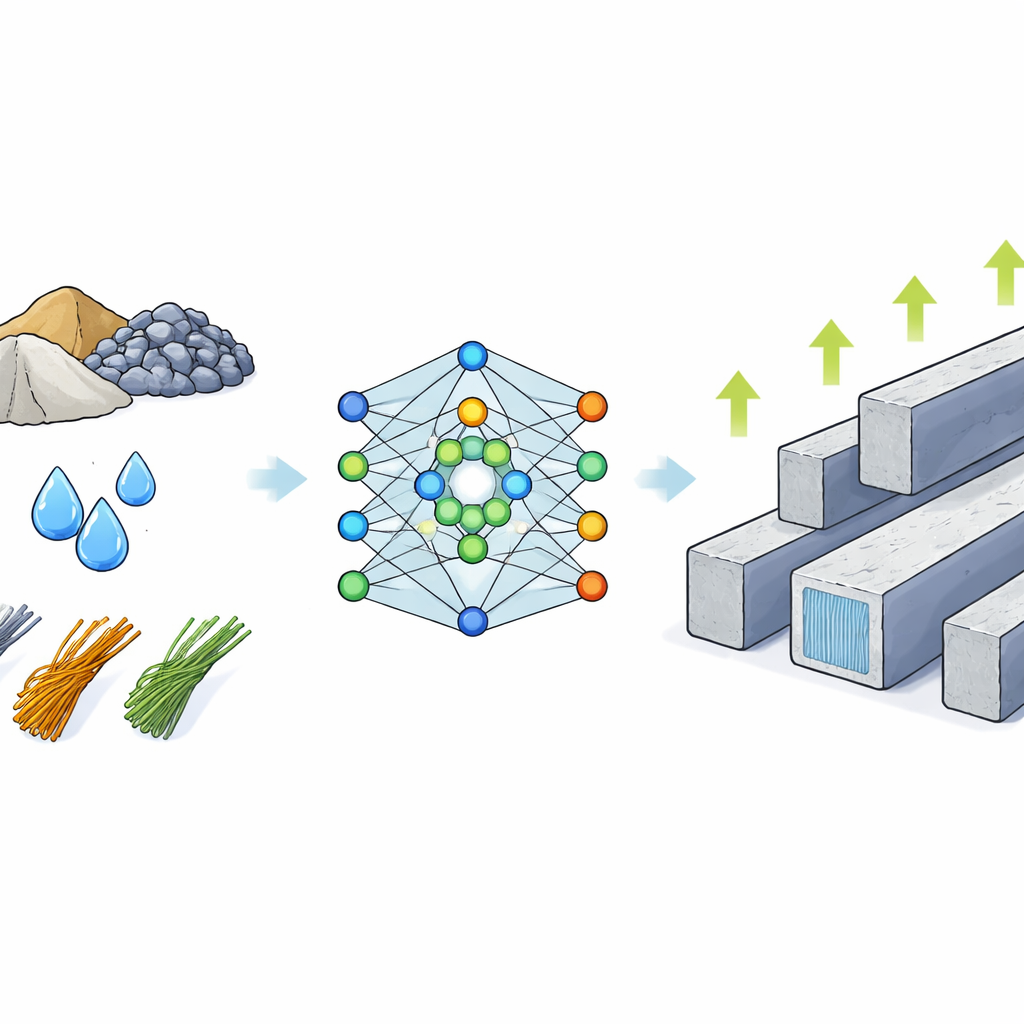
Teaching an AI to Predict Concrete Strength
Physical testing of every possible mix is slow, costly, and wasteful. To avoid endless trial-and-error in the lab, the authors built a deep learning model to predict how strong a given fiber-reinforced concrete will be, based only on its ingredients and curing age. Their model, called A-PDDLSTM-SA, combines several advanced ideas from artificial intelligence: memory units that can follow how strength develops over time, multi-scale filters that capture both fine and broad patterns in the data, and an attention mechanism that focuses on the most important inputs, such as fiber type, dosage, and curing period. They further tuned the model’s internal settings using a new optimization strategy inspired by hikers exploring a landscape, ensuring that the algorithm does not get stuck in poor solutions. 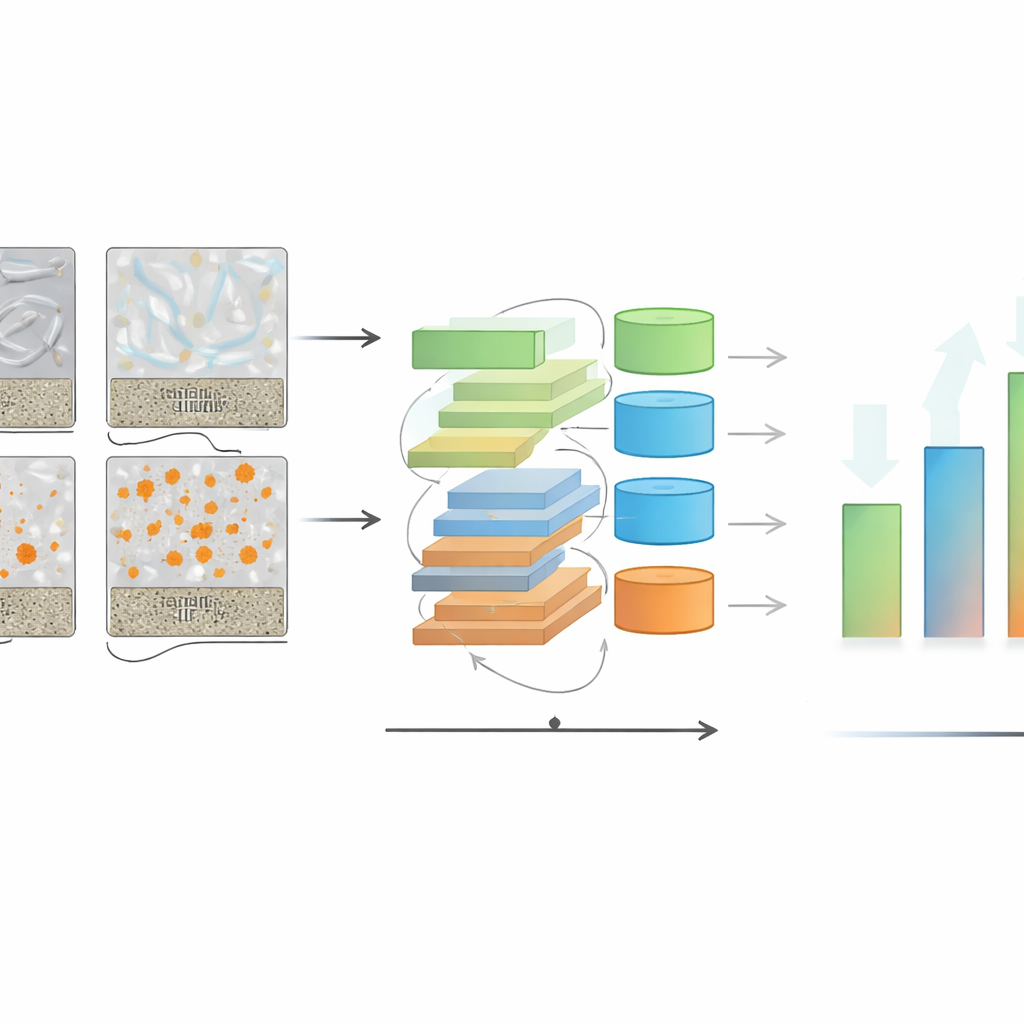
What the Tests and Predictions Reveal
Experimentally, the best-performing mix used 10% metakaolin and 1% steel fiber, which delivered higher compressive, tensile, and flexural strength than the control concrete without fibers. Glass, nylon, and polypropylene fibers also improved behavior in different ways—raising impact resistance, reducing shrinkage cracks, and enhancing post-cracking toughness—though not always as dramatically as steel. The AI model was then trained on the experimental data and compared to several established machine learning methods. It consistently predicted compressive, tensile, and flexural strength more accurately than competing techniques, with low error levels and good stability even when trained on limited data.
From Lab Insight to Real-World Impact
For non-specialists, the key message is that it is now possible to design smarter concrete mixes that are simultaneously stronger, more durable, and more sustainable—and to do so largely on a computer before pouring a single batch. By combining metakaolin with carefully selected fibers, engineers can reduce cement use and improve resistance to cracking. The AI model developed in this study acts as a powerful planning tool: it can suggest promising mix designs, cut down on wasteful physical testing, and speed up the adoption of greener, high-performance concretes in real projects. In the long run, this approach could help deliver safer infrastructure with a smaller environmental footprint.
Citation: N.S, N.P., P, K. & P, S. AI-driven sustainable strength prediction and experimental evaluation of high-performance fiber-reinforced concrete incorporating metakaolin. Sci Rep 16, 13614 (2026). https://doi.org/10.1038/s41598-026-41115-z
Keywords: fiber-reinforced concrete, metakaolin, deep learning, sustainable construction, strength prediction