Clear Sky Science · en
Data-driven machine learning modelling in wire EDM of TiNiCo shape memory alloy
Smart metals that remember their shape
Imagine a metal wire that can be bent out of shape and then, with a bit of heat, quietly snaps back to its original form. These “shape memory” metals are already being explored for medical implants, tiny robotic parts, and aerospace components. But to use them in real devices, engineers must cut and shape them without ruining the very properties that make them special. This study explores how to precisely slice a titanium–nickel–cobalt shape memory alloy using sparks instead of blades, and how machine learning can help tune the process for smooth surfaces and efficient cutting.
Cutting with sparks instead of blades
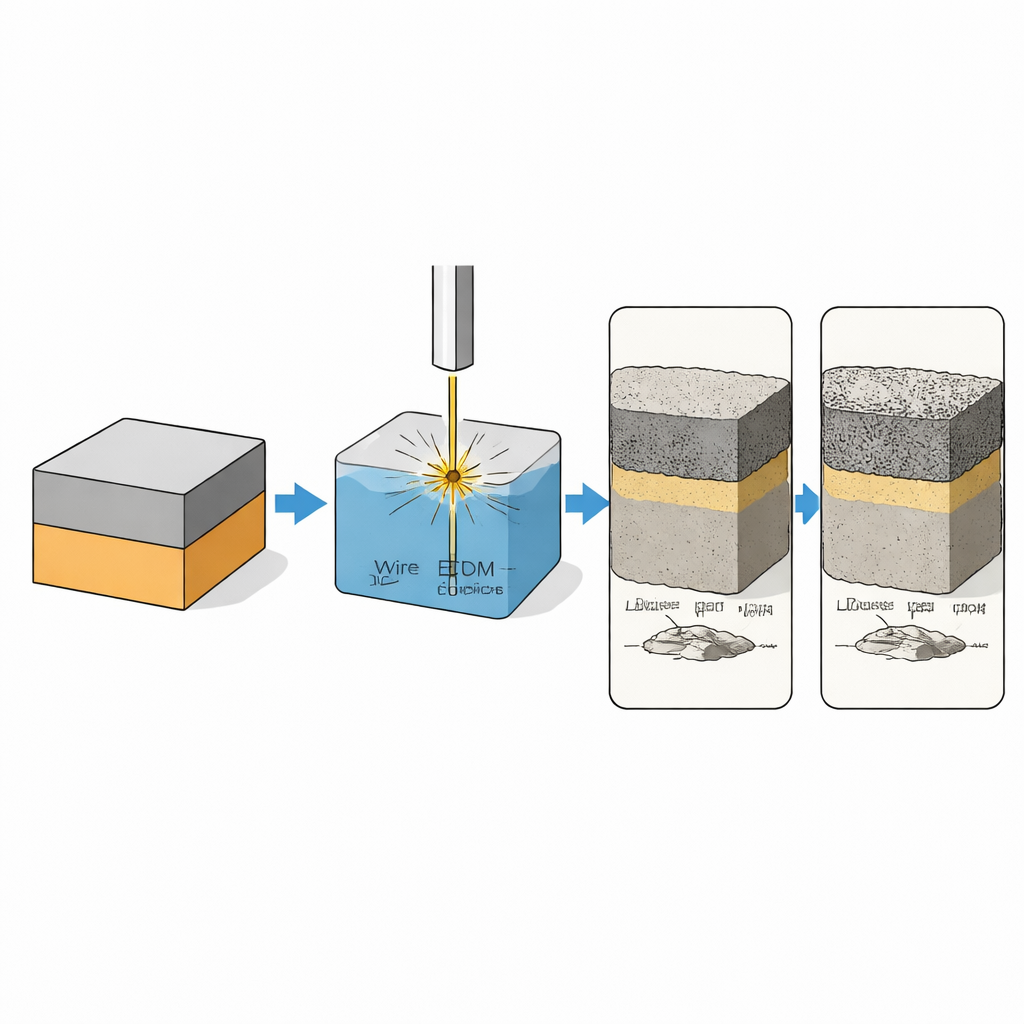
The researchers work with a specific alloy called Ti₅₀Ni₄₀Co₁₀, part of a family of metals that can “remember” their original shape and show spring-like behavior even after large deformations. Traditional cutting tools struggle with such alloys: they are strong, harden as they deform, and can lose their shape-memory behavior if overheated or damaged. To avoid these issues, the team uses wire electrical discharge machining (WEDM). In this method, a thin brass wire never actually touches the metal. Instead, the metal is submerged in a liquid, and rapid electrical sparks jump across a tiny gap between wire and workpiece, melting and vaporizing metal in a narrow path to create the cut.
Finding the right spark settings
Even with WEDM, getting a good balance between cutting speed and surface quality is tricky. Each spark is controlled by parameters such as how long it lasts and how far apart the wire and workpiece sit. This study focuses on two especially important levers: pulse-on time (how long each spark remains on) and servo voltage (which helps control the gap between the wire and metal, and thus the spark strength and stability). By carefully varying these two settings while keeping others fixed, the authors measure two key outcomes: how fast material is removed (material removal rate, or MRR) and how rough the surface becomes after cutting (surface roughness, SR). They also inspect the cut surfaces in three dimensions and under electron microscopes to see how deep craters, cracks, and re-frozen molten layers form.
What the metal surface looks like up close
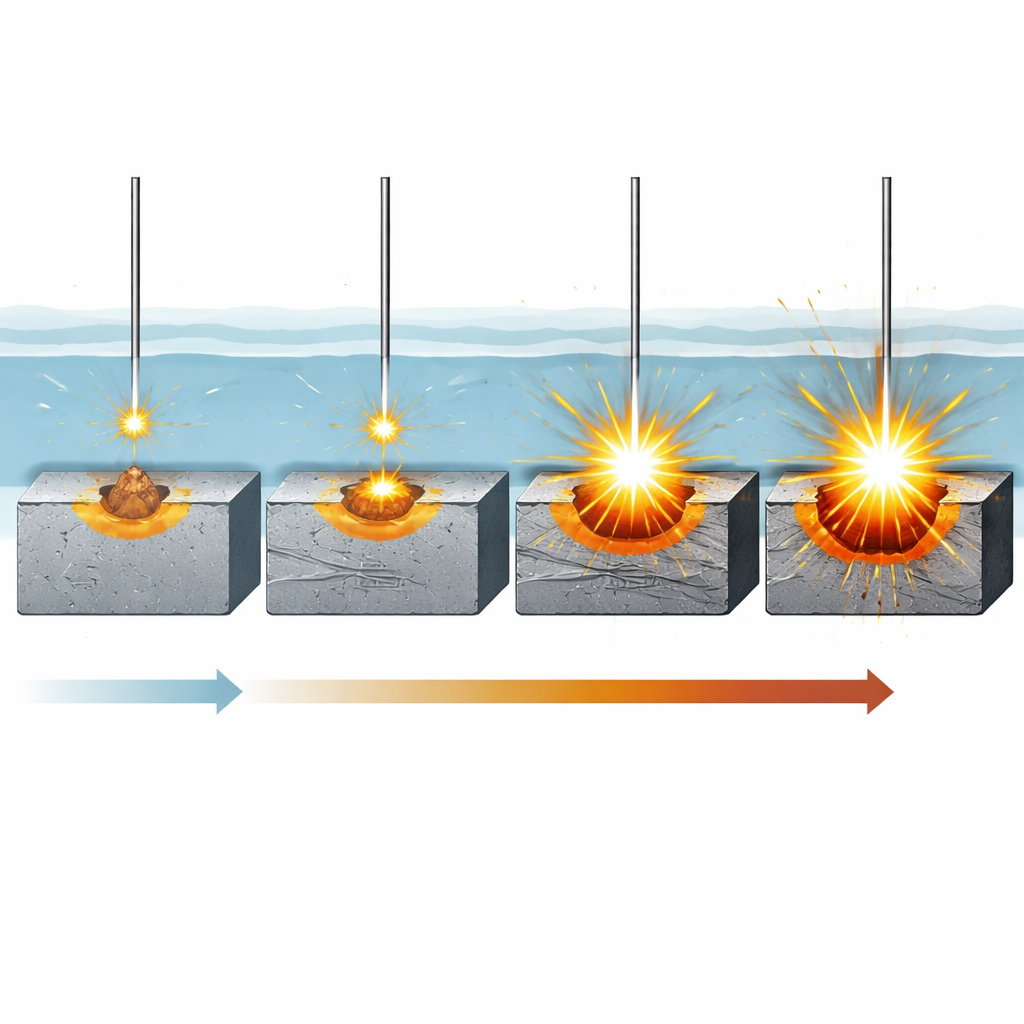
When the sparks are strong and long-lasting—high pulse-on time combined with low servo voltage—the metal is removed quickly, but the surface suffers. Microscopy reveals deep craters, overlapping molten pools, a thick “recast” layer of re-frozen metal, and fine cracks caused by rapid heating and cooling. Elements from the wire and the liquid, such as copper, zinc, oxygen, and carbon, are found in this outer layer, confirming that the surface chemistry is altered during cutting. At the other extreme, shorter sparks and a larger gap—lower pulse-on time and higher servo voltage—produce gentler, more stable discharges. Material removal slows down, but the resulting surface shows shallow craters, fewer cracks, and a thinner disturbed layer, indicating better “surface integrity,” which is crucial for fatigue life, corrosion resistance, and eventually for safe implants.
Letting a neural network learn the best settings
Because the relationship between spark settings and surface quality is complex and highly nonlinear, the team turns to data-driven modelling. They feed results from 25 WEDM experiments into an artificial neural network, a type of machine learning model that can learn patterns from examples. The network takes pulse-on time and servo voltage as inputs and predicts both surface roughness and material removal rate as outputs. With most of the data used for training and a smaller portion reserved for testing and validation, the model quickly learns to mimic the experimental results. Statistical measures show very high agreement between predicted and measured values, with small average errors and no strong bias, suggesting that the neural network can reliably forecast how a new combination of settings will perform within the tested range.
Why this matters for real-world devices
For engineers designing medical implants or miniature actuators from shape memory alloys, every cut must be both accurate and gentle enough to preserve the material’s special behavior. This study shows that by combining controlled spark-based cutting with machine learning, it is possible to identify settings that deliver an acceptable trade-off between cutting speed and surface quality, while keeping most of the alloy’s internal structure intact. Although the dataset is modest and further testing of functional performance is still needed, the work demonstrates a practical route toward “smart” machining: instead of trial-and-error, manufacturers can rely on trained models to quickly home in on process conditions that yield smoother, more reliable parts from these otherwise difficult-to-machine smart metals.
Citation: Tyagi, R., Soni, H., Tripathi, A. et al. Data-driven machine learning modelling in wire EDM of TiNiCo shape memory alloy. Sci Rep 16, 11845 (2026). https://doi.org/10.1038/s41598-026-41113-1
Keywords: shape memory alloy, wire EDM, surface roughness, material removal rate, neural network modeling