Clear Sky Science · en
Low complexity sphere decoding with probabilistic radius prediction and hybrid modulation for low latency wireless MIMO systems
Why faster wireless matters
Video calls that never freeze, rescue drones that stay connected in storms, and billions of tiny sensors talking to the cloud all depend on wireless links that are both fast and reliable. Modern networks use many antennas at once, a setup called MIMO, to cram more data into the air. But making sense of all those overlapping signals can require heavy calculations, which slow things down and drain battery power. This paper tackles that hidden bottleneck by redesigning how receivers search for the most likely transmitted signal, aiming for low latency, low energy use, and strong performance even in noisy or disaster-hit environments.
How many antennas talk at once
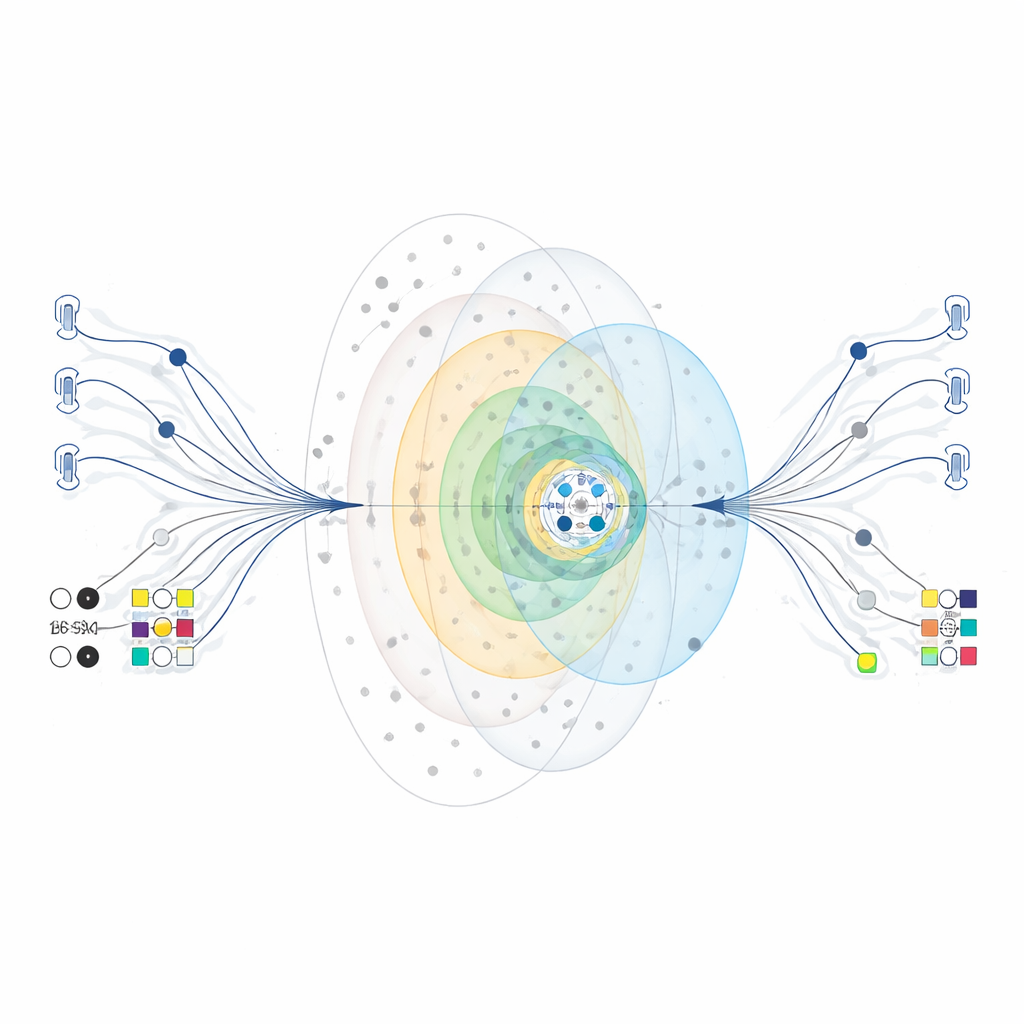
MIMO systems use multiple antennas at both the transmitting and receiving ends so that several data streams can travel in the same frequency band. In theory, the receiver can recover each stream perfectly by checking every possible combination of transmitted symbols and picking the one that best matches the signal it sees. This exhaustive approach, known as maximum-likelihood detection, quickly becomes impractical as the number of antennas or symbol choices grows. Sphere decoding is a smarter shortcut: instead of checking all possibilities, it only looks inside a “sphere” around the received signal, searching for nearby candidates. The challenge is to choose the sphere just right—too large, and the work explodes; too small, and the correct answer may be missed.

Smarter guessing of where to look
Traditional sphere decoders often set their search radius using a chi-square rule that assumes a broad range of possible noise outcomes. This is simple but conservative: the radius is usually too big, so the algorithm visits far more candidate points than needed. The authors replace this with a Gaussian-based method that uses the statistical properties of the noise to predict a tighter, probabilistic radius. As the decoder works its way through the search tree of symbol combinations, it adapts the radius dynamically, pruning branches whose distance from the measured signal is unlikely under the Gaussian noise model. This focused search keeps performance close to ideal while dramatically cutting the number of visited nodes, computation time, and therefore power use.
Mixing simple and rich signal patterns
Beyond the search strategy, the paper also changes the way data itself is encoded onto radio waves. Conventional systems often pick one modulation format—such as 16-QAM—on all antennas, which packs many bits into each symbol but makes the signal more fragile and the decoding more complex. The authors propose a hybrid scheme where some antennas use a robust but simpler pattern (BPSK), while others use the denser 16-QAM pattern. This mix shrinks the total pool of symbol combinations the decoder must consider, because fewer antennas contribute high-complexity choices. At the same time, the sturdier BPSK streams help lower the overall error rate, particularly when the channel is noisy or signal quality is poor.
Putting the pieces together in realistic channels
The combined approach was tested on an 8×8 MIMO system under a detailed “phased scattering” channel model that mimics real-world reflections and phase shifts. The researchers compared three receiver designs: a baseline sphere decoder with chi-square radius selection, a sphere decoder with Gaussian-based radius prediction, and the full system that adds hybrid modulation on top of the Gaussian method. They tracked key performance indicators such as bit error rate, symbol error rate, average number of visited nodes in the search tree, and per-frame decoding time across a range of signal-to-noise ratios relevant to 5G and future 6G scenarios.
What the numbers mean for future networks
At a representative moderate signal-to-noise level, the Gaussian-based radius prediction alone cut the average number of visited nodes by about three quarters and nearly halved the decoding time compared with the chi-square method, while improving error rates. When hybrid modulation was added, the improvements became striking: bit errors fell by roughly 99.5 percent relative to the baseline, node visits dropped by about 77.6 percent, and execution time shrank by around two-thirds. In everyday terms, the receiver finds the right answer far more quickly while making far fewer mistakes, using less computational effort. This makes the proposed design attractive for low-latency services, battery-powered Internet-of-Things devices, and harsh low-signal environments such as disaster zones. Although scaling to very large antenna arrays and higher modulations will need further work, the study shows that combining smarter probabilistic search with a mixed signaling strategy can unlock substantial gains for the next generations of wireless networks.
Citation: Girija, M.G., Sudha, T. Low complexity sphere decoding with probabilistic radius prediction and hybrid modulation for low latency wireless MIMO systems. Sci Rep 16, 11051 (2026). https://doi.org/10.1038/s41598-026-41109-x
Keywords: MIMO, sphere decoding, hybrid modulation, low-latency wireless, bit error rate