Clear Sky Science · en
Multivariate analysis of Ixiolirion tataricum (Pall.) Schult. & Schult.f. based on morphological characteristics
Why these wild bulbs matter
In the hills and dry plains of central Iran grows a little-known bulb plant with elegant purple blooms: Ixiolirion tataricum. Gardeners prize it for its hardiness and beauty, while ecologists value it for surviving tough, changeable climates. Yet until now, no one had taken a close, systematic look at how much this species varies from place to place. This study set out to measure that hidden variety, revealing just how flexible the plant’s form can be—and how that flexibility could be harnessed for future gardens and conservation.
Exploring wild flowers across the landscape
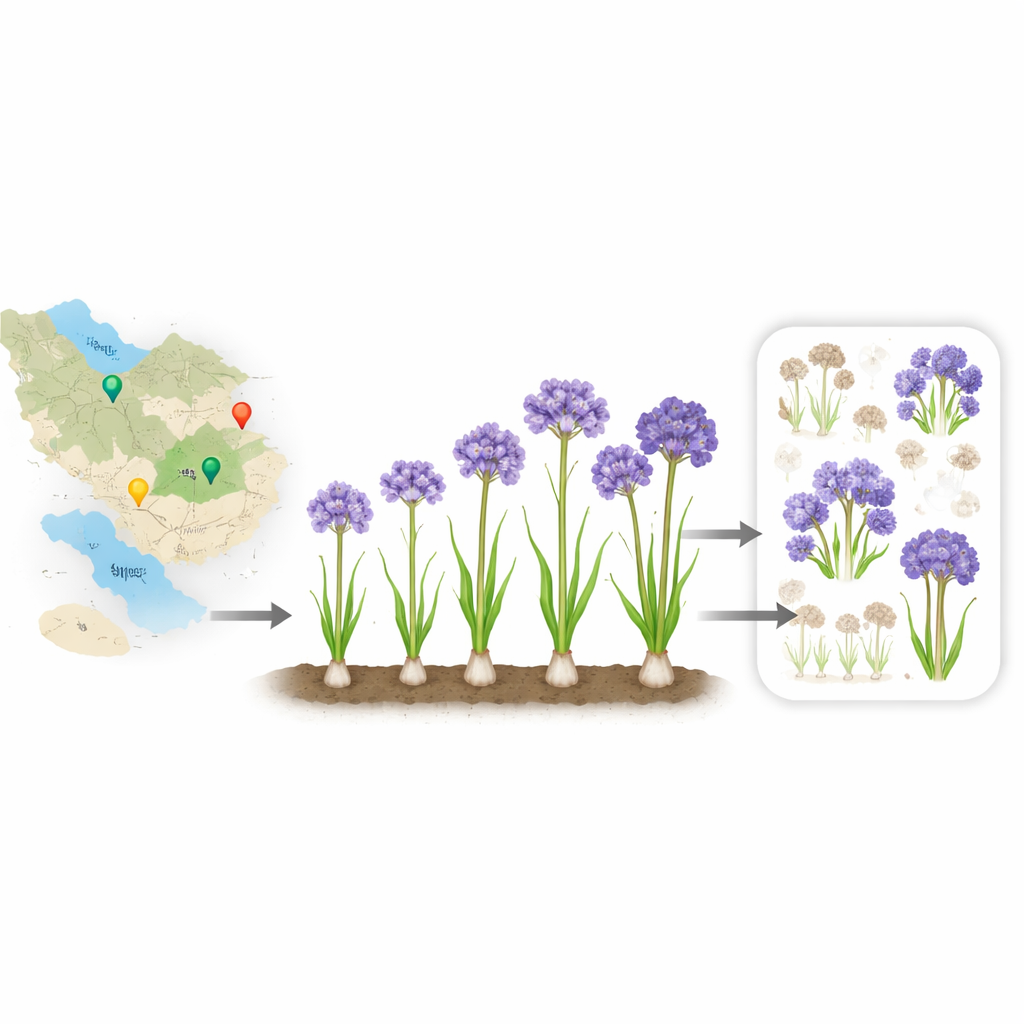
The researchers collected 140 wild plants from ten locations across Markazi Province, a region that spans snowy mountains, steppe grasslands, and areas near desert. To avoid repeatedly sampling the same clone, they kept at least 200 meters between plants in the field. Back in the lab, they carefully measured 32 visible traits, from bulb size and underground stem length to leaf number, stem height, and the size and color of the flowers. This approach treats each plant as a bundle of physical clues that together tell a story about how it lives and adapts.
Measuring shape, color, and size
After removing traits that were completely uniform, 27 characteristics were left for detailed analysis. Almost all of them showed strong variation among plants. Some, such as the number of small side bulbs (bulblets) around the main bulb or the colors of stems and flower parts, varied enormously. Others, such as flower length and bulb length, were more stable but still differed from one plant to another. Flower colors ranged from light lilac to deep purple, sometimes mixed with white, and flower shapes shifted from tightly closed trumpets to fully open forms. Even underground, bulbs and stems differed widely in length and thickness, suggesting many ways to cope with local soils and climate.
Hidden links between roots, leaves, and blooms
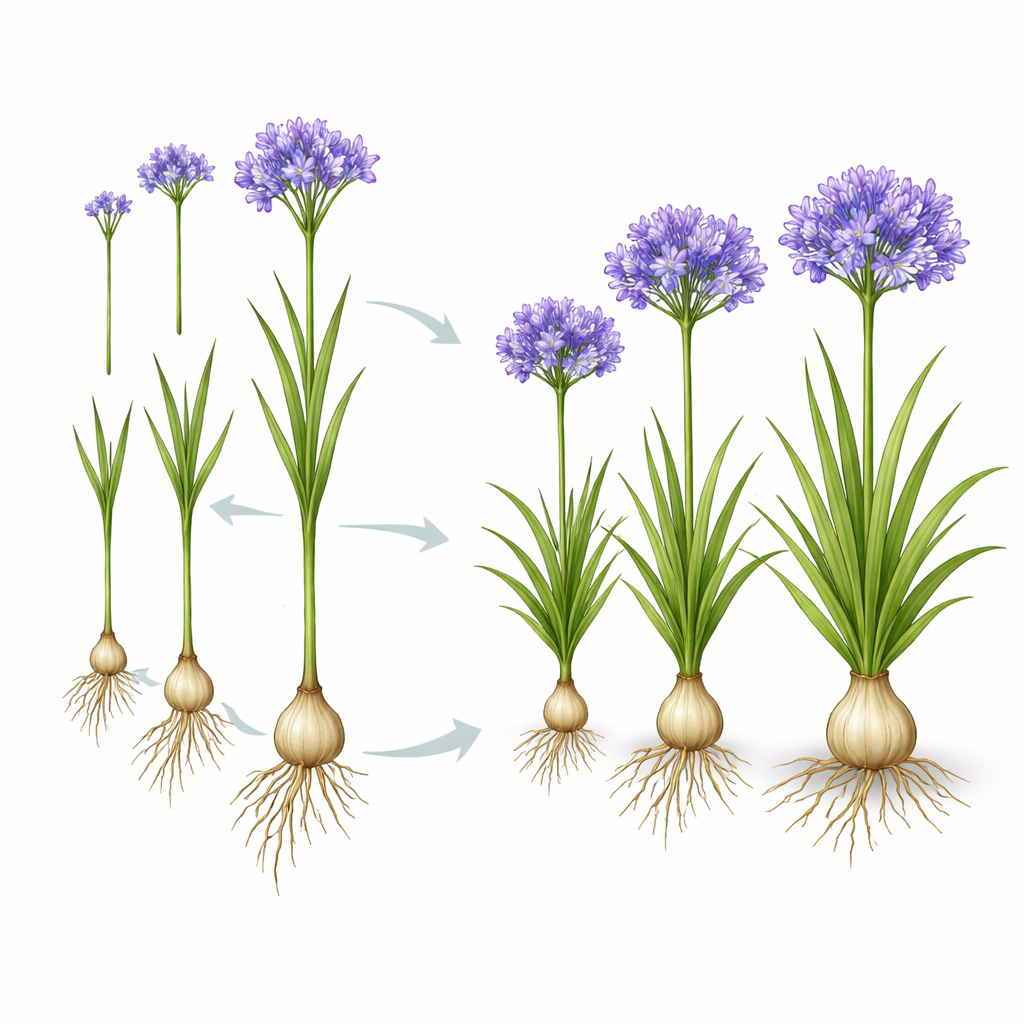
By using statistical tools that look at many traits at once, the team uncovered strong connections running through the whole plant. Individuals with more leaves and longer stems tended to carry more clusters of flowers. Larger, thicker underground stems and bulbs were linked to sturdier aboveground growth and more numerous blossoms. In other words, big, well-stocked bulbs helped build tall, leafy plants that could invest heavily in reproduction. Flower size itself also followed a pattern: plants with longer stamens and broader petals tended to have longer flowers overall, which may influence how pollinators visit them.
Sorting plants into groups and spotting standouts
To make sense of this tangle of measurements, the researchers grouped traits into main dimensions of variation. One major axis reflected overall vigor: larger bulbs and underground stems, thicker stalks, more leaves, and more flower clusters all traveled together. Other axes captured differences in color patterns and the fine details of flower shape. When the team plotted all 140 plants in this simplified space, some individuals fell far from the main crowd. These outliers combined especially desirable features—such as very tall stems, long flowers, or very wide bulbs—and were flagged as “superior accessions” that could be particularly valuable for ornamental breeding and conservation.
What this means for gardens and wild habitats
For non-specialists, the key message is that Ixiolirion tataricum is not a single fixed type of wildflower but a whole spectrum of forms, finely tuned to different corners of its home range. The study shows that strong bulbs underground, vigorous leaves and stems above, and rich flowering at the top are tightly linked rather than independent features. By identifying which plants combine these qualities best, the work provides a roadmap for selecting robust, showy lines for gardens without losing the species’ natural variety. At the same time, it highlights which wild populations are most distinctive and therefore most worth protecting, helping ensure that this resilient purple bulb continues to thrive in both cultivated beds and its rugged native landscapes.
Citation: Ghonji, M., Khaleghi, A., Khadivi, A. et al. Multivariate analysis of Ixiolirion tataricum (Pall.) Schult. & Schult.f. based on morphological characteristics. Sci Rep 16, 10101 (2026). https://doi.org/10.1038/s41598-026-41103-3
Keywords: ornamental bulbs, plant diversity, flower morphology, Iran flora, geophyte conservation