Clear Sky Science · en
Investigation and proposal of a novel solar-powered trigeneration system for more environmentally friendly heating, cooling, and power generation
Why turning sunlight into comfort matters
Keeping our homes, offices, and hospitals comfortable takes a lot of energy, most of it still coming from fossil fuels that warm the planet and pollute the air. At the same time, the sun is pouring vast amounts of clean energy onto our rooftops and city streets every day. This study explores a new way to tap that sunlight so that a single solar system can provide three essential services at once for buildings: electricity, heating, and cooling. By squeezing more useful energy out of each ray of sunshine, the proposed design aims to cut waste, lower emissions, and reduce our dependence on conventional power plants.
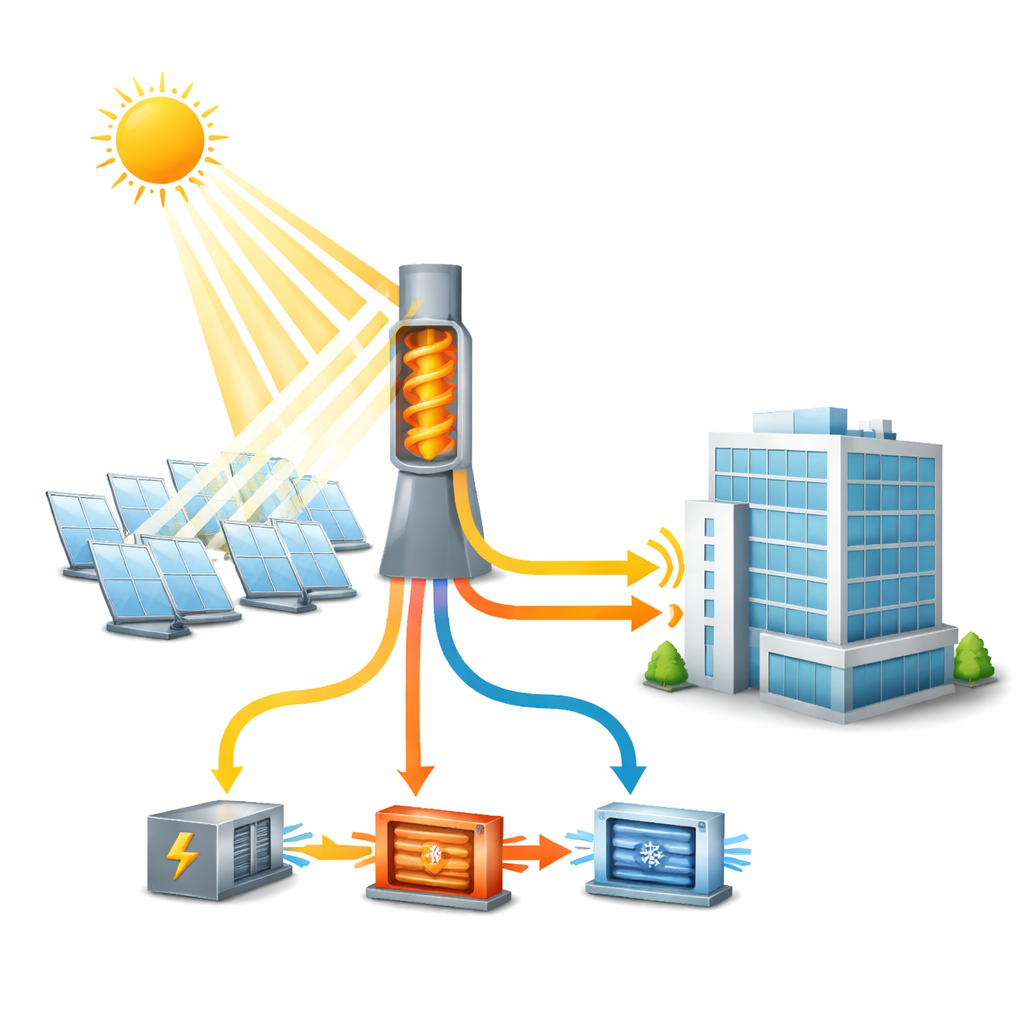
One solar tower, three useful services
The heart of the proposed setup is a solar tower surrounded by mirrors that track the sun and reflect its light onto a receiver at the top. Inside this receiver, the researchers use tightly wound helical pipes with small internal ribs, filled with a special heat-transfer oil called Syltherm 800. As concentrated sunlight hits the receiver, the oil inside these coiled tubes heats up sharply. Instead of using this hot oil for just one job, the system routes the heat into a combined arrangement that can generate electricity, produce chilled water for cooling, and deliver hot water or steam for heating, all at the same time. In other words, the same captured sunlight drives a “trigeneration” plant dedicated to serving building needs.
Hidden loops that turn heat into power and cooling
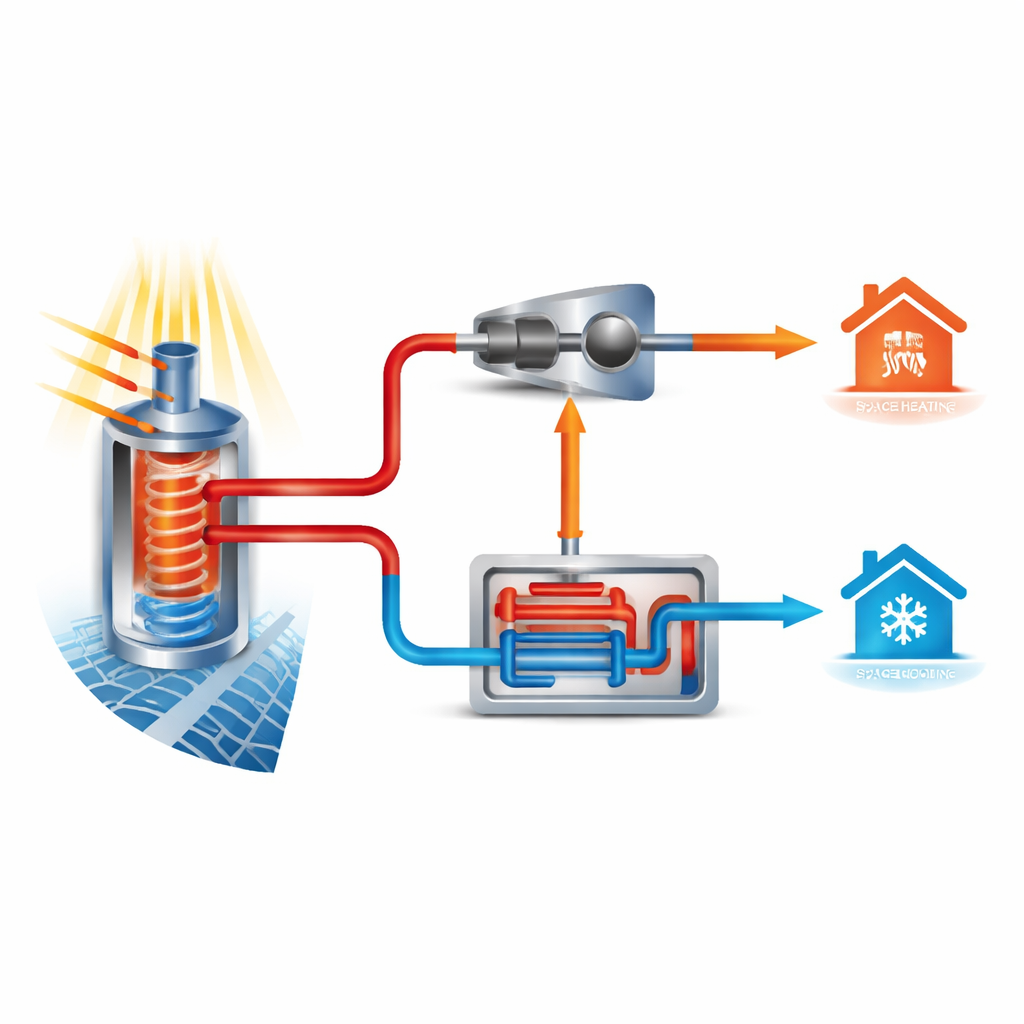
To convert this captured heat into useful services, the system relies on two linked loops. The first is a power loop known as a Kalina cycle, which uses a blend of ammonia and water that boils and condenses over a range of temperatures. This allows it to match well with the solar heat and extract more work from relatively moderate temperatures than traditional steam cycles. Hot oil from the receiver transfers its energy to this mixture, which then expands through a turbine to produce mechanical power that can be turned into electricity. Afterward, the partially cooled working fluid still carries enough heat to be reused rather than wasted.
The second loop is an absorption cooling cycle that also uses an ammonia–water mixture, but now arranged so that heat, rather than electricity, drives the cooling process. Some of the warm fluid leaving the power loop is sent to a generator that separates ammonia vapor from the solution. As this vapor is later reabsorbed, it pulls heat out of a separate stream, creating a cooling effect suitable for air conditioning or cold storage. Any remaining heat can be directed through a process heater to deliver useful warmth for hot water or industrial needs. Together, these loops ensure that high‑temperature solar heat first does the most valuable job—making power—and then cascades down to cooling and heating duties.
How design tweaks boost performance
The researchers use computer simulations to test how design choices influence the system’s performance. They focus on the shape of the coiled tubes in the receiver, the intensity of incoming sunlight, and operating conditions inside the power and cooling loops. They find that using smaller internal ribs in the helical coils, combined with strong sunlight, sharply raises the outlet temperature of the oil—by almost 40 percent in a favorable case—without imposing large pressure penalties. Higher oil temperatures, in turn, increase the power produced by the turbine, the heating delivered to users, and the cooling capacity of the absorption unit. When direct sunlight intensity is increased from a moderate to a high level, the overall useful output of the trigeneration system climbs from about 145 kilowatts to over 200 kilowatts, and both energy efficiency and the more demanding exergy efficiency improve.
Finding where energy is lost
Not all incoming solar energy can be turned into useful services; some of it is inevitably degraded or lost. To understand where the biggest losses occur, the authors carry out an exergy analysis, which tracks not just how much energy flows through the system, but how much of that energy remains capable of doing work. They discover that the central receiver on top of the tower is the single largest source of quality loss, followed by the mirror field and the superheater that passes heat from the oil to the working fluid. These losses mostly arise from temperature differences between hot and cold streams and from heat leaking to the surroundings. By narrowing these temperature gaps and refining the receiver and separator designs, the authors argue that future versions of the system could extract even more useful power, heating, and cooling from the same sunlight.
What this means for cleaner buildings
In everyday terms, the study shows that one carefully designed solar tower can act as a compact energy hub, delivering electricity, air conditioning, and heating for buildings using only sunlight and clever plumbing. Under realistic sun conditions, the system’s overall energy and exergy efficiencies are on par with, and sometimes slightly better than, other advanced solar trigeneration concepts reported in the literature. Although the work is based on detailed simulations rather than full‑scale experiments, it points toward a practical pathway for replacing separate fossil‑fueled boilers, chillers, and grid power with a single integrated solar solution that makes better use of every captured photon.
Citation: Alsharif, A.M., Khaliq, A., Hussein, E. et al. Investigation and proposal of a novel solar-powered trigeneration system for more environmentally friendly heating, cooling, and power generation. Sci Rep 16, 12871 (2026). https://doi.org/10.1038/s41598-026-41098-x
Keywords: solar trigeneration, building energy systems, concentrated solar power, solar heating and cooling, Kalina cycle