Clear Sky Science · en
Experimental and theoretical investigation of industrial solar desalination ponds enhanced with nano-ferric oxide for sustainable freshwater production
Turning Sunlight into Drinking Water
Across much of the world, people live next to the sea yet struggle to find safe drinking water. Converting salty seawater into fresh water usually consumes a lot of electricity and money. This study explores a quiet, low-tech alternative: shallow sun-powered ponds that distill seawater during the day. The twist is a thin layer of specially engineered iron oxide "nanoplates" on the pond floor, designed to soak up more sunlight and turn it into useful heat. The work asks a simple question with big implications for dry, off-grid regions: can a small materials upgrade make solar desalination practical at larger scale?
How a Sun Pond Makes Fresh Water
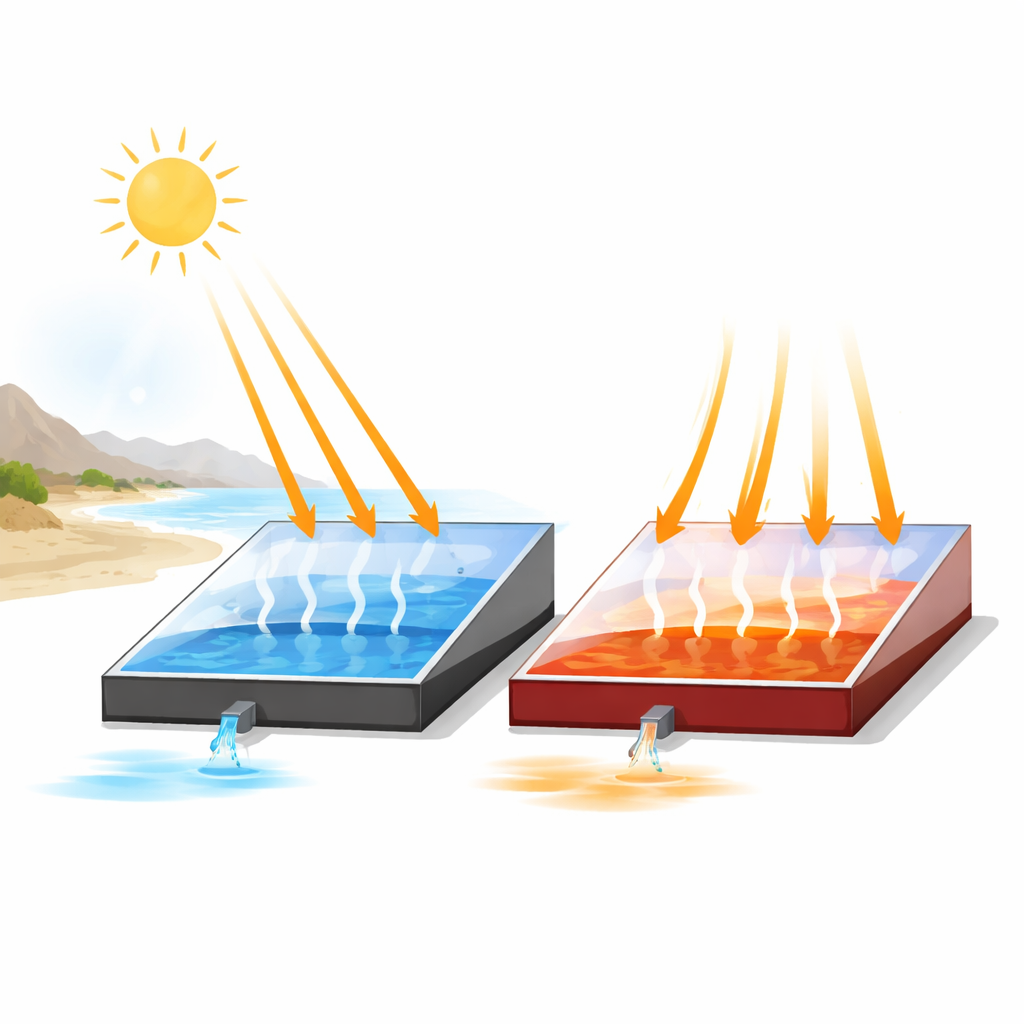
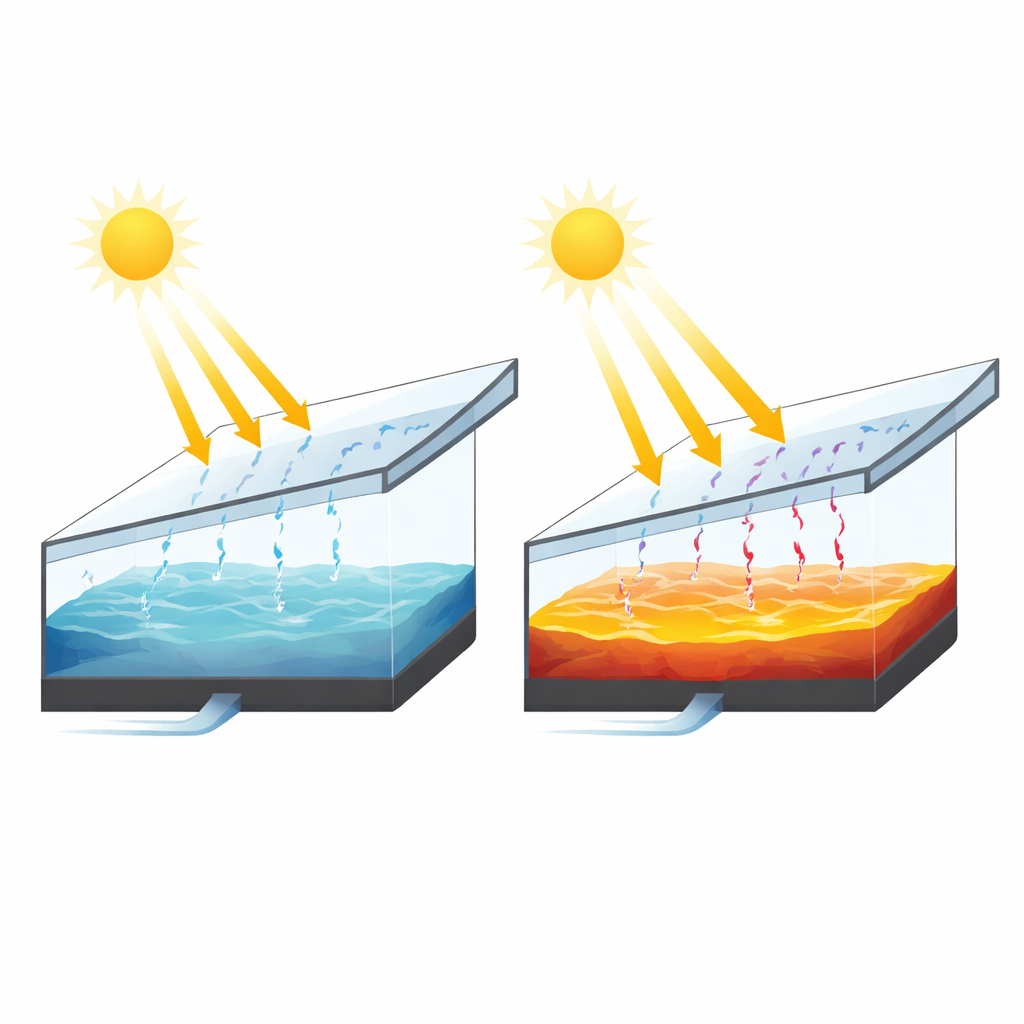
A solar desalination pond works a bit like a greenhouse for water. A shallow tray is filled with salty water and covered by a sheet of glass. Sunlight passes through the glass and warms the water and the dark base underneath. As the water heats up, some of it evaporates and rises as vapor until it touches the cooler glass. There it condenses into droplets that run down to a trough and are collected as fresh water, leaving the salt behind. The key to making this process efficient is to trap as much solar heat as possible in the water while losing as little as possible to the surroundings.
Giving the Pond a Smarter Floor
The researchers built two nearly identical one-square-meter ponds and ran them side by side outdoors for a full year. One had a conventional steel bottom, while the other was coated with a thin, reddish layer of iron oxide nanoparticles, a material also found in common rust. These tiny particles, only tens of billionths of a meter across, were carefully synthesized and checked with electron microscopes and X-ray measurements to confirm their uniform size, high surface area, and stable crystal structure. Because the coating is both a strong absorber of visible light and a reasonably good conductor of heat, it is expected to act as a solar sponge that quickly passes warmth into the overlying salty water.
Measuring Heat, Vapor, and Efficiency
Over many clear days and different seasons, the team tracked how sunlight, temperatures, and water production changed hour by hour in both ponds. They found that the nano-coated pond consistently heated up faster and reached higher peak temperatures, with the brine getting as hot as 74 °C compared with 68 °C in the standard pond. The temperature gap between the warm water and the cooler glass cover was also larger, which is important because it drives evaporation and condensation. As a result, the enhanced pond produced more vapor at midday, with hourly evaporation boosts sometimes reaching 60 percent, and delivered about 27–30 percent more fresh water over a full day—up to 6.5 liters per square meter.
Checking the Physics Behind the Gains
To ensure these improvements were not just a fluke, the authors built a detailed mathematical model of how heat and moisture move through the pond. The model balances where incoming solar energy goes: into evaporating water, warming surfaces, radiating back out, or leaking as waste heat. It also tracks the "quality" of that energy, known as exergy, which tells how much of the sunlight can theoretically be turned into useful work like vapor production. When they compared model predictions with real measurements of temperatures and water yield, the match was close, with differences of only a few percent. The iron oxide coating raised the maximum thermal efficiency from about 41 to 53 percent and the exergy efficiency from about 5.9 to 7.8 percent, confirming that more of the incoming sunlight was being converted into valuable fresh water rather than low-grade heat loss.
Why This Matters for Thirsty Regions
Beyond the numbers, the choice of material is crucial. Iron oxide nanoparticles are relatively cheap, chemically stable in salty water, and considered environmentally friendly, especially when fixed as a solid layer rather than dispersed into the liquid. The coating showed no visible damage over a year of outdoor use, and the system remained simple: no pumps, complex electronics, or expensive high-tech components were required. For remote coastal or desert communities with plenty of sun but limited resources, such improved solar ponds could offer a practical way to boost freshwater supplies using only sunlight and locally manageable hardware. While further work is needed to refine designs and study long-term durability and salt build-up, this study shows that a thin, smartly engineered layer at the bottom of a pond can significantly improve how efficiently the sun’s energy is turned into drinkable water.
Citation: Farahbod, F., Shakeri, A. & Hosseinimotlagh, S.N. Experimental and theoretical investigation of industrial solar desalination ponds enhanced with nano-ferric oxide for sustainable freshwater production. Sci Rep 16, 10125 (2026). https://doi.org/10.1038/s41598-026-41095-0
Keywords: solar desalination, nanoparticles, freshwater production, renewable water, arid regions