Clear Sky Science · en
A study on the mechanism of Buyang Huanwu Decoction in treating epilepsy by regulating adenosine levels
Why this ancient remedy matters today
Epilepsy affects tens of millions of people worldwide, and many patients still struggle with seizures despite modern drugs and their side effects. This study explores how a classic traditional Chinese herbal formula, Buyang Huanwu Decoction (BYHWD), might calm overactive brain circuits by tuning a natural brain chemical called adenosine. Using powerful computer-based methods instead of animal or human experiments, the researchers map out how dozens of plant compounds could work together on key brain switches linked to seizures.
The challenge of calming stormy brain circuits
Epilepsy arises when groups of brain cells fire in sudden, abnormal bursts, like a city grid short-circuiting. Standard anti-seizure drugs can help, but long-term use often brings problems such as drowsiness, mood changes, or drug tolerance. Scientists have become increasingly interested in adenosine, a substance our own brains produce, which acts as a built-in brake on excessive activity. One type of adenosine switch (A1 receptor) generally quiets brain cells and protects them, while another (A2A receptor) tends to rev them up. In epilepsy, this natural balance is often skewed: the calming A1 pathway weakens and the stimulating A2A pathway becomes too strong.
An old formula with many moving parts
Buyang Huanwu Decoction is a seven-herb mixture used for centuries to "tonify" vital energy and improve blood flow, especially after stroke. Modern studies suggest it can improve brain circulation, reduce inflammation, and protect nerve cells. In this work, the authors treat the formula as a complex network rather than a single magic bullet. They mine pharmacology databases to identify chemical ingredients in each herb, then predict which human proteins each ingredient might interact with. In parallel, they gather hundreds of proteins already linked to epilepsy, and look for overlaps. This systems approach reveals 254 shared targets, including the two key adenosine switches, ADORA1 and ADORA2A, highlighting adenosine signaling as a central bridge between the herbal formula and seizure biology. 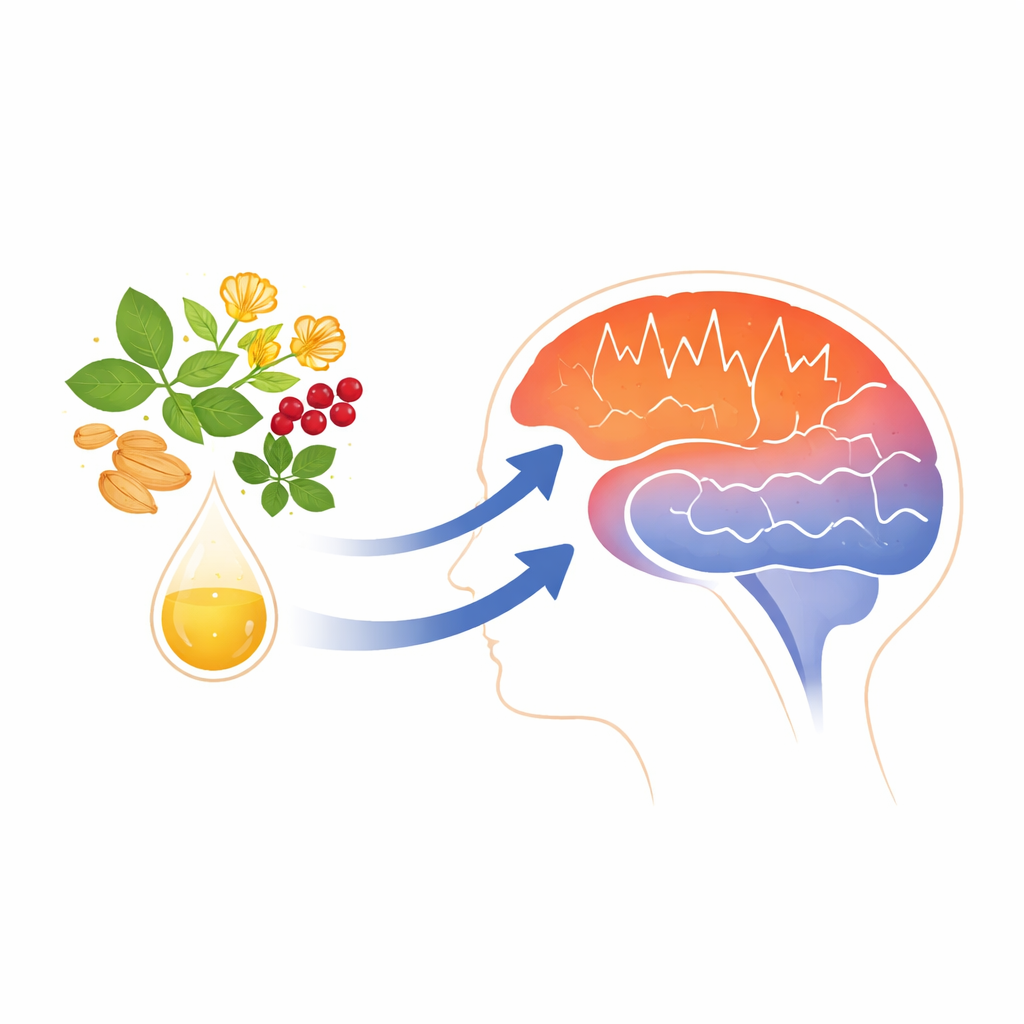
How plant molecules may tune brain switches
The analysis identifies 33 active compounds in the formula that can act on adenosine-related targets, with Radix Astragali (Huangqi) contributing the largest share, supporting its role as the "chief" herb. Thirteen molecules, including familiar plant flavonoids like quercetin and kaempferol, appear able to influence both the calming A1 and stimulating A2A receptors. Using molecular "docking" simulations, the team then virtually fits key compounds into 3D models of these receptors, as if testing how well different keys fit into a lock. Several molecules, especially a flavonoid called isorhamnetin, show tight and specific binding at the same microscopic contact points used by known drugs that either activate A1 or block A2A. This pattern suggests these plant compounds could, in principle, boost the brain’s natural brakes while dampening its accelerators.
Following the signal from receptors to circuits
Looking beyond single proteins, the researchers analyze which biological pathways these shared targets cluster in. They find strong enrichment in networks related to brain signaling chemicals, the cAMP messenger system inside cells, and the machinery of synapses where nerve cells talk to each other. These pathways govern how easily neurons fire and how the balance between excitatory and inhibitory signals is maintained. In particular, the targets concentrate in processes that control ion flow and membrane voltage—core ingredients of an electrical storm in the brain. This supports a picture in which BYHWD does not act at one point only, but nudges an interconnected web of switches to restore a more stable rhythm.
Putting one key interaction under the microscope
To test one especially promising interaction in more depth, the team runs a long, detailed computer simulation of isorhamnetin bound to the A2A receptor. Over 100 nanoseconds of simulated time, the complex remains snug and stable, maintaining multiple close contacts inside the receptor’s binding pocket. Calculations of binding energy indicate a strong, favorable attraction between the two, consistent with a drug-like interaction rather than a fleeting encounter. Energy breakdown points to specific amino acids in the receptor that contribute most to this grip, and these match sites already known to be important for A2A-blocking drugs. Together, these results strengthen the idea that certain BYHWD components could directly modulate adenosine receptors in a pharmacologically meaningful way. 
From computer models to future therapies
In everyday terms, the study suggests that an old multi-herb remedy may steady epileptic brain activity by helping the brain’s own calming system work better and by easing back its internal accelerators. Rather than relying on a single ingredient, many plant molecules appear to share the load, acting on the same brain switches and their downstream pathways to rebalance excitation and inhibition. Because all of the evidence here comes from computational modeling, these ideas still need to be tested in cells, animals, and ultimately people. Even so, the work offers a testable roadmap: if experiments confirm these predictions, BYHWD or its key components could inspire new, more gentle strategies for seizure control that cooperate with the brain’s natural chemistry instead of overpowering it.
Citation: Wu, S., Deng, Y., Yang, J. et al. A study on the mechanism of Buyang Huanwu Decoction in treating epilepsy by regulating adenosine levels. Sci Rep 16, 12625 (2026). https://doi.org/10.1038/s41598-026-41089-y
Keywords: epilepsy, adenosine receptors, traditional Chinese medicine, network pharmacology, flavonoids