Clear Sky Science · en
Foreign object detection in power transmission lines using SESYOLO
Keeping Power Lines Clear and Safe
Modern life depends on electricity flowing smoothly through vast networks of power lines. Yet something as ordinary as a bird’s nest or a stray kite can trigger power outages, fires, or costly repairs when it ends up tangled in high‑voltage equipment. This study introduces an improved computer‑vision system, called SESYOLO, that helps drones automatically spot such foreign objects on power transmission lines quickly and accurately, even when the objects are tiny, oddly shaped, and hidden in cluttered scenery.
Everyday Clutter, High‑Voltage Risk
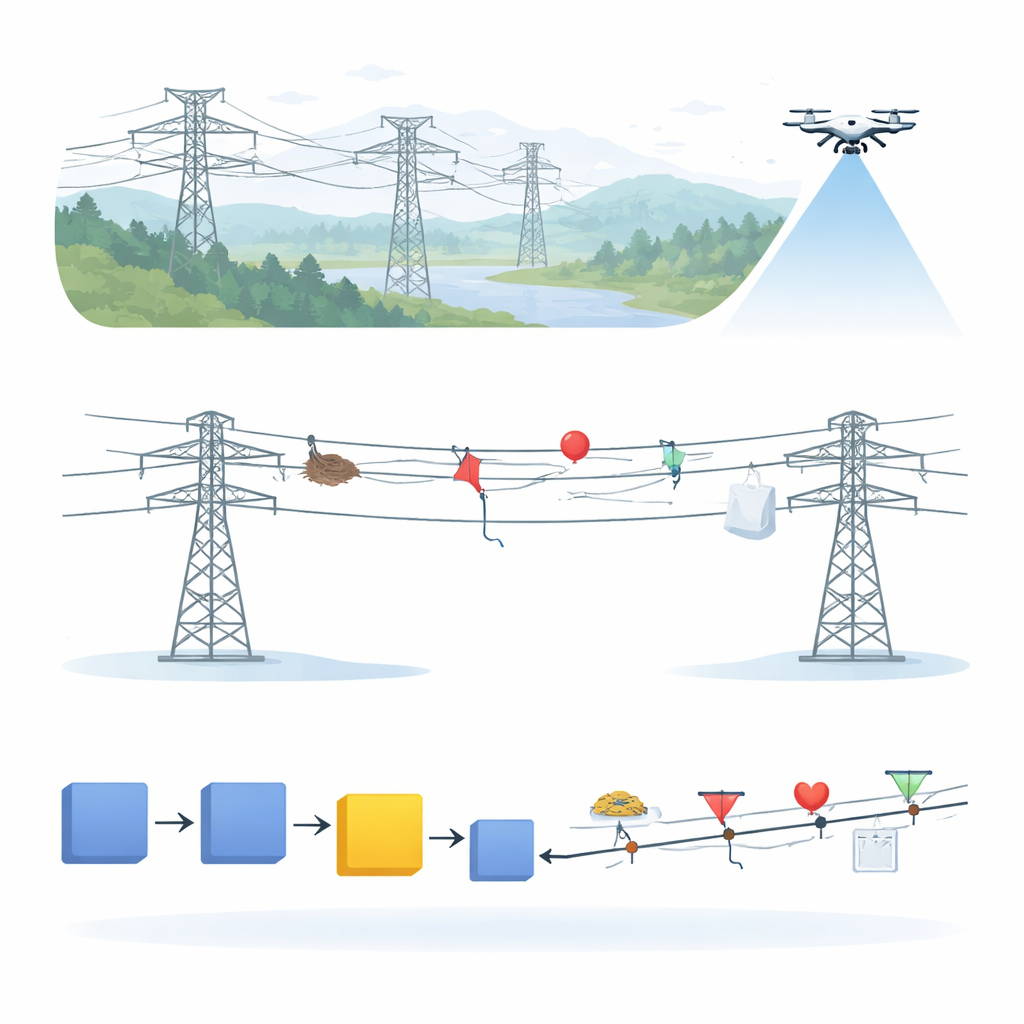
Transmission lines stretch for thousands of kilometers across fields, rivers, and cities, passing through environments full of birds, trees, and human activity. Nests, plastic bags, kites, and balloons can stick to wires or towers, creating paths for electricity to jump where it should not. Traditional inspections rely heavily on workers traveling long distances and visually scanning structures, a slow and sometimes dangerous task. Drones have made it easier to gather images, but turning those images into reliable, automatic warnings requires software that can pick out small, irregular objects against backgrounds filled with cables, steel trusses, and vegetation. Existing detection programs often confuse background patterns for hazards, miss tiny objects, and suffer from a lack of well‑labeled training images.
Teaching Machines What Trouble Looks Like
To overcome the shortage and imbalance of real inspection photos, the researchers first built a new image collection, called FOD24, focused on foreign objects on power lines. They combined 1,401 real drone photos with several types of image enhancement, such as adjusting color and brightness, adding blur and noise, and simulating rain, snow, and fog. They then used modern image‑generation tools to create additional realistic scenes, filling in underrepresented categories like balloons or kites. After careful human screening and annotation, the final dataset contained 2,817 images covering bird nests, kites, balloons, plastic bags, and insulators. Only real photos were used for testing, ensuring that performance claims reflect real‑world conditions rather than artificial examples.
A Smarter Eye for Tiny Targets
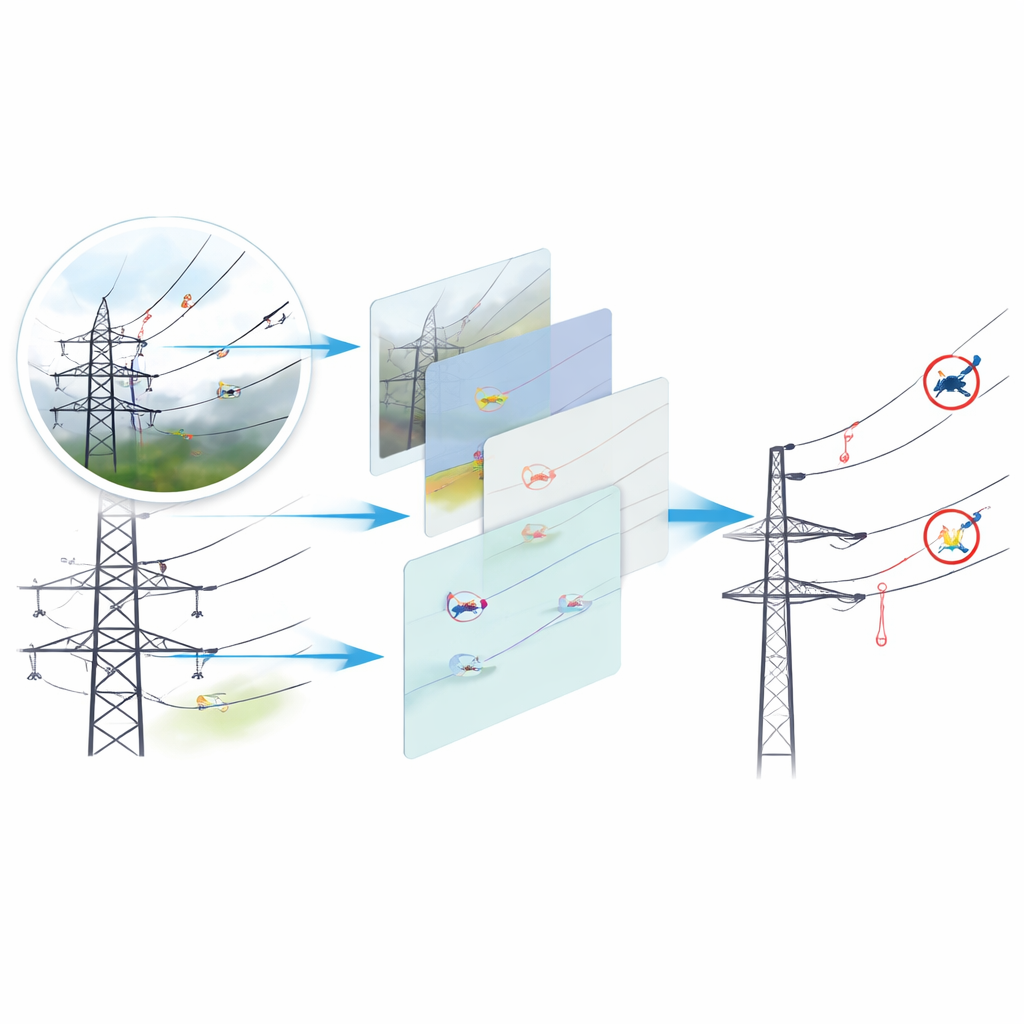
Building on a popular fast detector known as YOLOv8, the team redesigned several key parts of the network so it would better handle small, camouflaged objects while still running in real time on hardware typically used onboard drones. A new module called SCConv helps the system focus on the most informative details in both the position and intensity of features in the image, cutting down on redundant calculations. Another component, Efficient RepGFPN, improves how information from coarse, big‑picture views and fine, close‑up views is blended, which is crucial when nests or kites occupy only a few pixels. Finally, a tailored attention mechanism in the detection “head” encourages the network to emphasize foreign objects and downplay distracting backgrounds. Together, these changes sharpen the model’s eye for subtle shapes without significantly slowing it down.
Learning from a Stronger Teacher
The researchers further boosted SESYOLO’s abilities using a technique called knowledge distillation. In simple terms, they trained a smaller, faster detector (the “student”) to imitate the behavior of a larger, more capable model (the “teacher”). During training, the student was exposed to aggressively augmented images that mimicked the varied and messy scenes drones encounter in the field. Special modules aligned the internal signals between teacher and student so that the student could more easily absorb both what is present in the image and where it is located. After this two‑stage training, the student model retained much of the teacher’s accuracy while remaining compact and efficient enough for practical deployment on aerial platforms.
Better Detection for a More Reliable Grid
When tested against several well‑known object‑detection systems, SESYOLO delivered notably higher accuracy and recall, especially for small and irregular objects. Compared with the original YOLOv8 version it builds upon, SESYOLO improved a key accuracy score by about nine percentage points and showed particularly strong performance in spotting bird nests, reaching nearly 94% accuracy. At the same time, the model stayed lightweight—using only around 7.9 megabytes of memory—and fast enough to process roughly 142 images per second on a standard graphics card. For power companies, this means drones can scan lines quickly and automatically flag likely hazards, allowing crews to focus on timely repairs instead of manual searching. In everyday terms, the work offers a path to fewer unexpected blackouts, greater safety near high‑voltage lines, and a more reliable electric grid.
Citation: Duan, P., Zhang, X., Liang, X. et al. Foreign object detection in power transmission lines using SESYOLO. Sci Rep 16, 11807 (2026). https://doi.org/10.1038/s41598-026-41080-7
Keywords: power line inspection, drone imaging, object detection, deep learning, infrastructure safety