Clear Sky Science · en
Design optimization of multiple cooling plate battery thermal management system for minimizing temperature difference considering interactions between cooling plates
Why Cooler Batteries Matter for Everyday Drivers
As electric vehicles become more common, what happens inside their battery packs quietly shapes how far we can drive, how long the batteries last, and how safe they remain. This study looks at how to keep hundreds of tightly packed lithium-ion cells at nearly the same temperature, using cleverly tuned metal plates that carry cooling liquid. By rethinking how these plates share coolant, the researchers show that small design tweaks can noticeably even out temperatures without using more energy.
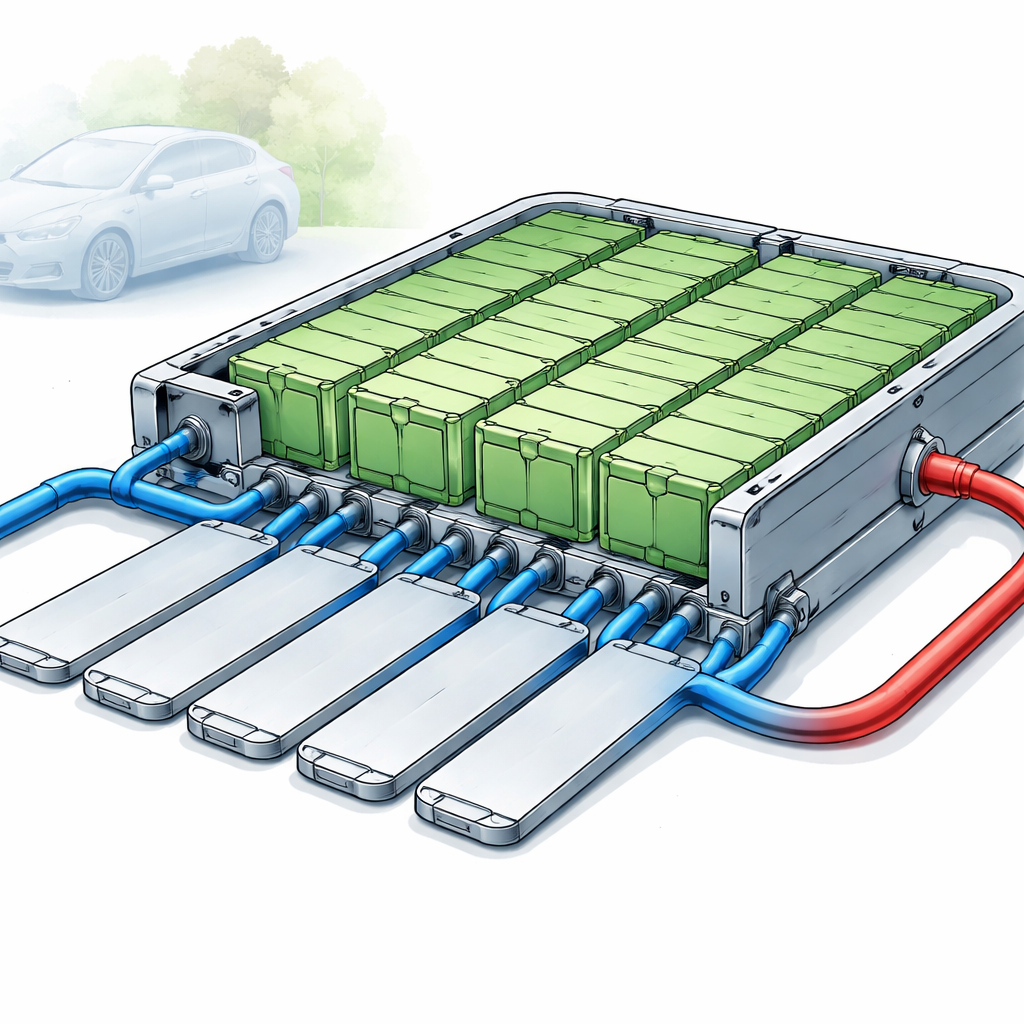
Hidden Heat Inside Electric Car Batteries
Modern electric cars rely on large packs made from many individual lithium-ion cells. When these cells charge and discharge, they generate heat. If some cells run hotter than others, they age faster, may deliver less power, and in extreme cases can become unsafe. Automakers therefore aim to keep cell temperatures within a safe window and, just as importantly, to keep the differences between the hottest and coolest cells small—ideally within a few degrees.
How Cooling Plates Keep Packs in Check
Many electric cars use an indirect liquid cooling approach: flat metal plates sit beneath stacks of battery cells, and coolant flows through channels inside the plates. In the pack studied here, five long cooling plates lie under five modules of prismatic cells. All plates share a single coolant inlet and outlet, meaning the liquid enters through one side, splits among the plates, then rejoins and exits. Earlier research often assumed that each plate received the same flow and behaved on its own. In reality, however, the plates are hydraulically linked, and the coolant naturally favors some paths over others.
Uneven Flow, Uneven Temperatures
Using detailed computer simulations of fluid flow and heat transfer, the authors first examined the original design, in which all plates had identical channel widths. They found that the coolant took the easiest route: plates closest to the inlet and outlet received most of the flow, while the farthest plate saw very little. Those well-fed plates removed heat effectively, but cells above the poorly fed plate warmed more. Within each plate, the coolant also heated up as it moved along, so cells near the downstream end ran slightly hotter than those near the inlet. Across the full pack of 75 cells, the temperature difference between the hottest and coolest cells reached almost 4 kelvins, even though the maximum temperature stayed within an acceptable range.
Smart Tuning Instead of Bigger Pumps
Rather than adding more pumps, inlets, or bulky hardware—which is often impossible in a real vehicle—the team treated the flow channels themselves as adjustable knobs. They allowed each plate’s channel width to vary independently and also allowed the channels to narrow from inlet to outlet. A smaller channel raises flow resistance, gently pushing coolant toward other plates; a tapering channel speeds up the liquid near the outlet, boosting local heat removal. Because running full simulations for every possible combination would be too slow, the researchers built a fast mathematical surrogate of their model and used an evolutionary optimization algorithm to search for the best set of dimensions and overall flow rate.
A More Even Pack Without Extra Energy
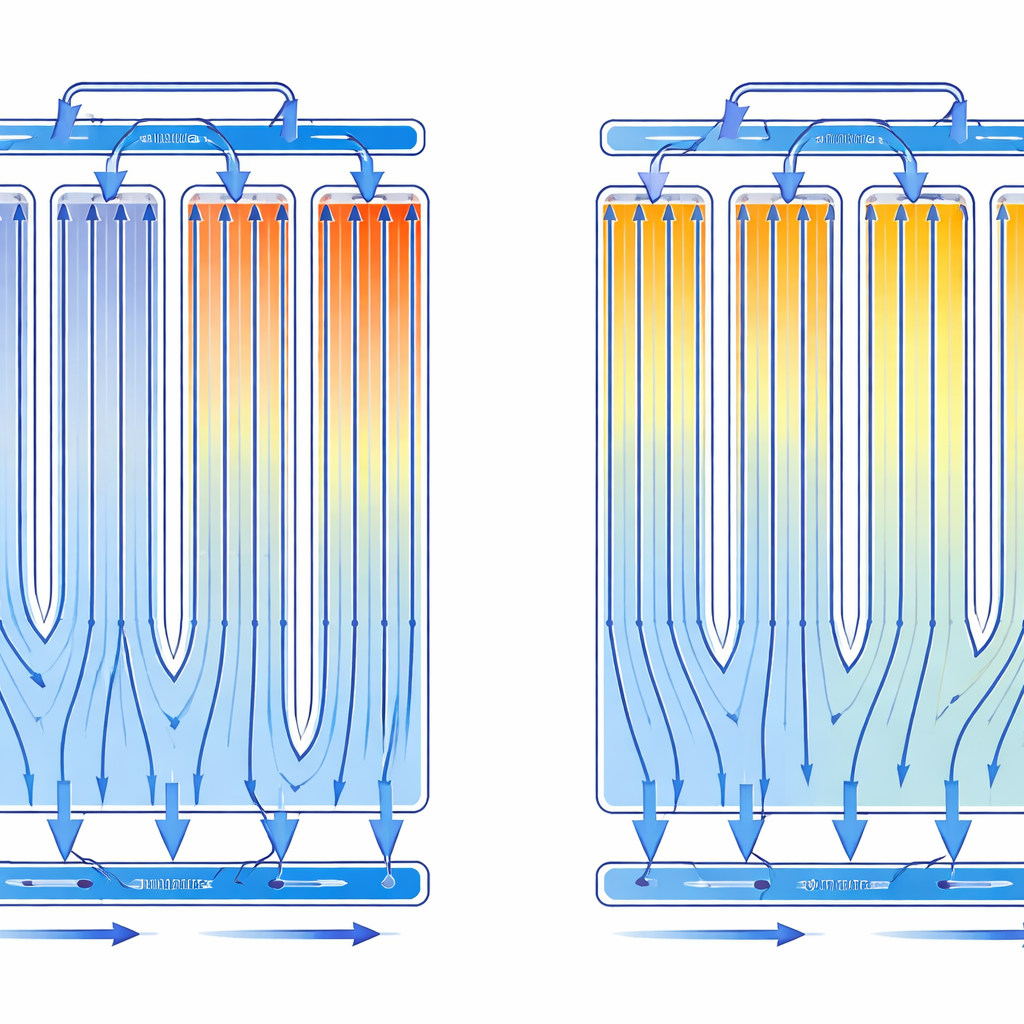
The optimized design produced a more balanced coolant distribution across all five plates. The plates nearest the inlet and outlet ended up with narrower channels, which increased their resistance and encouraged more flow through the once-neglected distant plate. At the same time, the channels were shaped to gradually narrow along the flow path, which improved cooling near the outlets and reduced temperature gradients within each module. As flow and surface area traded off, the net heat transfer from each plate became more similar. The result was a substantial drop in the pack’s cell-to-cell temperature spread—from about 3.98 to 1.73 kelvins—while the peak temperature decreased slightly and the pumping power stayed essentially unchanged.
What This Means for Future Electric Cars
To a non-specialist, the key message is that smarter geometry can sometimes replace heavier hardware. By carefully tuning how coolant channels are sized and shaped, engineers can coax the fluid to go where it is most needed, evening out temperatures across large battery packs. This makes it easier to keep every cell in a comfortable range, which in turn supports longer battery life, consistent performance, and improved safety, all without demanding extra energy from the vehicle’s pumps.
Citation: Lee, H., Park, S., Park, C. et al. Design optimization of multiple cooling plate battery thermal management system for minimizing temperature difference considering interactions between cooling plates. Sci Rep 16, 14063 (2026). https://doi.org/10.1038/s41598-026-41068-3
Keywords: electric vehicle batteries, battery cooling, thermal management, liquid cooling plates, lithium ion packs