Clear Sky Science · en
Investigating serum free light chains in patients with common variable immunodeficiency disorder in compare with other immunodeficiency diseases
Why this matters for everyday health
Some people get pneumonia, sinus infections, or ear infections over and over again because their immune system cannot make enough protective antibodies. Doctors struggle to tell which type of immune problem these patients have, and the right diagnosis can change treatment and long‑term outlook. This study explores a simple blood test that measures tiny antibody pieces, called free light chains, to see whether it can help distinguish one common disorder, known as common variable immunodeficiency (CVID), from other, similar immune diseases.
A closer look at a common but puzzling immune disorder
CVID is the most frequently diagnosed serious antibody deficiency. People with CVID have low levels of major antibody types and often suffer repeated lung, sinus, and ear infections, along with a higher risk of autoimmunity, enlarged lymph nodes, and sometimes cancer. Yet CVID is a “diagnosis of exclusion”: doctors must rule out many other causes of low antibodies, from certain cancers to rare inherited disorders. Genetic testing helps only a minority of patients, and the condition itself is very mixed—two people with CVID can look quite different. That makes fast, accurate diagnosis difficult in real‑world clinics.
Tiny antibody fragments as a potential signal
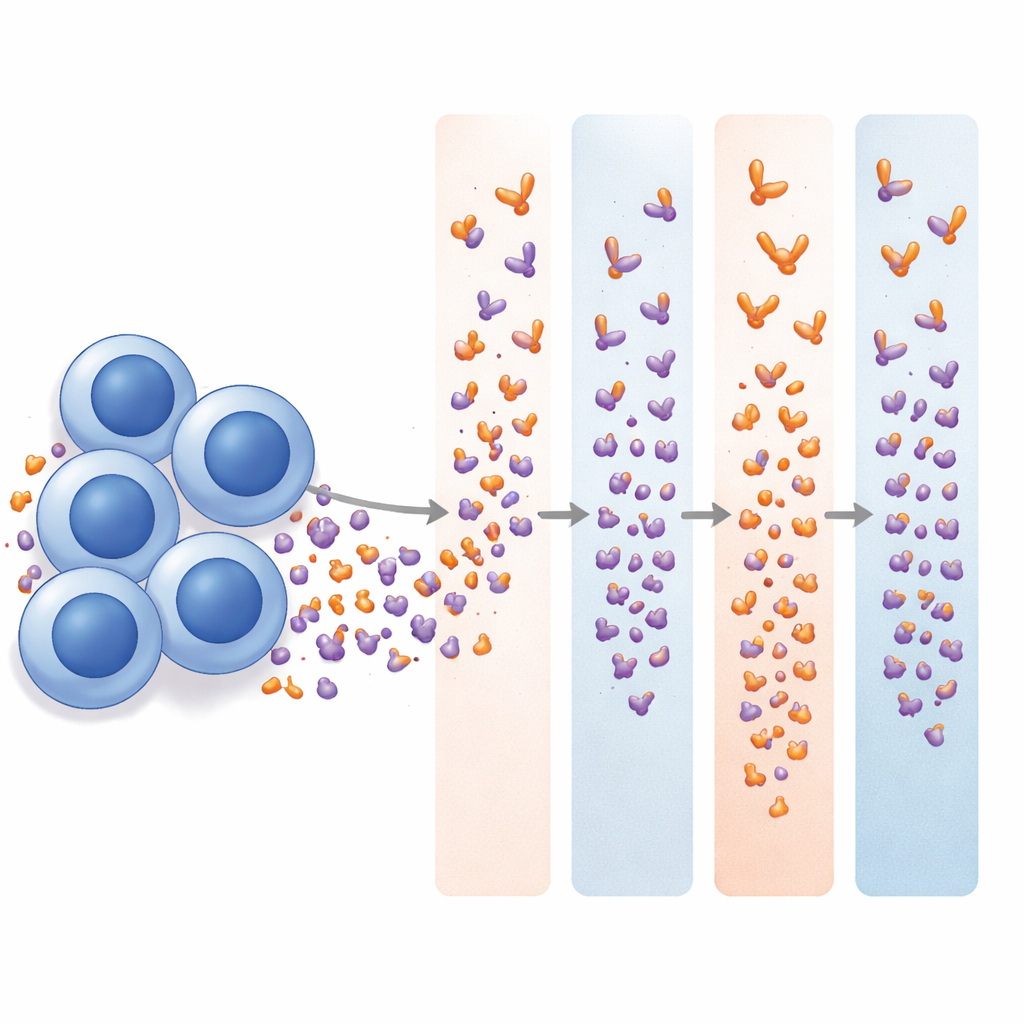
Antibodies are built from heavy and light protein chains. Normally, antibody‑producing cells churn out slightly more light chains than they need, and the excess spills into the blood as “free light chains.” In healthy people, these free kappa and lambda chains are present at low but steady levels and reflect how active certain immune cells are. Because CVID and related disorders affect the development and function of these cells, the team asked whether measuring free light chains in the blood could serve as a practical marker to separate CVID from other conditions that also feature low antibody levels.

What the researchers measured and how
The study followed 90 people: 39 with CVID, others with combined immunodeficiency, agammaglobulinemia (a more severe form of antibody absence), a few with other rare primary immune disorders, and 20 healthy volunteers. Using a routine laboratory method, they measured free kappa and lambda chains in frozen serum samples taken just before patients received their regular antibody infusions. They then compared median levels across groups and used statistical tools that are standard in diagnostic research to see how well the test could tell CVID apart from other immune problems and from healthy individuals.
Clear patterns in immune “light chain” levels
The results showed striking differences. Healthy volunteers had the highest levels of both types of free light chains. Patients with agammaglobulinemia had the lowest values, reflecting their near‑complete failure to make antibodies. People with CVID also showed markedly reduced free light chains compared with healthy controls and with some other immune disorders, especially for the kappa type. Combined immunodeficiency patients tended to fall in between—lower than healthy individuals but generally higher than CVID and agammaglobulinemia. When the team plotted how well these measurements separated groups, the accuracy for spotting CVID and agammaglobulinemia was very high, with near‑perfect scores for both sensitivity and specificity in several analyses.
Linking test results to immune cell behavior
Beyond group differences, the researchers looked at how free light chain values lined up with specific immune cell subsets in CVID. They focused on a population of more “experienced” B cells that have switched from early forms into cells poised to become antibody‑secreting plasma cells. In CVID patients, higher free kappa and lambda levels tracked with higher frequencies of these switched memory B cells and with levels of certain antibody classes, suggesting that the blood test mirrors how well this arm of the immune system is functioning. Interestingly, a handful of CVID patients had unusually high free light chain levels and later turned out to have autoimmune gut disease, lymphoma, or a gene defect that led doctors to reclassify their diagnosis, hinting that sudden increases in these markers could warn of complications.
What this could mean for patients and doctors
In simple terms, this work suggests that measuring free light chains in the blood can provide a fast, inexpensive snapshot of how well a person’s antibody‑making cells are working. Low levels strongly point toward CVID or agammaglobulinemia, while normal levels make these conditions less likely. Used alongside clinical history, standard antibody tests, and, when appropriate, genetic analysis, this assay could help doctors sort patients with low antibodies into more precise categories and potentially flag those who need closer monitoring for autoimmunity or cancer. The authors note that larger, more uniform studies are still needed, but their findings support adding free light chain testing as a useful tool in the diagnostic and follow‑up care of people living with chronic immune deficiencies.
Citation: Bemanian, M.H., Khoshmirsafa, M., Ahmadi, M. et al. Investigating serum free light chains in patients with common variable immunodeficiency disorder in compare with other immunodeficiency diseases. Sci Rep 16, 13442 (2026). https://doi.org/10.1038/s41598-026-41057-6
Keywords: common variable immunodeficiency, serum free light chains, primary immunodeficiency, hypogammaglobulinemia, B cell function