Clear Sky Science · en
Research on the impact of digital finance on rural revitalization
Why Phones and Farms Now Belong Together
Across much of the world, people in the countryside still struggle to get the money and services they need to improve their lives. This study looks at what happens when smartphones, online payments, and other forms of digital finance reach rural China. Using detailed data from hundreds of cities over more than a decade, the authors ask a simple but powerful question: can these new financial tools actually help rebuild villages, modernize farming, and raise living standards for rural families—and under what conditions do they work best?

New Money Tools for Old Rural Problems
The paper starts by explaining why rural revitalization is so challenging. Villages need better roads and water systems, more modern farms and small businesses, cleaner environments, and stronger local services such as schools and clinics. All of this requires steady funding, yet traditional banks often overlook small, remote communities. Digital finance—built on mobile phones, big data, and online platforms—offers a way around these barriers. It can deliver loans and payments over the air, build trust using data instead of physical collateral, and cut paperwork so money moves faster and at lower cost.
How the Study Took a Close Look at China’s Countryside
To move beyond anecdotes, the researchers assembled records from 281 prefecture‑level cities in China between 2011 and 2022. They built a broad score for “rural revitalization” that captures five goals: strong local industries, pleasant and green living conditions, active community life, effective village governance, and rising incomes. They then compared this measure with a city‑level index of digital finance, while also accounting for factors such as schooling levels, industrial structure, population density, transport links, government budgets, and economic output. Using several statistical models and cross‑checks, they tested not just whether digital finance matters, but also how and where it works best.
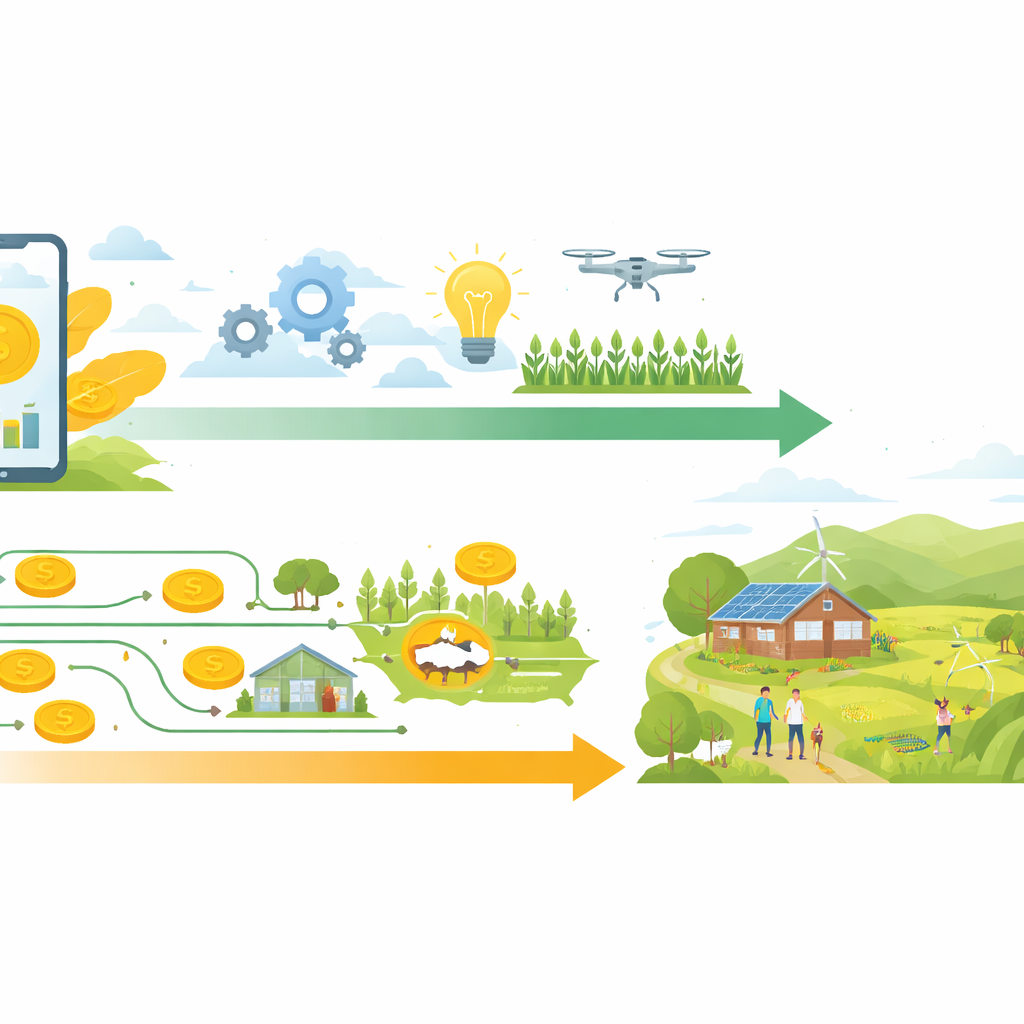
How Digital Tools Spark Change Behind the Scenes
The results show that digital finance has a clear and sizable link with stronger rural revitalization. But the relationship is not simply that “more apps mean better villages.” Instead, digital tools act through two major channels. First, they support new ideas and technologies in farming and rural business—for example, by easing funding for modern equipment, data‑driven irrigation, or online training. Second, they improve how capital is steered: money can be channeled more precisely to promising projects and underserved communities, while waste and transaction costs are reduced. Both pathways—innovation and smarter capital flows—explain a meaningful share of digital finance’s impact, with innovation playing the slightly larger role.
Why Place and Prosperity Level Still Matter
The study also finds that the power of digital finance depends strongly on a region’s broader development. In better‑off areas, where internet coverage, devices, and digital skills are already in place, each extra step forward in digital finance brings larger gains for rural revitalization. In poorer regions, the effect is positive but weaker, because weak networks and limited digital literacy dull the benefits. When the authors divided China into eastern, central, and western zones, digital finance showed the strongest push in the more advanced eastern cities, a modest yet positive effect in many western areas, and little measurable impact in the central region, where aging populations and an uneven urban–rural split hold back adoption.
What This Means for Villages and Policymakers
For a lay reader, the takeaway is straightforward: putting smart financial tools into farmers’ hands can help turn struggling villages into thriving communities—but only if the basics are in place. Digital finance works best where there is solid network coverage, enough local know‑how to use the tools, and a supportive economic setting. The authors argue that to make the most of these technologies, governments and institutions need to invest in rural digital infrastructure, boost financial and digital literacy, back agricultural innovation, and tailor strategies to local conditions. Done well, digital finance becomes more than a payment method; it becomes a quiet engine powering better jobs, cleaner environments, and higher quality of life in the countryside.
Citation: Zhou, L., Ji, X. & Yuan, S. Research on the impact of digital finance on rural revitalization. Sci Rep 16, 11029 (2026). https://doi.org/10.1038/s41598-026-41024-1
Keywords: digital finance, rural revitalization, financial inclusion, agricultural modernization, China rural development