Clear Sky Science · en
Additively manufactured bioinspired multilayer sandwich structures with varied core configurations under out-of-plane compression
Why nature inspired crash protection matters
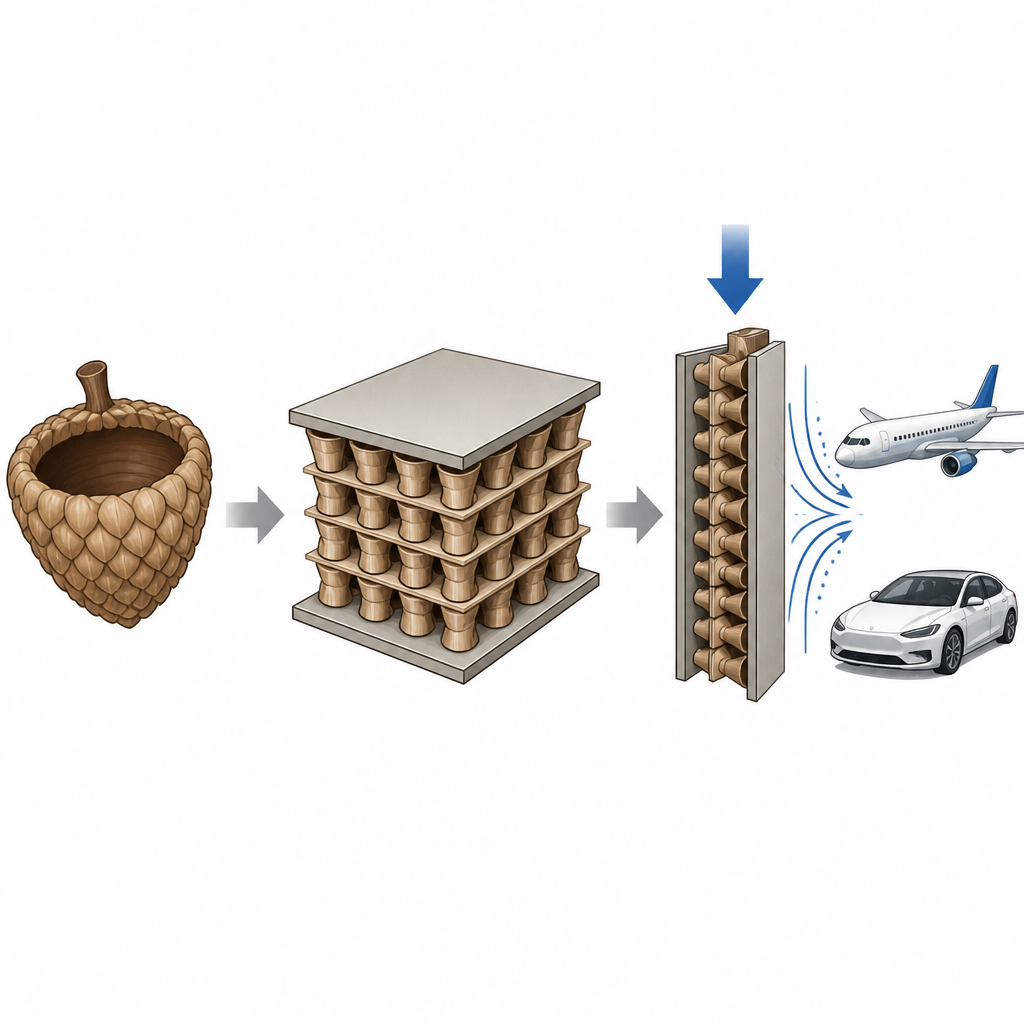
From car bumpers to aircraft cabins, many modern vehicles rely on hidden “sandwich” panels that must be light yet able to soak up huge forces in a crash. This study explores a new class of such panels inspired by the rough, protective cup around an oak acorn. By copying that natural shape with 3D printing and carefully tuning the internal pattern, the researchers show how to build plastic structures that are light, recyclable, and far better at cushioning impacts.
Learning from the oak tree
The starting point is the oak cupule, the scaly shell that cradles an acorn when it falls. In nature, this shell spreads impact forces through a network of thin walls and cavities. The team translated that idea into man made panels built like a sandwich: two flat, stiff outer plates with a hollow, patterned core in between. Instead of foam, the core is made of many small cell like shapes, stacked in several layers. These shapes were chosen to mimic patterns seen in nature and to test which ones handle crushing forces most gracefully.
Building complex cores by 3D printing
To turn these designs into real parts, the researchers used a powder based 3D printing process called Multi Jet Fusion, working with a tough engineering plastic known as Nylon PA12. This method can produce intricate internal patterns without glue or bolts, so the plates and core emerge as a single piece. The team printed multilayer panels whose cores followed four basic layouts: rhombic, hexagonal, square, and circular cells. They also varied how big each cell was, how much space sat between neighboring cells, and whether the corrugated layers were stacked in the same direction or rotated from one layer to the next.
Crushing tests and what they reveal
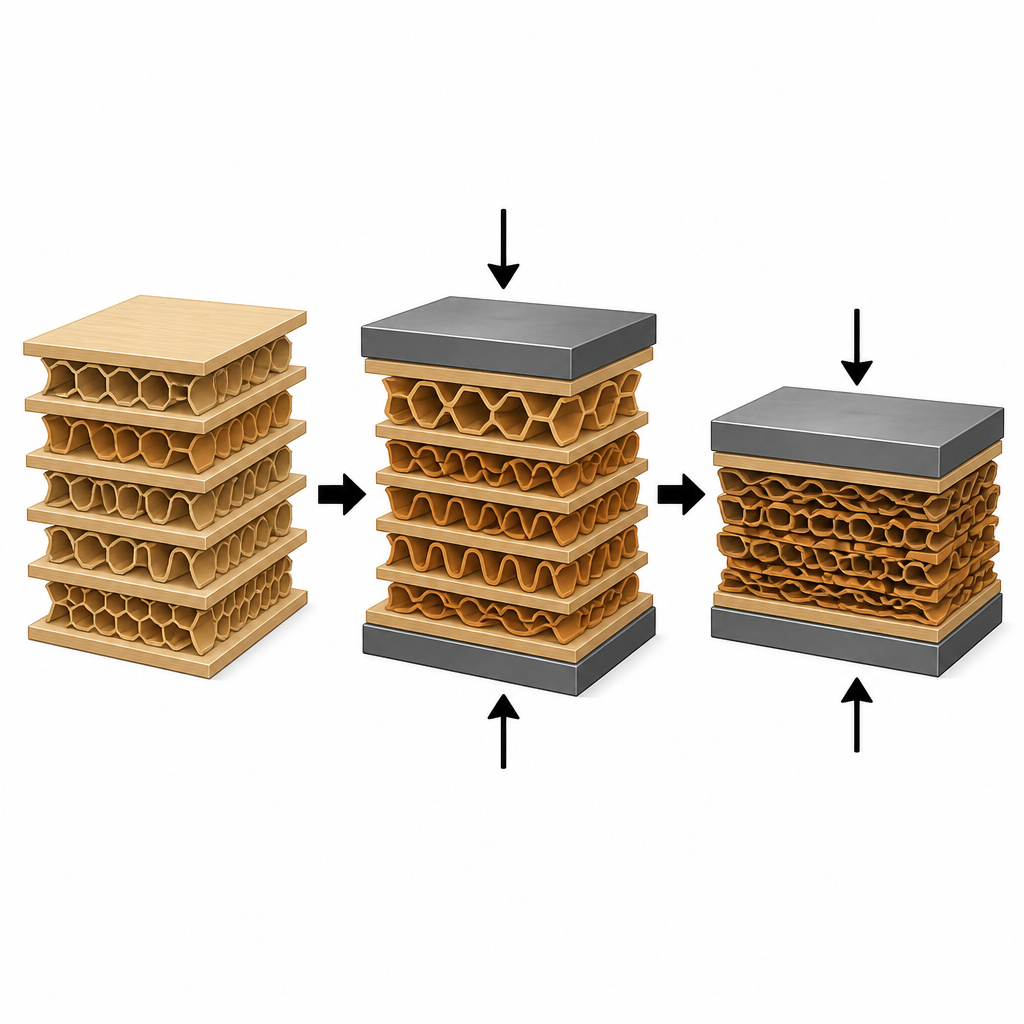
The panels were then squeezed slowly between flat steel plates while measuring force and displacement. These tests mimic what happens when a wall or floor in a vehicle is pressed from the outside during a collision. At first, each panel responds elastically, springing back when the force is removed. As the load grows, the thin internal walls begin to bend, buckle, and crack, and the panel enters a long “plateau” where it keeps absorbing energy as it collapses. By tracking the force curve and the area beneath it, the team calculated both total energy absorbed and energy absorbed per gram of material, a key measure for weight sensitive designs.
Which shapes work best
The rhombic and hexagonal patterns stood out. Panels with rhombic cores absorbed about 440 joules with the highest energy per gram, while hexagonal cores came close behind. Their angled or faceted walls provide many paths for forces to flow, encouraging smooth, step by step folding rather than sudden failure. Square and circular cores absorbed significantly less energy, in part because sharp corners or fully curved walls concentrate stress and trigger early local collapse. Making each cell smaller, while keeping the overall panel size fixed, raised the peak force and the energy absorbed for both circular and hexagonal cores. Moderately increasing the gap between cells further delayed interactions between neighboring walls and extended the gentle collapse stage.
Layers that work together
The way layers are stacked also plays a major role. When all corrugations pointed in the same direction, many cell walls buckled at once, leading to sharper drops in load. Rotating each layer relative to the next spread instabilities through the thickness of the panel. This staggering forced forces to redistribute from one layer to another and increased friction and sliding between them. In circular and hexagonal cores alike, the alternating pattern boosted total energy absorption by about one fifth and raised energy per gram by more than ten percent. Hexagonal cores with small cells, wider spacing, and alternating layers delivered the most balanced performance, combining high peak strength with very efficient cushioning.
What this means for safer, lighter structures
For a non specialist, the main message is that internal pattern and layer arrangement inside a panel can be just as important as the amount of material used. By borrowing motifs from an oak acorn cup and fabricating them with 3D printing, the team shows that cleverly shaped and stacked cells can turn a lightweight plastic sheet into a highly capable impact absorber. Such panels could help future cars, trains, and aircraft better protect people while keeping fuel use and material waste in check.
Citation: Taghizadeh, S., Cheng, L., Askari, M. et al. Additively manufactured bioinspired multilayer sandwich structures with varied core configurations under out-of-plane compression. Sci Rep 16, 15833 (2026). https://doi.org/10.1038/s41598-026-41021-4
Keywords: bioinspired structures, sandwich panels, energy absorption, additive manufacturing, crashworthiness