Clear Sky Science · en
Improving personalized recommendations system using graph attention networks driven by perceived complexity and innovation
Why smarter suggestions matter
Every time you shop online, a hidden engine is guessing which products you are most likely to enjoy. Most of these engines mainly watch what you clicked and whether reviews sound positive or negative. This paper argues that such a view is too shallow. The authors show that understanding how “easy to use” and how “new or inventive” a product feels to customers can make recommendations far more satisfying and accurate. They build and test a new recommendation system that reads written reviews, learns these deeper perceptions, and then uses them to suggest products that better match people’s comfort levels and appetite for novelty.

Looking beyond simple thumbs-up or thumbs-down
Traditional recommendation systems rely heavily on star ratings and basic sentiment analysis: is a review positive, negative, or neutral? While useful, this misses important nuances. A gadget might be highly rated yet still feel confusing to set up, or a very original device may delight some customers and overwhelm others. The authors argue that two overlooked ingredients—perceived complexity (how simple or difficult a product seems to use) and perceived innovation (how fresh or novel it feels)—strongly shape whether a person will actually want to buy and keep using a product. Capturing these traits from everyday language in reviews could help tailor suggestions to users who prefer straightforward tools versus those who enjoy experimenting with cutting-edge designs.
Teaching a system to read nuance in reviews
To tap into these subtler signals, the researchers started with thousands of Amazon product reviews. Human annotators carefully labeled each review according to how complex and how innovative the product seemed, following strict guidelines and checks to ensure they agreed with one another. They then expanded these labels using tools from language research: dictionaries of related words, measures of word sentiment, and explainable artificial intelligence techniques that highlight which words most influence the system’s decisions. This process allowed them to automatically score new reviews on scales of simplicity versus difficulty and innovation versus ordinariness, while keeping the labeling rules transparent and auditable.
Turning customer opinions into a knowledge network
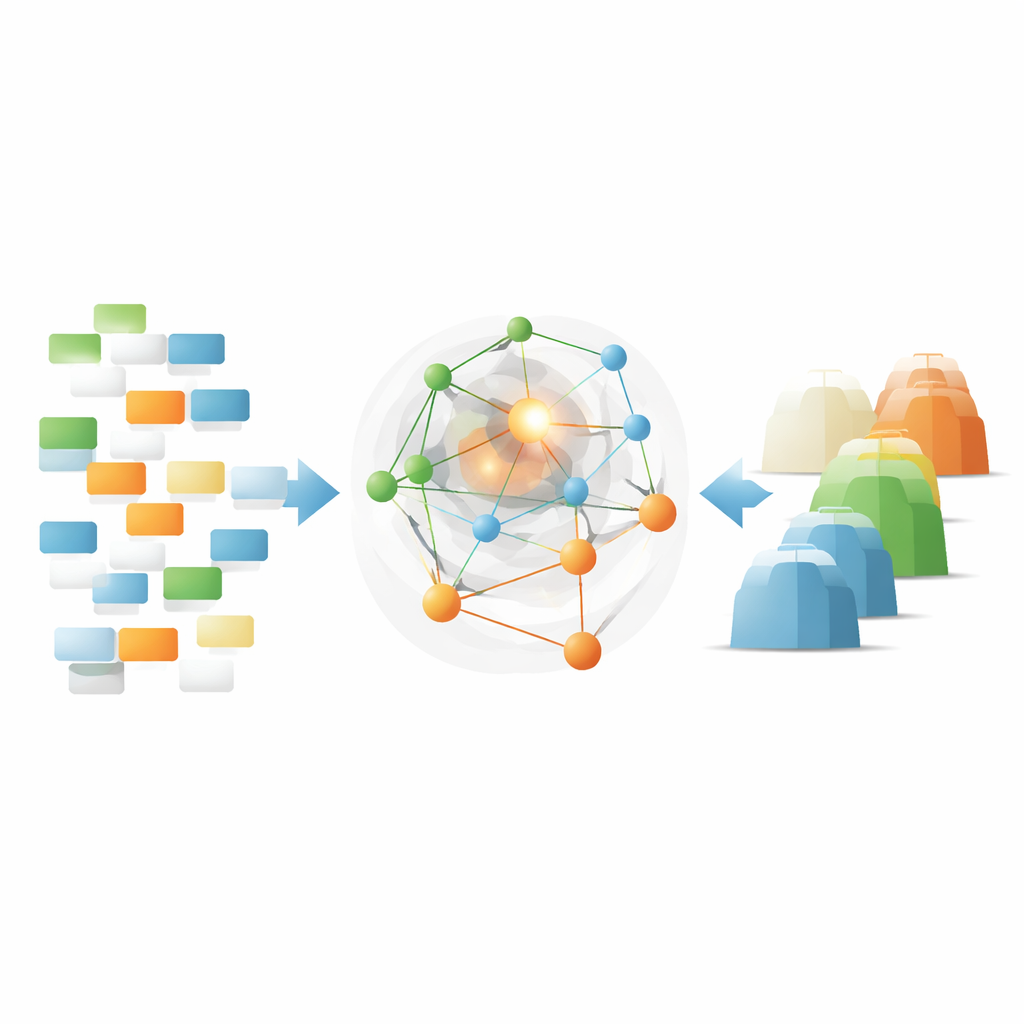
Once reviews were labeled, the team converted each one into a rich numerical summary that captures its meaning in context. They used a modern language model that learns to place similar sentences close together in a mathematical space, so that reviews describing “easy setup” cluster near one another, while those describing “confusing menus” form a different cluster. On top of this, they built a graph—a web of connections—linking reviews and products that share similar patterns of perceived complexity and innovation. A specialized model called a graph attention network then learns to focus on the most informative connections in this web, weighing which related products and reviews should matter most when predicting whether a given item deserves a strong, medium, or weak recommendation.
Balancing the data and explaining the choices
Real-world data are usually imbalanced: there may be many more “recommended” products than “not recommended” ones, or vice versa. To avoid a biased system that simply favors the majority, the authors used a technique that fabricates realistic extra examples for under-represented groups, evening out the training pool without distorting the underlying patterns. They also combined this with weighting strategies during learning so that the model pays fair attention to rarer cases. Crucially, they applied explainable AI methods to inspect how the system arrives at its decisions, tracing back which words and review patterns most strongly pushed a product toward a Yes, Medium, or No recommendation. This makes the system’s behavior more understandable to designers, businesses, and potentially even end users.
How well the new system performs
The resulting system, called GAT-RS, was tested against several strong modern baselines, including deep learning models that already perform well on review analysis. GAT-RS not only matched but exceeded these approaches, correctly classifying recommendations for about 95 out of every 100 test cases and showing a very high ability to distinguish between products that should and should not be suggested. The main remaining challenge lies in telling apart borderline cases—products that are neither clearly recommended nor clearly rejected—but even here the errors were relatively modest. Overall, the system proved especially strong at identifying items that truly deserved a confident recommendation.
What this means for everyday shoppers
In plain terms, this study shows that recommendation engines can do better than simply detecting positive vibes in reviews. By paying attention to whether a product feels simple or demanding, and whether it feels tried-and-true or boldly new, systems can match suggestions to individual thinking styles and curiosity for novelty. For shoppers, this could mean fewer regrets over purchases that turn out to be too complicated or too boring, and more products that feel like a natural fit. For businesses, it offers a path toward more trustworthy and effective recommendation tools that are not only accurate, but also explain why a particular item was suggested in the first place.
Citation: Ullah, S., Khan, A., Khan, K.U. et al. Improving personalized recommendations system using graph attention networks driven by perceived complexity and innovation. Sci Rep 16, 11286 (2026). https://doi.org/10.1038/s41598-026-41019-y
Keywords: personalized recommendations, product reviews, graph attention networks, perceived complexity, perceived innovation