Clear Sky Science · en
Secure quantum-resilient smart city communication networks using QSC-Net with MF-MBO-based energy-aware task scheduling
Why safer city networks matter
Modern cities run on invisible digital nervous systems. Traffic lights, power grids, hospitals, and public safety sensors constantly exchange data, and a single failure or hack can ripple through daily life. As powerful quantum computers emerge, today’s security tools and network designs will no longer be enough. This paper introduces QSC-Net, a blueprint for future city networks that stay secure, fast, and energy-efficient even under quantum-era threats, and a new scheduling method (MF‑MBO) that keeps all this running smoothly without wasting power.
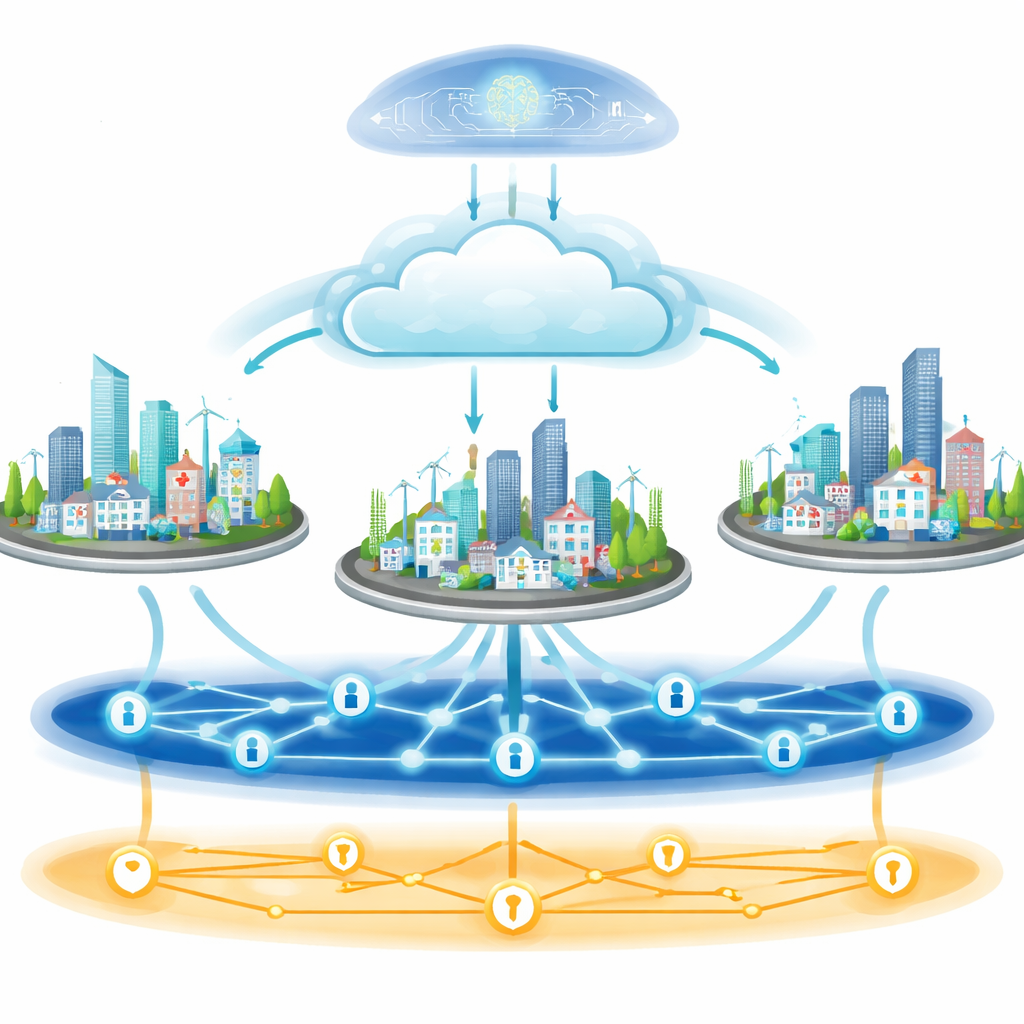
Connecting cities with a secure digital backbone
The authors imagine multiple smart cities linked by a shared communication fabric that treats security as a built-in property, not an afterthought. QSC-Net weaves together two kinds of protection: quantum key distribution, which uses the physics of light to detect eavesdropping, and post‑quantum encryption, designed to resist attacks from future quantum computers. A health check on the quantum channel decides whether to use ultra-secure quantum keys or to fall back to robust mathematical protection, so messages keep flowing securely even when fiber links are noisy or long. This hybrid layer sits under ordinary 5G and fiber networks, turning them into a resilient backbone for city services.
Teaching the network to choose safe and efficient paths
Rather than relying on fixed routing rules, QSC-Net uses reinforcement learning—an AI technique that learns by trial and feedback—to steer data. Each gateway in the city observes how trustworthy its neighbors are, how stable the quantum links look, and how busy the network is. It then chooses to forward, delay, or drop packets based on a learned policy that balances speed and safety. Over time, the system discovers routes that avoid unreliable or suspicious nodes, improving delivery rates and cutting delays compared with a standard protocol. In tests, this AI-driven routing delivered more packets, reacted faster to changing conditions, and maintained high trust in chosen paths.
Spotting attacks without pooling everyone’s data
City networks must detect intrusions, but shipping all raw data to a central server raises privacy, legal, and bandwidth concerns. QSC-Net answers this with federated learning: each node trains its own lightweight anomaly detector on local logs—including both classical traffic patterns and quantum link signals—then shares only model updates, not raw records. These updates travel over quantum-secured channels and are masked with added noise for extra privacy. A central aggregator blends them into a stronger global model and sends it back out. The resulting system can catch a range of threats—from denial-of-service storms to tampering with quantum links—while keeping sensitive health, mobility, and sensor data where it originates.
Proving device identity with unique physical fingerprints
Another weak point in today’s systems is device identity: passwords and digital certificates can be copied or broken by future quantum machines. QSC-Net instead uses Quantum Physical Unclonable Functions (Q‑PUFs), tiny hardware structures whose microscopic variations act like a built‑in fingerprint. When a device joins the network, it is challenged to produce a response only its hardware can generate. If the response is close enough to the stored reference, within a carefully chosen tolerance, the device is accepted. Experiments show this method authenticates legitimate devices accurately, rejects impostors, and remains reliable even when quantum noise is present, outperforming a traditional RSA-based approach.
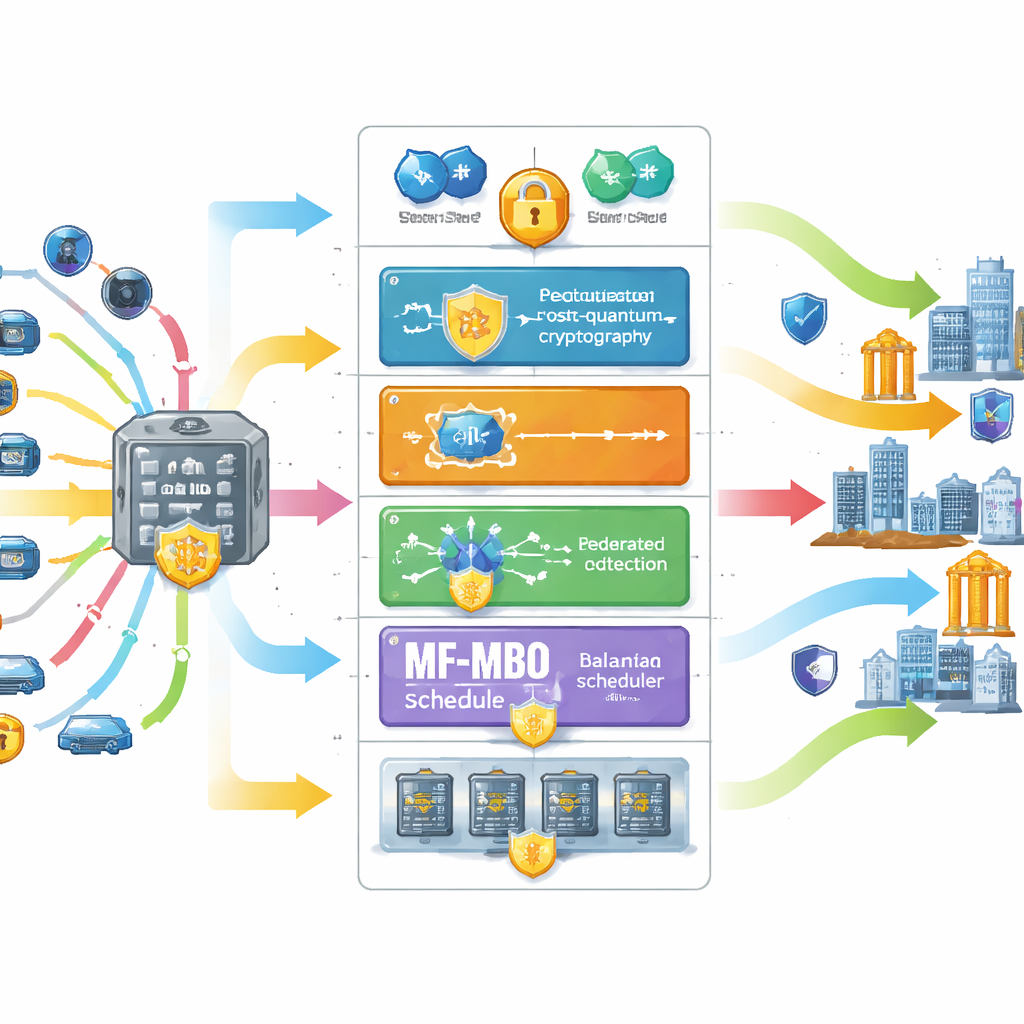
Keeping city computing fast and energy-wise
Behind the scenes, smart-city applications must be assigned to virtual machines in data centers and at the edge. If this scheduling is naive, some machines overload, others sit idle, and energy is wasted. The paper introduces MF‑MBO, a meta‑heuristic scheduler inspired by butterfly migration and refined with three ideas: fuzzy scoring to handle conflicting goals (speed, balance, and energy use), a quantum‑inspired “tunneling” step that occasionally accepts worse moves to escape dead ends, and a greedy local adjustment that shifts tasks from busy to quiet machines. Across simulated workloads, MF‑MBO shortens completion times, improves load balance, and cuts energy consumption compared with standard genetic, swarm, and butterfly‑based methods.
What this means for future smart cities
Taken together, QSC-Net and MF‑MBO outline how tomorrow’s cities might defend themselves against both classical hackers and quantum-era attacks while still delivering quick, reliable digital services. The architecture shows that quantum keys, post‑quantum algorithms, learning‑based routing, privacy‑preserving threat detection, and careful task scheduling can be combined into a single, explainable framework. Although the results come from detailed simulations rather than live deployments, they set benchmarks and design patterns for future testbeds. For citizens, the promise is simple: city services that remain available, trustworthy, and energy-conscious, even as the underlying technology becomes more complex.
Citation: Reddy, N.R., Dalton, G.A., Swathi, K. et al. Secure quantum-resilient smart city communication networks using QSC-Net with MF-MBO-based energy-aware task scheduling. Sci Rep 16, 12534 (2026). https://doi.org/10.1038/s41598-026-41015-2
Keywords: quantum secure communication, smart city networks, federated anomaly detection, post-quantum cryptography, energy-aware task scheduling