Clear Sky Science · en
rGO/BC nanocomposite aerogels exhibit recyclable adsorption of organic solvents and oils with enhanced flame resistance
Cleaning Up Spills with Smart Sponges
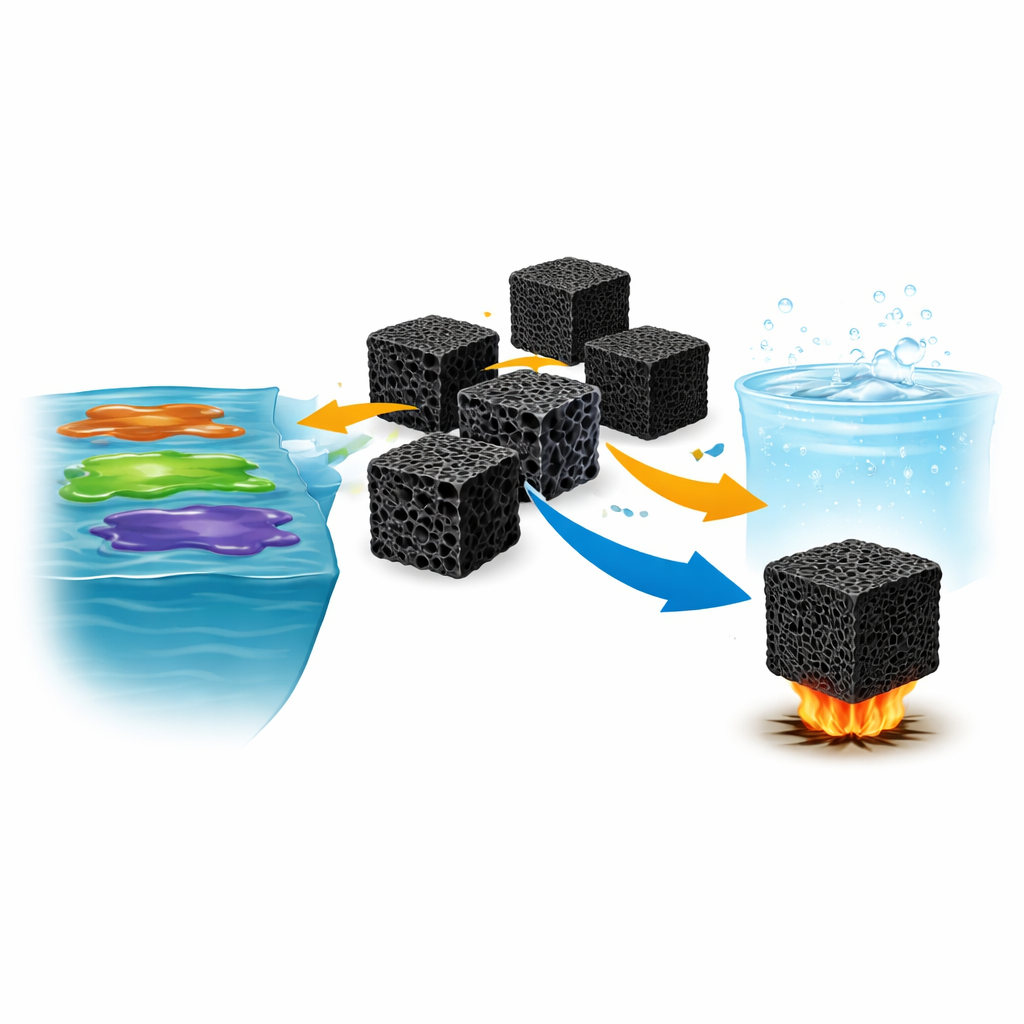
Oil and chemical spills in water are notoriously difficult and expensive to clean up. The materials we use today can soak up pollutants, but they often burn easily, fall apart after a few uses, or are themselves unfriendly to the environment. This study introduces a new kind of ultra-light "smart sponge"—a nanocomposite aerogel built from natural bacterial cellulose and sheet-like carbon called graphene oxide—that can repeatedly soak up organic liquids from water while resisting flames and remaining structurally stable.
Building a Better Sponge from Nature and Carbon
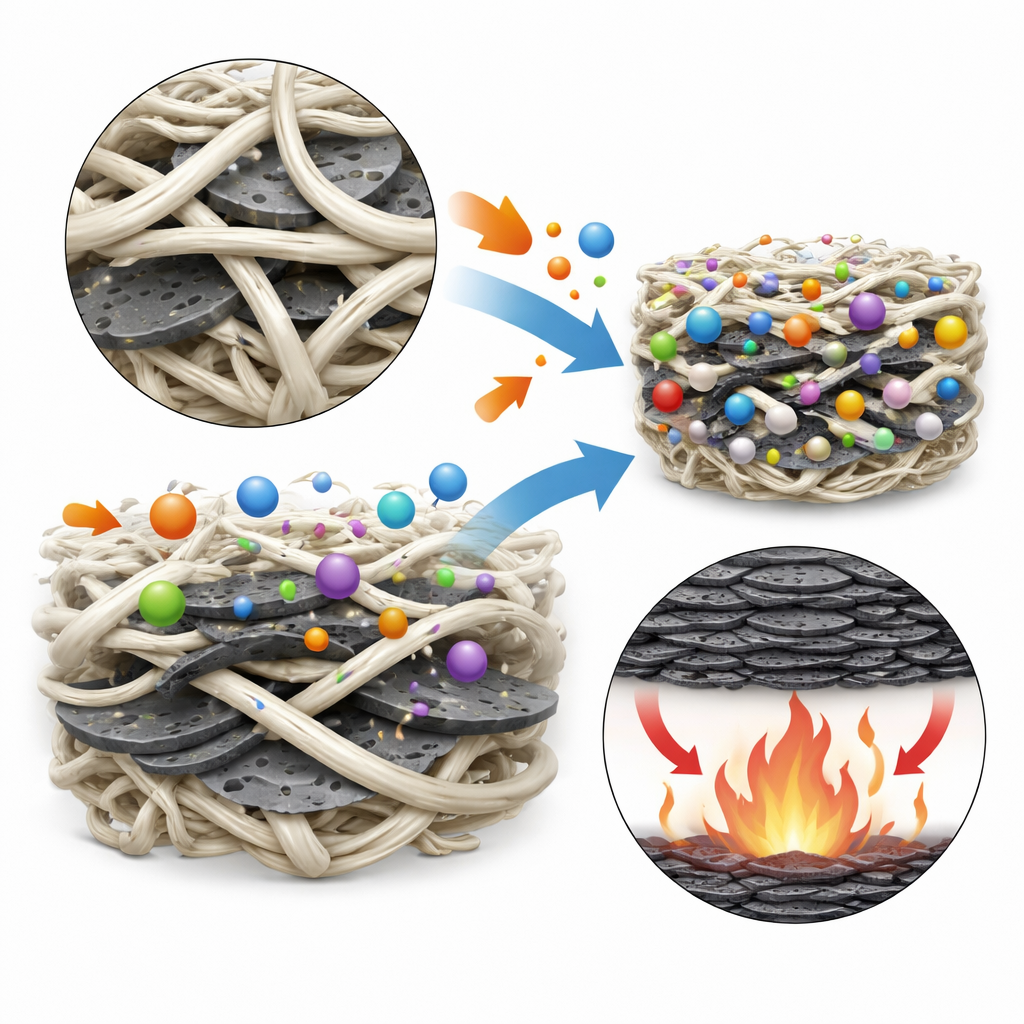
The researchers started with bacterial cellulose, a web of tiny plant-like fibers made by microbes, prized for being renewable, non-toxic, and highly porous. On its own, however, it is not ideal for capturing oily pollutants and can be easily damaged by heat. To boost its performance, the team combined this cellulose network with graphene oxide, a carbon material made of ultrathin sheets decorated with oxygen-containing groups. When mixed in water and then freeze-dried, the two ingredients interlock into a three-dimensional, feather-light aerogel with a maze of pores and channels. By adjusting the mixing ratios (from equal parts to cellulose-rich blends) and how vigorously the mixtures were homogenized, the scientists tuned how evenly the graphene oxide spread through the cellulose scaffold and how strong and open the resulting structure would be.
Tuning the Surface for Selective Soaking
Simply blending the two components was not enough. The key to turning these aerogels into powerful pollution sponges lay in "reducing" the graphene oxide, which means removing many of its oxygen groups to make the surface more carbon-rich and water-repelling. The team tried several strategies: chemical treatments with hydrazine or ethylenediamine, greener routes using vitamin C (ascorbic acid), and exposure to hydrogen gas at high temperature. Some methods were applied while the aerogel was already formed, others before shaping. Each route altered how hydrophobic the material became, how many defects formed in the carbon sheets, and how tightly the carbon and cellulose bound to each other. Measurements of surface area, pore size, and chemical signatures showed that the right treatment could dramatically increase the internal area available for trapping liquids while keeping the porous network intact.
Soaking Up Solvents Again and Again
To test performance, the aerogels were placed in various organic liquids and oils, including common industrial solvents and model oils, both alone and mixed with water. The best-performing sample, a cellulose-rich aerogel labeled rGO/BC-90G, first used vitamin C to reduce graphene and then a small linker molecule to tie the carbon and cellulose together. This version reached a surface area more than twice that of the untreated composite and was able to absorb over 100 times its own weight in certain solvents—up to about 116 grams of dichloromethane per gram of aerogel. Other versions were tailored to be strongly water-repelling, so they would float on water and selectively draw in oil or solvent droplets while leaving the water behind. Importantly, these aerogels could be squeezed out or dried and reused at least five times, still retaining the majority of their original absorption capacity, making them more practical for real-world cleanup.
Standing Up to Heat and Flames
Beyond soaking up spills, the new materials also needed to be safe in hot or hazardous settings. The team used controlled heating tests to see how the aerogels lost weight as they decomposed, which revealed how the cellulose and carbon components broke down and how strongly they were bonded. Aerogels with higher graphene content were more thermally stable, and certain reduced versions, especially those crosslinked after reduction, held up particularly well. Direct flame tests showed that while pure bacterial cellulose burned readily, the optimized nanocomposites formed a protective char layer, resisted burning, and even shielded delicate flowers placed beneath them during the experiment. This combination of heat resistance, mechanical stability, and light weight is attractive for situations where fire risk and chemical spills can occur together.
New Tools for Cleaner Water
Overall, this work demonstrates that carefully engineered mixtures of bacterial cellulose and graphene-derived carbon can serve as recyclable, high-capacity sponges for organic solvents and oils that also withstand heat and flames. By fine-tuning how the carbon is reduced and how it is linked to the cellulose network, the researchers created aerogels that selectively soak up pollutants from water, can be reused multiple times, and remain structurally robust. For non-specialists, the takeaway is that combining a natural fiber network with smart carbon chemistry yields a promising new class of eco-friendly materials for cleaning up contaminated water and managing industrial spills more safely and sustainably.
Citation: Khalili, E., Heidari, H. rGO/BC nanocomposite aerogels exhibit recyclable adsorption of organic solvents and oils with enhanced flame resistance. Sci Rep 16, 11819 (2026). https://doi.org/10.1038/s41598-026-41010-7
Keywords: oil spill cleanup, graphene aerogels, bacterial cellulose, water remediation, reusable absorbents