Clear Sky Science · en
Creatine increases muscle fiber size in embryonic chick muscle cells and age-dependent swimming performance in zebrafish
Why this study matters for everyday fitness
Creatine is one of the most popular supplements used by people looking to gain strength, preserve muscle with age, or boost athletic performance. Yet, studies in humans and animals have not always agreed on how well it works, especially in older bodies. This paper uses two different animal models—developing chick muscle cells in a dish and adult zebrafish in swimming tests—to ask a simple, practical question: how does creatine shape muscle size and movement across the lifespan?
Watching muscle grow in a dish
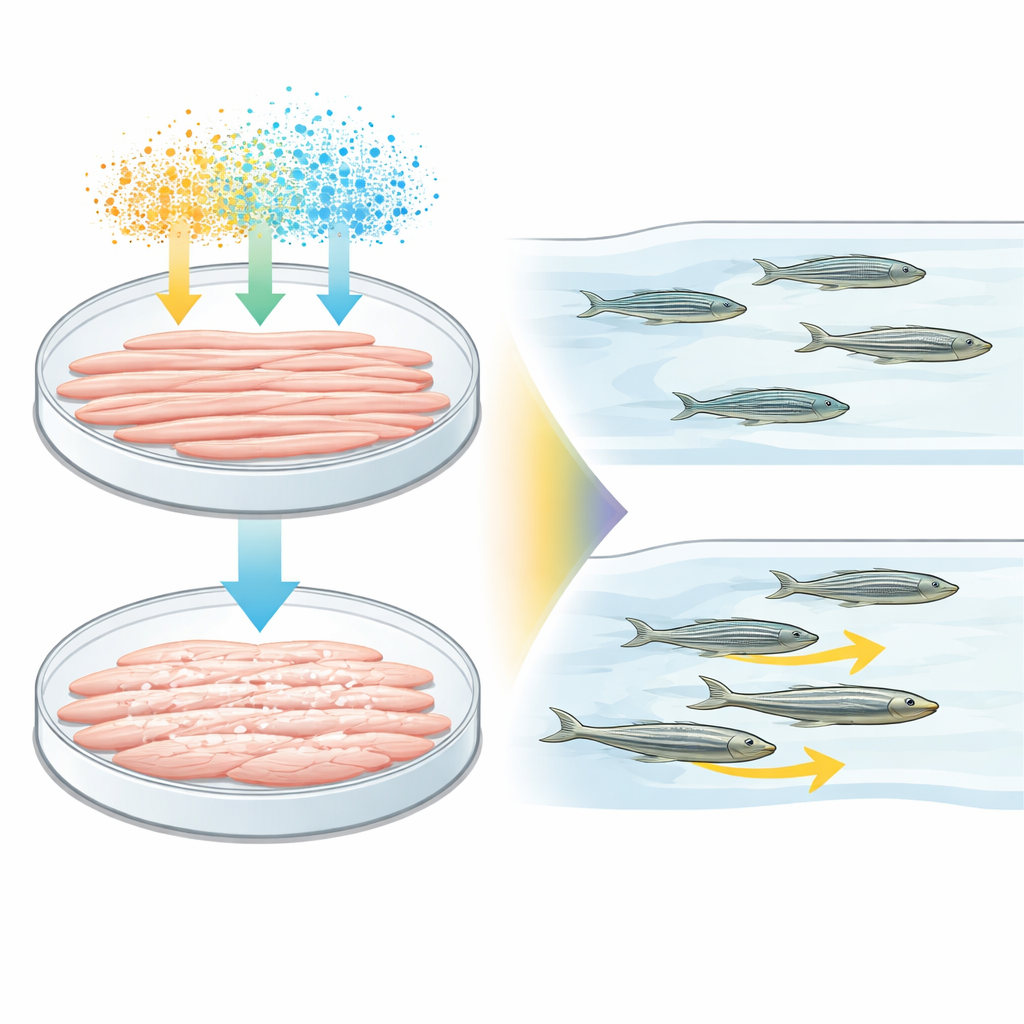
To isolate what creatine does directly to muscle cells, the researchers first turned to chick embryo muscle grown in laboratory dishes. In this simplified setting, muscle precursor cells naturally fuse into long, tube-like fibers similar to human skeletal muscle. When these cultures were given creatine at carefully chosen doses, the fibers became markedly thicker over 48 hours, without signs of toxicity. There were fewer separate fibers per viewing field, not because cells were dying, but because many small fibers seemed to have fused into fewer, much larger ones. Under high-resolution microscopes, these enlarged fibers showed clear internal stripes—the hallmark of mature, contractile muscle—indicating that creatine was encouraging full differentiation rather than producing oversized but poorly organized cells.
Protecting tired muscle powerhouses
Muscle health depends heavily on mitochondria, the tiny power plants that fuel contraction and, when stressed, can generate harmful reactive oxygen species. To probe whether creatine supports these powerhouses, the team challenged chick muscle cultures with rotenone, a compound that disrupts mitochondrial function and shrinks developing fibers. As expected, rotenone alone reduced the area occupied by muscle cells and impaired their fusion. Strikingly, when creatine was added alongside rotenone, fiber size and fusion largely rebounded toward normal, suggesting that creatine can buffer muscle cells against mitochondrial stress and oxidative damage. This protective role fits with a growing body of work showing creatine as not only an energy helper, but also a modest antioxidant in muscle tissue.
Testing swimming strength in a small fish
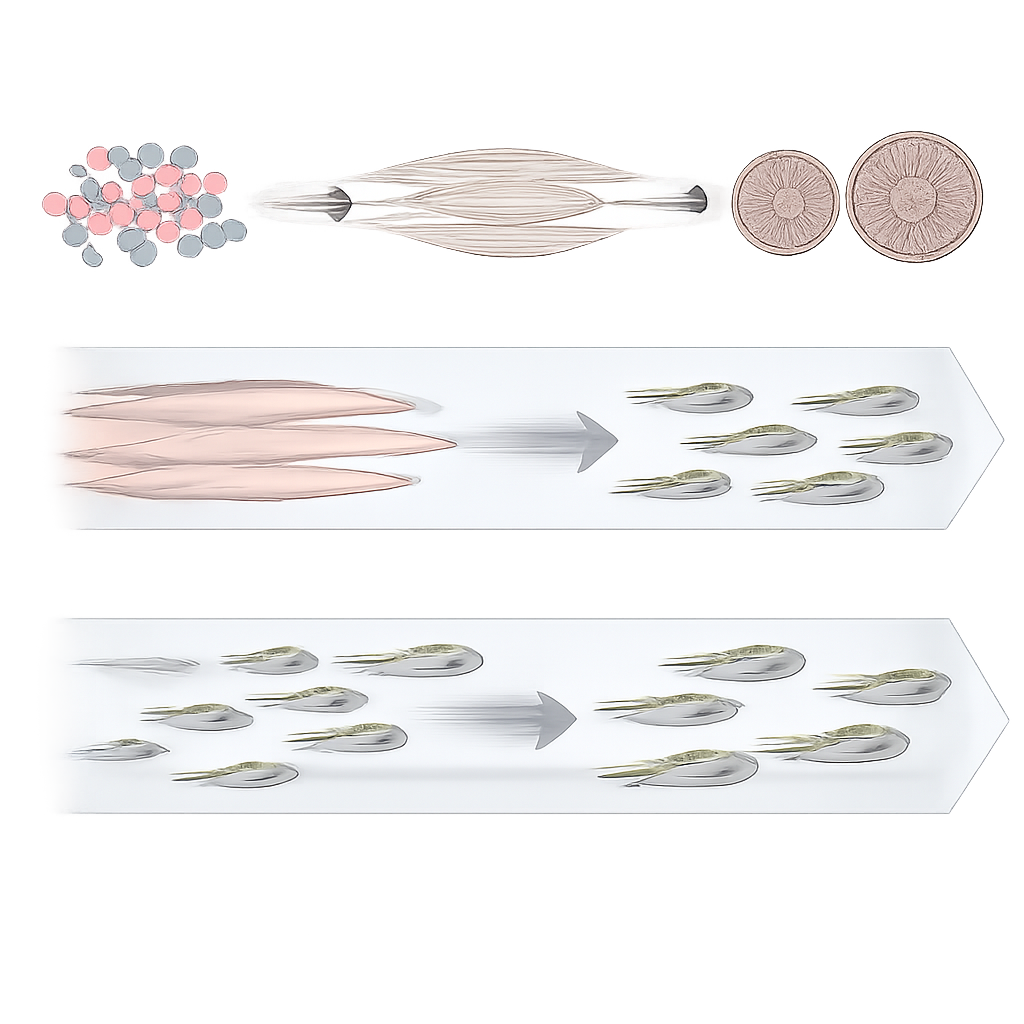
Next, the researchers asked how these cellular effects translate to whole-animal performance. They used zebrafish, a small tropical fish whose muscles and genes resemble our own in many key ways, and which naturally exercise by swimming. Young and aged adult fish were assigned to four groups: no treatment, creatine in the water, exercise training in a flowing tank, or both exercise and creatine for eight weeks. The team built a low-cost video system that tracks each fish in a narrow channel where water flows from left to right. Fish that can hold their ground against the current stay toward the left; those that tire drift to the right. From these positions they computed a simple “swimming score” for each condition and also examined muscle slices under the microscope to measure fiber cross-sectional area.
Different gains for young and old fish
In young zebrafish, creatine alone had little effect on swimming performance and only modestly increased muscle fiber size. Exercise training, with or without creatine, clearly boosted both fiber size and the ability to resist the current, underscoring the dominant role of physical activity in already-healthy adults. In aged fish, the picture shifted. Over eight weeks, all active or supplemented groups outperformed sedentary controls, but creatine alone and exercise alone each gave the largest jump in swimming scores. Interestingly, in older fish, creatine by itself did not significantly enlarge muscle fibers, while exercise—with or without creatine—did. This suggests that in aging muscle, creatine may improve function through mechanisms other than sheer fiber size, such as better mitochondrial resilience and reduced oxidative strain.
What this means for muscle health with age
Taken together, the study shows that creatine can directly promote the formation of large, well-structured muscle fibers in developing cells and can shield muscle tissue from mitochondrial stress. In whole animals, its benefits depend on age and activity level: in young, active fish, exercise is the main driver of performance, whereas in older fish, creatine alone can noticeably improve swimming ability even without clear growth in fiber size. For a layperson, the message is that creatine is not a magic shortcut to fitness, but it may be a valuable ally—especially later in life—by helping muscles stay functional and resilient, particularly when combined with regular exercise.
Citation: Vieira, P.d., Spineli, M.N., Bagri, K.M. et al. Creatine increases muscle fiber size in embryonic chick muscle cells and age-dependent swimming performance in zebrafish. Sci Rep 16, 10237 (2026). https://doi.org/10.1038/s41598-026-41008-1
Keywords: creatine supplementation, muscle aging, zebrafish exercise, mitochondrial health, muscle hypertrophy