Clear Sky Science · en
Characterization of volcanic tuff pores pre- and post-underground nuclear detonation using ultra-small and small angle neutron scattering
Why the Hidden Spaces in Rock Matter
Far beneath Nevada’s desert, past nuclear tests have left more than cavities in volcanic rock. They have also changed the rock’s invisible inner structure—the tiny pores and fractures that control how radioactive gases move toward the surface. This study peeks into those hidden spaces using beams of neutrons, revealing how underground nuclear explosions subtly rework the rock and what that means for detecting future tests from afar. 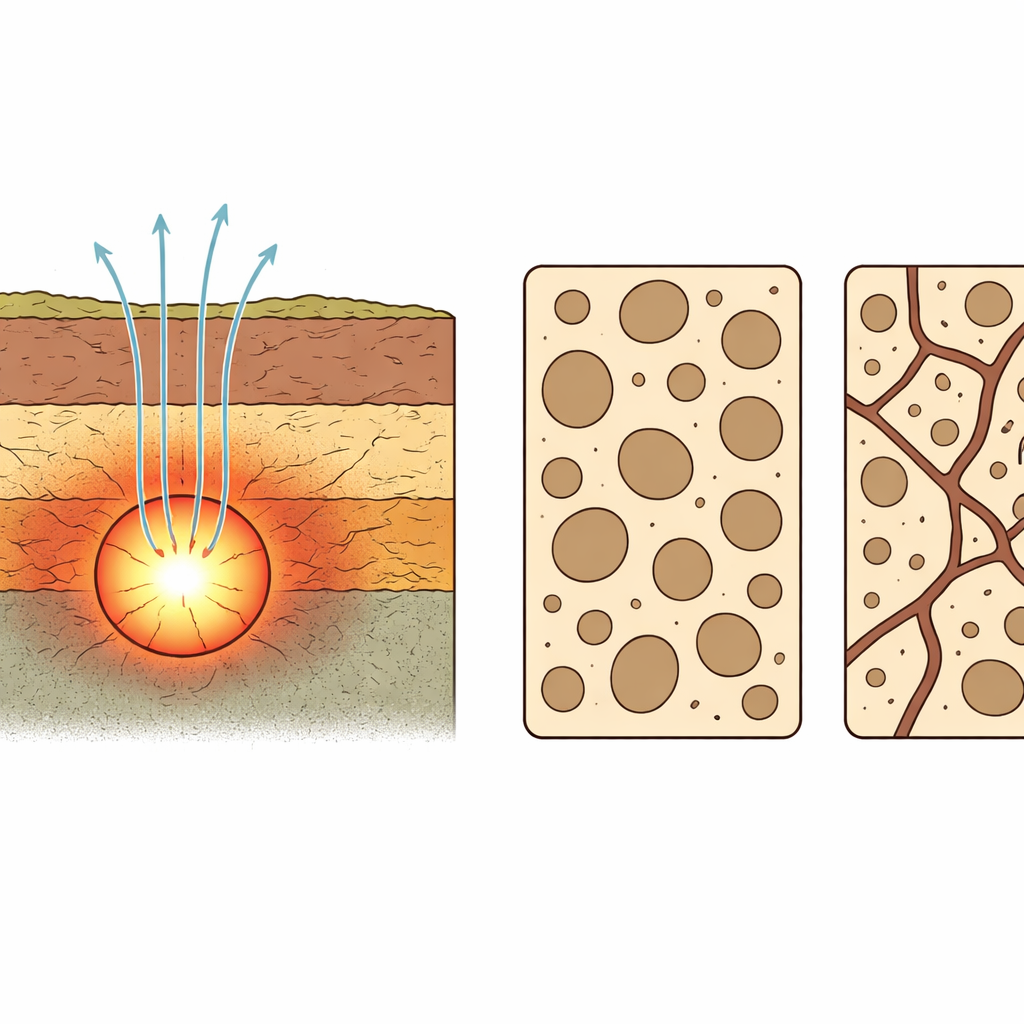
Peering Inside Rock with Neutrons
Instead of drilling ever more holes or relying only on large cracks and faults, the researchers focused on the rock’s fine-scale plumbing, from billionths of a meter to a few millionths of a meter across. They examined slices of five types of volcanic rocks, called tuffs and lavas, taken from the Nevada National Security Site. For each rock type they compared samples collected before a specific underground nuclear test (“pre-shot”) with material recovered afterward from near the blast (“post-shot”). To see inside without breaking the samples apart, they used ultra-small and small angle neutron scattering, techniques in which a beam of neutrons passes through a rock slice and the way the beam is deflected reveals the size, amount, and connectivity of pores and fractures.
Different Rocks, Different Damage
The neutron data showed that not all rocks respond to an explosion in the same way. In most of the tuff and lava types that could be fairly matched before and after the test, the total nanometer-to-micrometer pore space and the internal surface area decreased after the explosion. That pattern points to partial “pore crush,” where some of the finest pores collapse or are sealed. However, some rocks closer to the blast source, such as a rhyolitic lava, showed very strong signs of pore loss, while a weak, glassy tuff type showed almost no change at these small scales. One zeolitic tuff even appeared to gain pore space and surface area, but those samples came from very different depths and degrees of alteration, so natural geological differences may be masquerading as explosion effects. 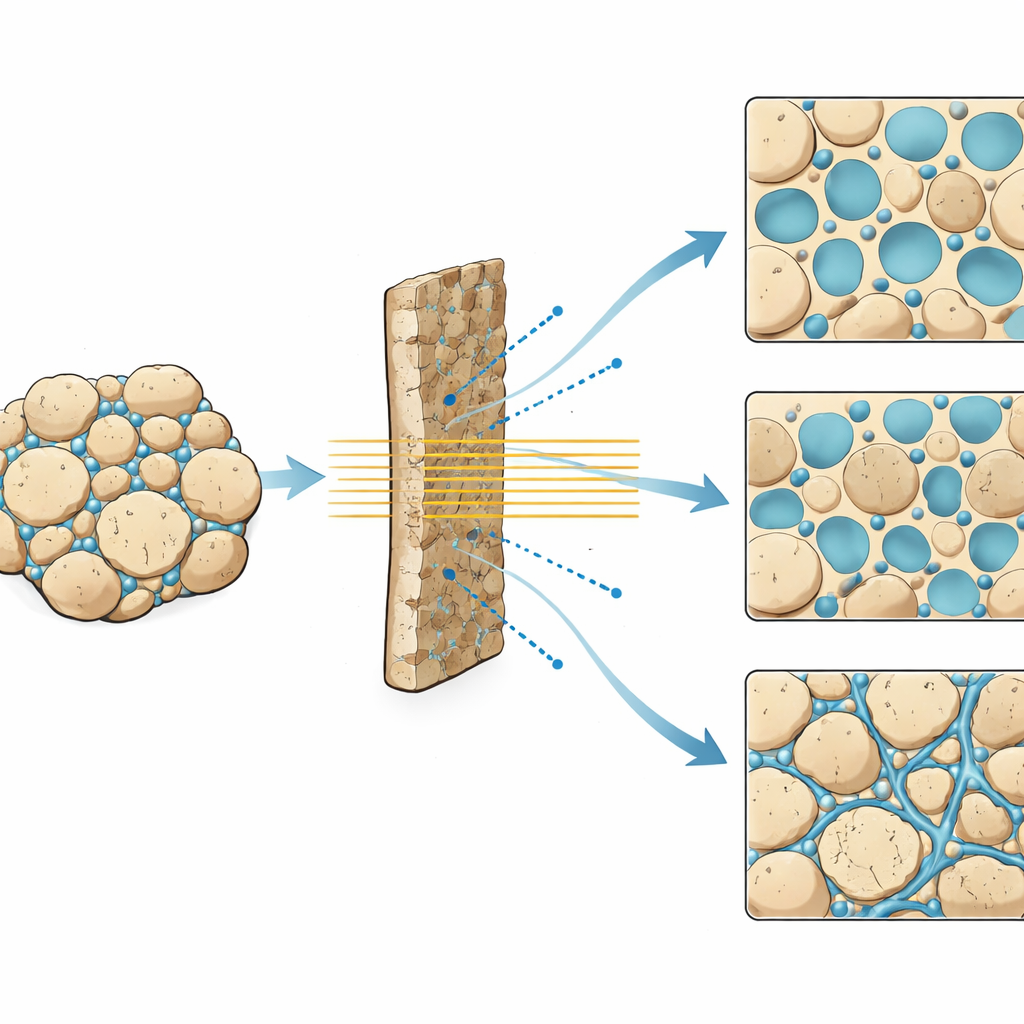
When Less Pore Space Means Easier Gas Flow
On its face, less pore space and less internal surface might suggest that gases from an explosion would have a harder time moving through the rock. Yet larger-scale measurements on the same formations tell a more complicated story. Core-scale tests show that, after the explosion, the overall ease with which fluids move—permeability—increased in every rock type studied. The authors reconcile these findings by proposing that crushing many tiny pores can concentrate stress and encourage the growth of new microfractures that link previously isolated pores. These new connections form a more efficient highway for gases, even though there may be less total void volume. Earlier microscopic work at the same site supports this idea, having documented an increase in small fractures that cut through grains in post-explosion samples.
From Pore Changes to Nuclear Test Detection
Understanding these subtle changes matters because monitoring underground nuclear tests relies on predicting when and where radioactive gases will leak to the surface. Models used today often treat the damaged rock zone around an explosion rather simply, without fully accounting for how different rock types deform at tiny scales. The new neutron-based measurements provide concrete numbers for pore sizes, surface areas, and porosity across several Nevada-relevant lithologies. Feeding these small-scale properties into larger computer models—alongside gas flow and geologic layering—should improve predictions of gas migration and the narrow time windows when detection is possible.
Toward Clearer Signatures Underground
The study concludes that underground nuclear explosions leave a measurable fingerprint in the nanoscale pore structure of surrounding volcanic rocks, generally reducing tiny pores and internal surface while still boosting larger-scale permeability through added microfractures. At the same time, the authors emphasize that natural alteration and rock variability can mimic some of these signals. They call for a broader “decision framework” that combines pore-scale neutron data, microscopic fracture observations, and mineral changes across many samples to better separate explosion-induced damage from normal geologic history. With such an approach, the quiet reshaping of pores deep underground could become a powerful, physical signature for identifying and characterizing underground nuclear tests.
Citation: Ding, M., Hjelm, R.P., Hawley, M.E. et al. Characterization of volcanic tuff pores pre- and post-underground nuclear detonation using ultra-small and small angle neutron scattering. Sci Rep 16, 10109 (2026). https://doi.org/10.1038/s41598-026-40996-4
Keywords: underground nuclear explosions, volcanic tuff, rock porosity, neutron scattering, radionuclide gas transport