Clear Sky Science · en
Presence-gated VOC sensing for urban search and rescue applications
Smelling Survivors When Sight Fails
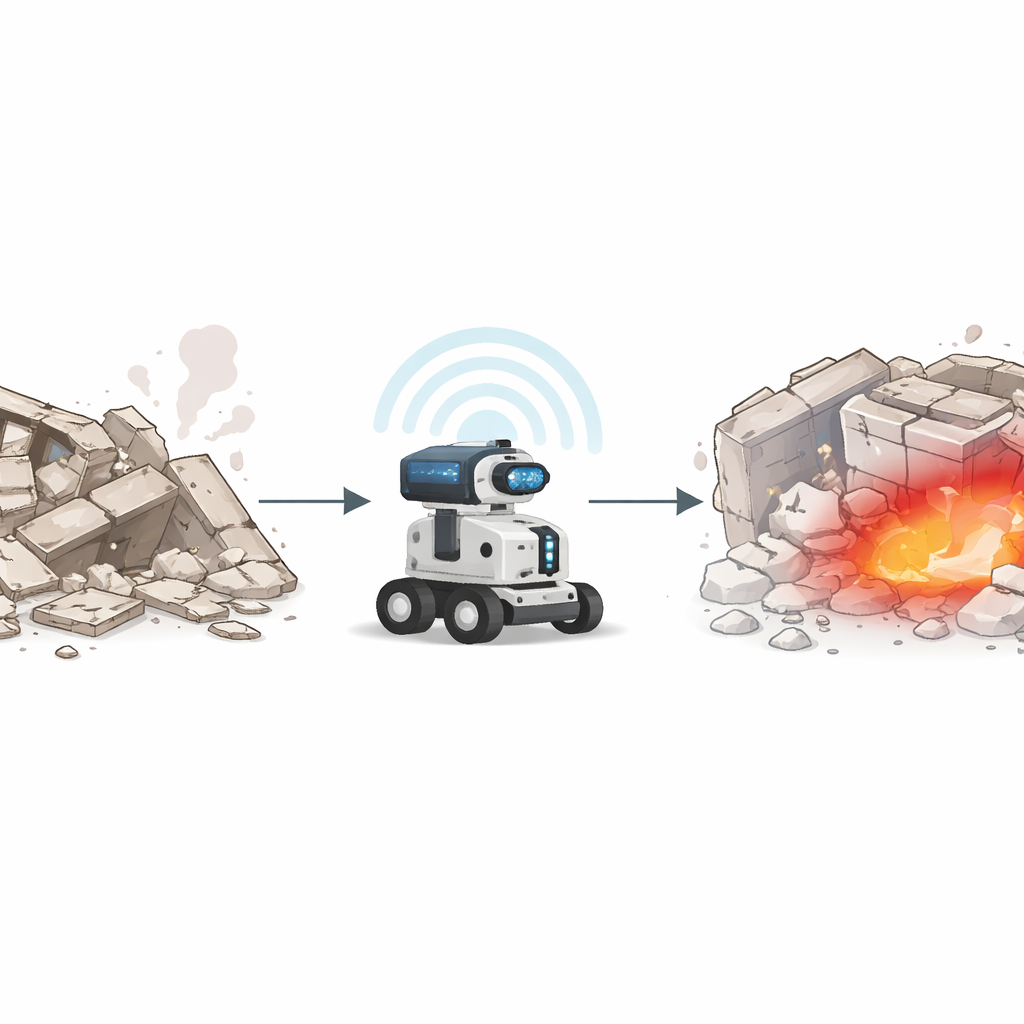
After an earthquake or building collapse, rescuers often work in darkness, dust, and smoke, where cameras and heat sensors struggle to see through rubble. This paper describes a new handheld system designed to help locate trapped people by "smelling" faint chemical traces from the human body while also checking for signs of life with radar. The goal is not to replace existing tools, but to add another simple cue that can guide rescuers or robots toward places where survivors are most likely to be found.
Why Smell Matters in Disaster Zones
Traditional search tools rely heavily on line of sight: video cameras, thermal imagers, and microphones all need a relatively clear path to the victim. In real disasters, dust clouds, debris piles, and twisted metal often block that path. By contrast, many gases released from human breath, skin, and wounds can seep through small cracks and porous rubble. Earlier studies have shown that mixtures of compounds such as ammonia, sulfur-containing gases, and certain aldehydes form a recognizable scent pattern around injured or trapped people. Instead of hunting for a single "magic" molecule, the new device reads this broader chemical fingerprint, much like a simplified electronic nose.
Combining a Mechanical Nose with a Silent Radar
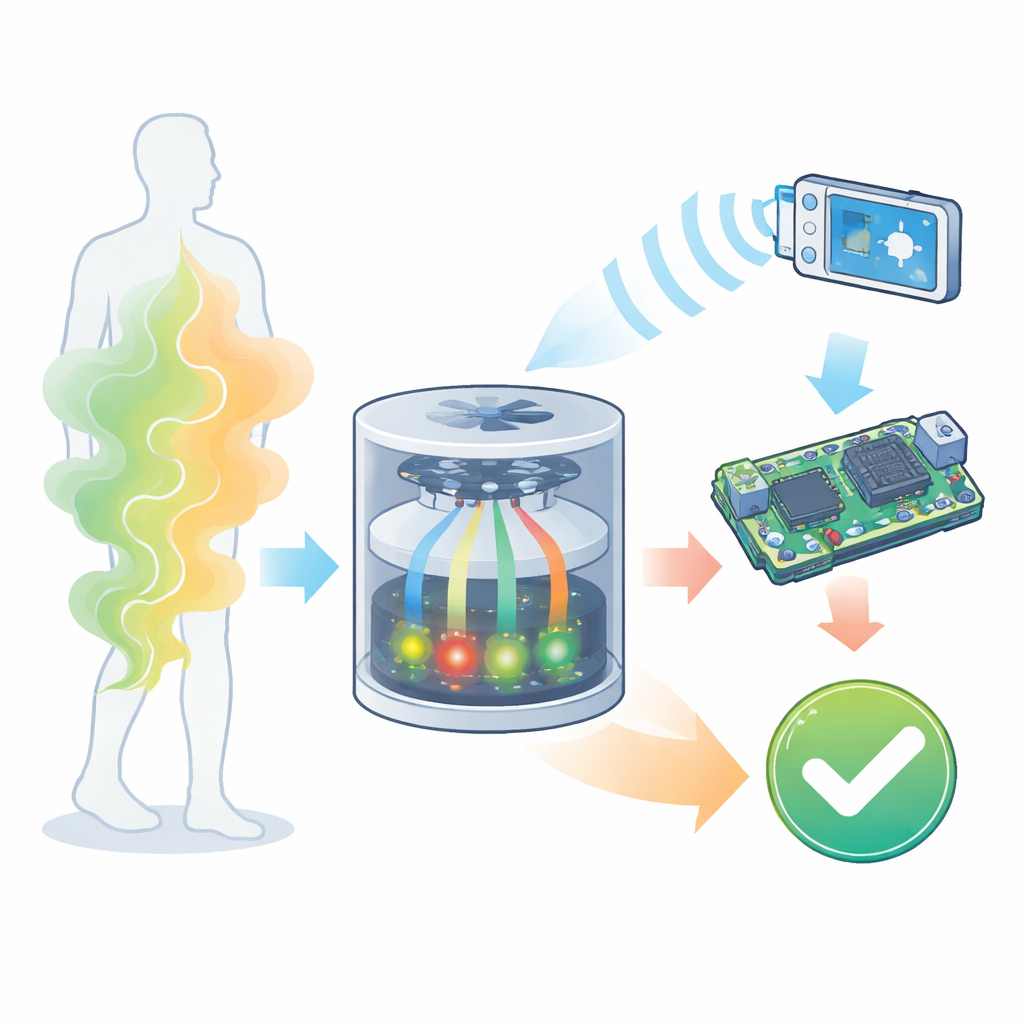
At the heart of the system, called SmellTec, is a small chamber packed with several low-cost gas sensors. A tiny fan actively pulls air through a short path into this chamber, holds it briefly for analysis, and then flushes it out in a repeating intake–hold–purge cycle. This controlled airflow makes the readings more stable than passive sniffing. Alongside the gas sensors, a separate chip monitors temperature, humidity, and pressure so that the device can correct for changing weather and reduce slow drifts that would otherwise mimic genuine chemical signals. All the raw readings are then distilled into simple numerical features that can be handled by a modest microcontroller similar to those found in consumer gadgets.
How Presence Gating Reduces False Alarms
One major challenge in gas-based search is that many everyday sources—cleaning products, exhaust, or leaking fuel—can confuse a purely chemical detector. To address this, the authors add a 24 gigahertz radar module that looks for tiny movements such as breathing or a faint heartbeat. This radar can sense motion through light debris and thin walls. The system only raises a full alarm when two things happen in the same short time window: the gas pattern looks injury-like and the radar confirms that something nearby is moving like a living person. If the chemical signature appears without motion, the alert is blocked, treating it as background pollution rather than a likely victim.
Testing the Device in a Controlled Setting
The researchers first verified that the full chain—airflow control, sensor corrections, feature extraction, and decision making—can run reliably on a battery-powered microcontroller. They then collected about two thousand brief samples in the lab under four controlled conditions: clean room air, ammonia, propane, and a gas mixture meant to mimic the smell of injury. Using these data, they trained and evaluated simple decision-tree and random-forest models. The device could clearly separate strong gas exposures like propane from clean air, while the most common confusion occurred between clean air and the injury-like mixture, where chemical differences were subtle. Importantly, the study treated these tests as a check of instrument behavior, not as proof that the system can diagnose real wounds or medical states.
What This Means for Future Rescues
The work shows that a compact, low-power gadget can fuse chemical sniffing with motion-sensing radar and still make timely decisions at the edge, without cloud connections. In practice, that means a rescuer or small robot could sweep a collapsed structure and receive guidance toward areas where both suspicious gases and signs of life are present, while many harmless chemical whiffs are safely ignored. The authors stress that large-scale field trials, better-targeted sensors, and richer data will be needed before such a tool can be trusted for medical judgments. Even so, this presence-gated sensing approach points toward a new class of search aids that extend human senses into places where eyes and ears alone cannot reach.
Citation: Tanggono, E.N., Mokhtarzadeh, A.A., Balasubramaniam, K. et al. Presence-gated VOC sensing for urban search and rescue applications. Sci Rep 16, 10305 (2026). https://doi.org/10.1038/s41598-026-40990-w
Keywords: urban search and rescue, electronic nose, gas sensors, radar sensing, disaster robotics