Clear Sky Science · en
Synergistic effects of meropenem, amikacin, and ciprofloxacin against carbapenem resistant Pseudomonas aeruginosa isolates
Why stubborn hospital germs matter
For many seriously ill patients, a routine hospital stay can be overshadowed by a hidden danger: infections that no longer respond to our best antibiotics. This study investigates one such troublemaker, Pseudomonas aeruginosa, a hard-to-treat germ that strikes people in intensive care units, burn wards, and cancer centers. The researchers asked whether combining three existing antibiotics could outsmart strains that have become highly resistant, offering a potential lifeline where treatment choices are running out. 
Tracking dangerous infections in real patients
The team collected 70 Pseudomonas aeruginosa samples from patients in three large hospitals in Shiraz, Iran, over a four‑month period. The bacteria came from many types of infections, including blood, sputum, wounds, and urine, and from high‑risk areas such as intensive care and emergency wards. After confirming the identity of each bacterial isolate, the researchers tested how well 11 commonly used antibiotics—and colistin, a last‑resort drug—could stop the growth of these germs. They also examined the bacteria’s DNA to look for known resistance genes that let microbes break down powerful drugs called carbapenems.
How resistant were these hospital germs?
The results were sobering. More than one‑third of the bacterial samples were resistant to carbapenems, a key class of antibiotics often used when others fail, and these carbapenem‑resistant strains were strongly linked with broader multidrug resistance. Worryingly, nearly three‑quarters of all samples were resistant to colistin, a drug usually reserved for the most desperate cases, suggesting that this final line of defense is faltering in this setting. On the other hand, some drugs such as meropenem, ceftazidime, and ciprofloxacin still worked against a majority of isolates, highlighting that not all Pseudomonas infections are equally difficult to treat.
Putting three drugs together in the lab
To see whether a clever use of existing medicines could overcome resistance, the researchers focused on eight particularly stubborn isolates that did not respond well to carbapenems alone. In laboratory tests, they combined meropenem, amikacin, and ciprofloxacin in a three‑dimensional “checkerboard” layout, varying the dose of each drug step by step. By measuring the smallest combination of doses that stopped bacterial growth, and comparing those values to single‑drug performance, they could classify the interaction as helpful (synergy), neutral, or harmful (antagonism). 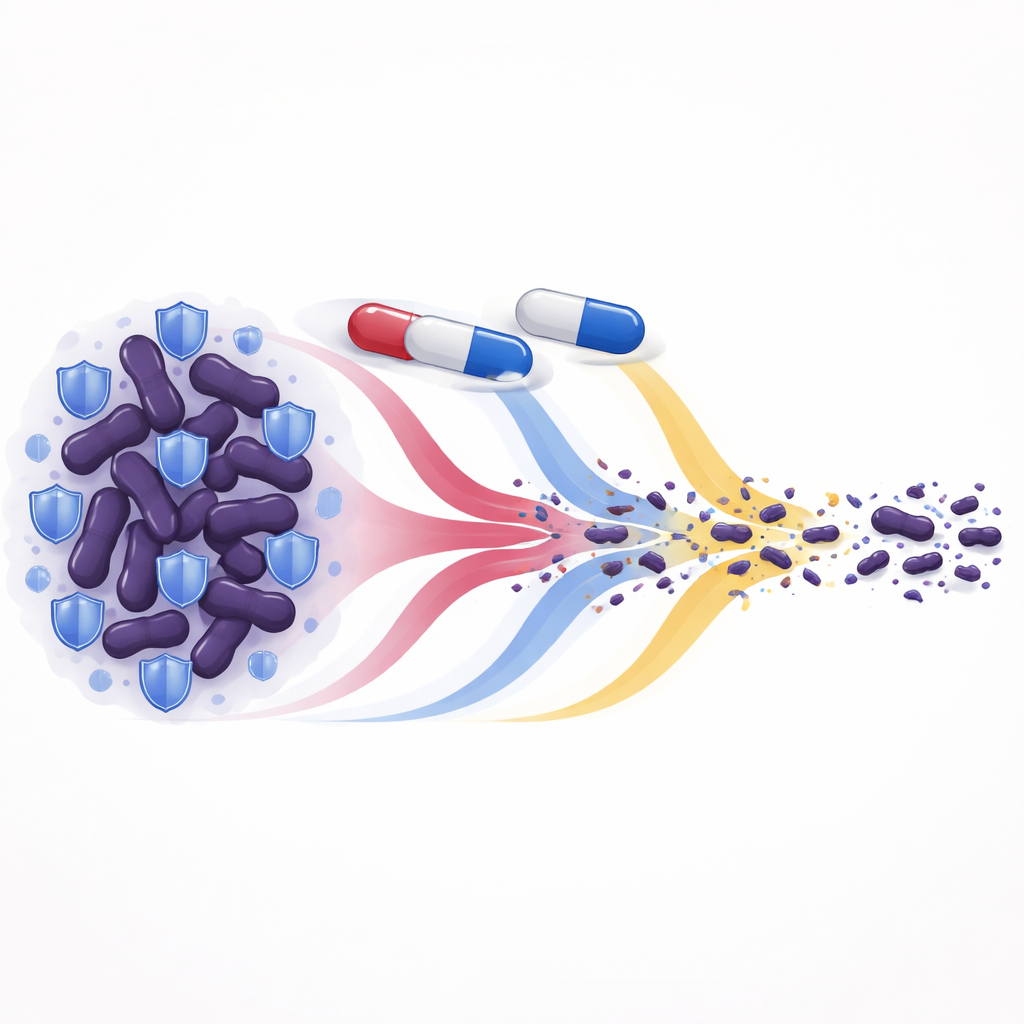
When teamwork between drugs helps—and when it does not
The triple‑drug mix showed hopeful signs: in five of the eight resistant isolates, the three antibiotics worked better together than any one alone, meaning that lower doses of each drug were enough to stop growth. The analysis suggested that synergy was most likely when, in the combined treatment, the required doses of amikacin, ciprofloxacin, and meropenem stayed below modest thresholds. When very high amounts of meropenem were needed to affect a strain, however, the three‑drug combination was less useful or even counter‑productive. This pattern hints that the success of combination therapy depends on how resistant a particular infection is at the start.
What this means for patients and doctors
For non‑specialists, the take‑home message is that some hospital germs have become so resistant that even last‑line antibiotics may fail, but there is still room for smarter strategies. This study shows that using three existing drugs together can, in some cases, weaken highly resistant Pseudomonas aeruginosa more effectively than any single medicine, at lower doses. However, the work was done in test tubes with a small number of samples, not in patients, and the authors stress that their findings are not ready to become treatment guidelines. Instead, they provide a promising starting point for larger clinical studies to see whether carefully chosen drug combinations can reclaim ground in the ongoing battle against hospital‑acquired infections.
Citation: Fooladfar, Z., Rafati Zomorodi, A., Parvizi Mashhadi, M.H. et al. Synergistic effects of meropenem, amikacin, and ciprofloxacin against carbapenem resistant Pseudomonas aeruginosa isolates. Sci Rep 16, 10044 (2026). https://doi.org/10.1038/s41598-026-40988-4
Keywords: antibiotic resistance, Pseudomonas aeruginosa, hospital infections, combination therapy, carbapenem resistant bacteria