Clear Sky Science · en
Research on damage size effect of cemented paste backfill under high sand-cement ratio conditions
Why the Size of Underground Support Matters
Modern mines often pump a kind of man‑made rock, called cemented paste backfill, into empty tunnels to keep the ground from collapsing. This material is made from leftover crushed rock (tailings), water, and a small amount of cement. For safety, engineers need to know exactly how strong this backfill is—but that turns out to depend not only on what it is made of, but also on the size and shape of the blocks they test in the lab. This study asks a simple but important question: when we change the proportions of sand and cement and the shape of the test block, how much do our strength measurements drift away from the true strength of the material buried deep underground?
How Mines Use Waste Rock to Stay Safe
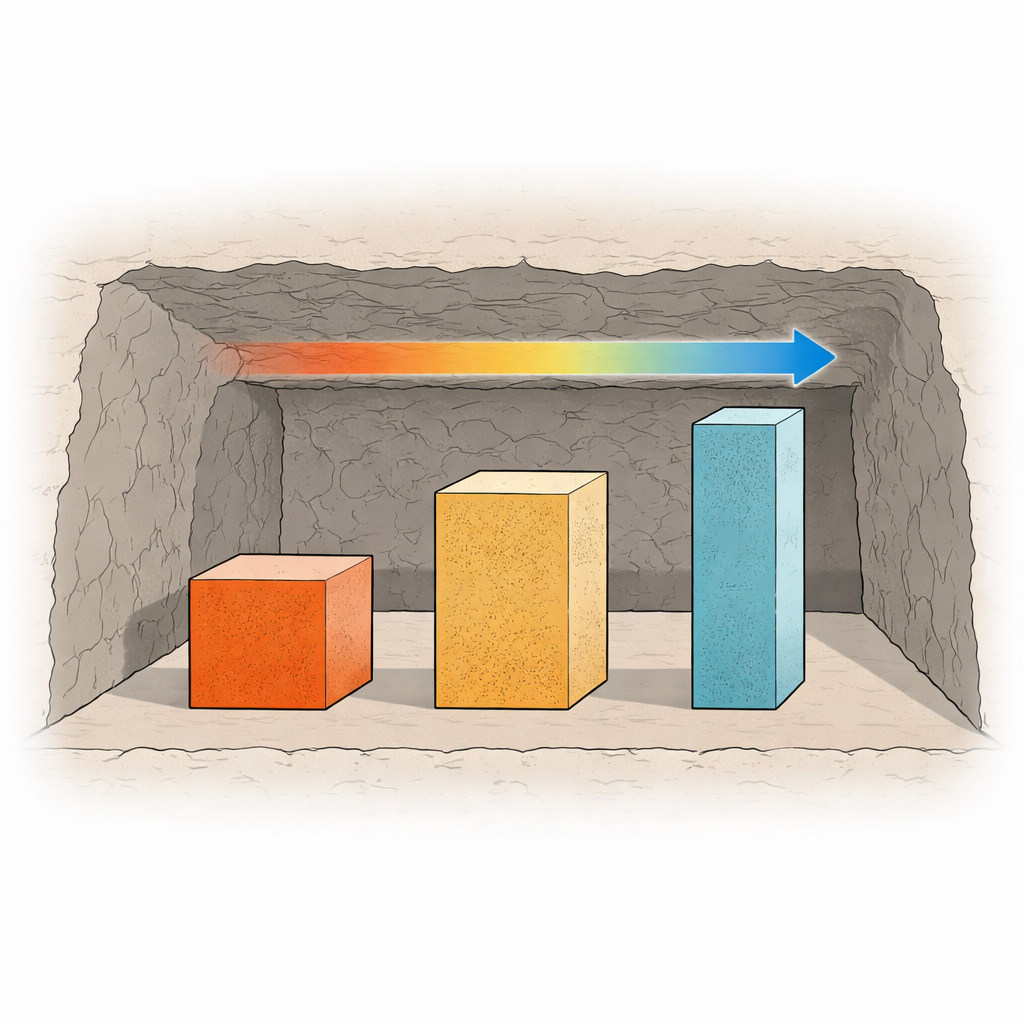
In backfill mining, waste rock from ore processing is mixed with water and cement, then pumped into empty underground spaces. Once hardened, this material supports the roof and walls, allowing more ore to be removed without causing dangerous collapses. The strength of this hardened paste—its ability to resist squeezing and crushing—directly affects how wide and tall engineers can make the underground rooms. Because many mines use mixtures with a lot of sand and very little cement (high sand–cement ratios) to save costs, the resulting material can be relatively weak. Measuring such low strengths accurately on standard testing machines is difficult, so researchers often change the size or shape of their lab samples. That convenience, however, can quietly distort the results.
Testing Different Shapes and Mixes
The authors prepared many blocks of cemented paste backfill using three sand‑to‑cement ratios (from 8:1 up to 24:1) and three solid contents (71–73 percent), mirroring real mine conditions. They focused on three simple shapes with different height‑to‑width ratios: a short, squat block, a cube, and a tall, slender column. After 28 days of curing, each specimen was squeezed in a press until it failed. The team then used statistical tools to see how much each factor—mix proportion, solid content, and specimen shape—influenced the measured strength. They also built computer models with finite‑element software to peer inside the samples and visualize how stresses built up before failure.
What Shapes Reveal About Hidden Stresses
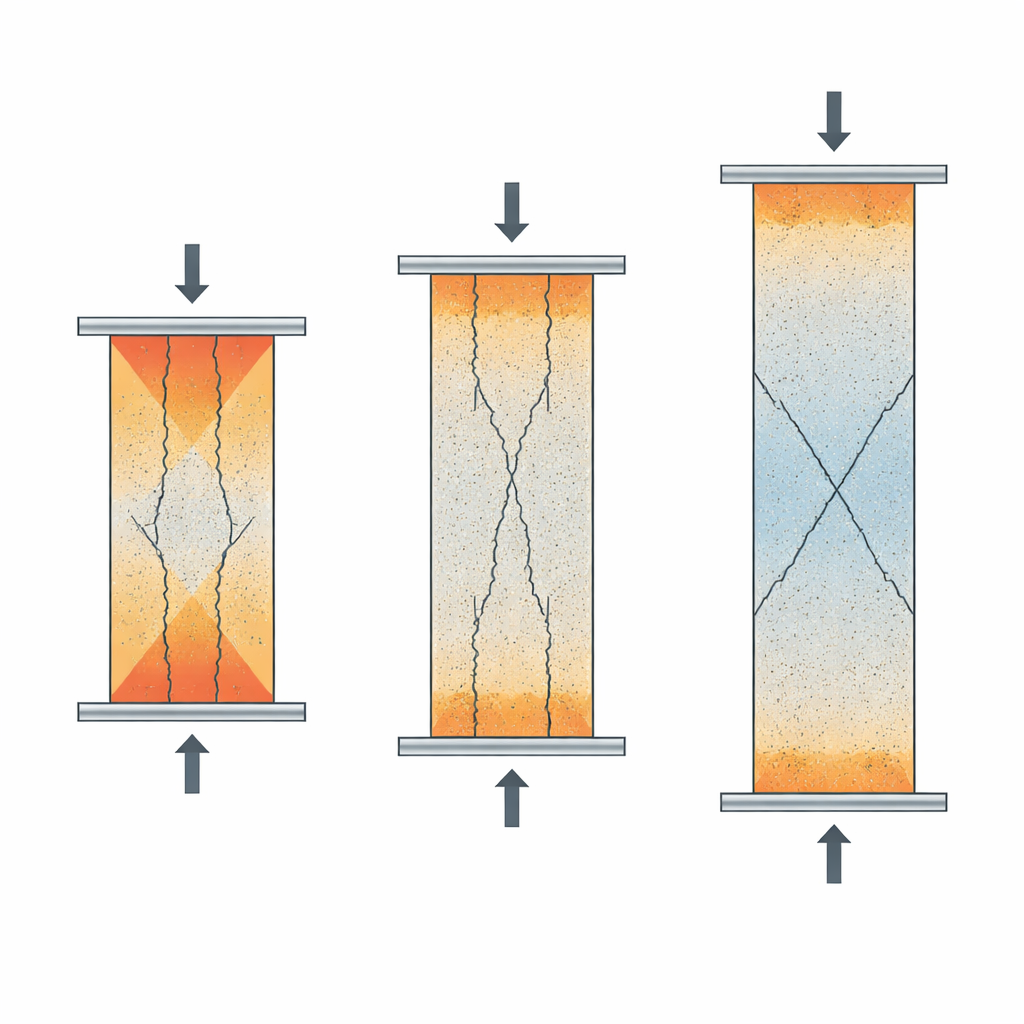
The tests showed clear trends. When the amount of cement decreased (higher sand‑cement ratio), strength dropped sharply—by as much as three‑quarters across the tested range—because there was less binding material to glue the grains together. Raising the solid content made the paste slightly stronger by reducing internal pores, but this effect was modest. The shape of the specimen, however, played a surprisingly large role: under the same mix and solid content, the short, squat blocks appeared strongest, the cubes a bit weaker, and the tall columns weakest. Careful observation of crack patterns revealed that short specimens tended to split vertically, while tall ones failed along X‑shaped diagonal lines, hinting at different internal stress states.
Why Short Blocks Look Stronger Than They Really Are
To understand these differences, the authors examined how the loading plates at the top and bottom of the specimens confined the material. In the shorter blocks, friction against these plates prevented the sides near the ends from bulging outward. This created strongly compressed cone‑shaped regions at both ends that overlapped in the middle, putting most of the material into a three‑dimensional squeezed state that makes it seem stronger than it truly is. In the tall columns, only thin zones near the plates were highly confined; the long middle section felt mostly one‑directional squeezing, more like the stress the backfill experiences underground. Computer simulations confirmed this picture, showing intense stress concentrations near the ends of short blocks and more uniform stress in the center of tall ones.
Turning Lab Results into Real‑World Strength
Because the tallest specimens are least distorted by these end effects, their measured strength most closely reflects the true strength of the backfill in the mine. Using the full set of test data, the researchers built mathematical relationships that translate the measured strength of short or cubic specimens into equivalent values for tall specimens. These conversion formulas, valid for the tested ranges of mix and solid content, provide a practical toolkit for engineers: they can keep using convenient specimen sizes in the lab, then correct the results to better match real in‑mine behavior. In doing so, the study helps ensure that underground support is neither under‑designed, which would threaten safety, nor over‑designed, which would waste cement and money.
Citation: Jiang, D., Li, H. & Sun, G. Research on damage size effect of cemented paste backfill under high sand-cement ratio conditions. Sci Rep 16, 11215 (2026). https://doi.org/10.1038/s41598-026-40983-9
Keywords: cemented paste backfill, mine ground support, size effect, sand–cement ratio, compressive strength