Clear Sky Science · en
High energy 1.53-cycle pulses via homogeneous post-compression in a single thin-plate
Why shrinking light pulses matters
Light pulses that last just a few quadrillionths of a second already underpin cutting‑edge research, from watching electrons move to driving compact particle accelerators. This work shows how to make such flashes even shorter—down to barely more than one cycle of a light wave—while keeping their energy high and their beam clean. Doing this with a simple piece of glass instead of a bulky, complex setup could help laboratories worldwide access extreme light for studying matter on its fastest time scales.
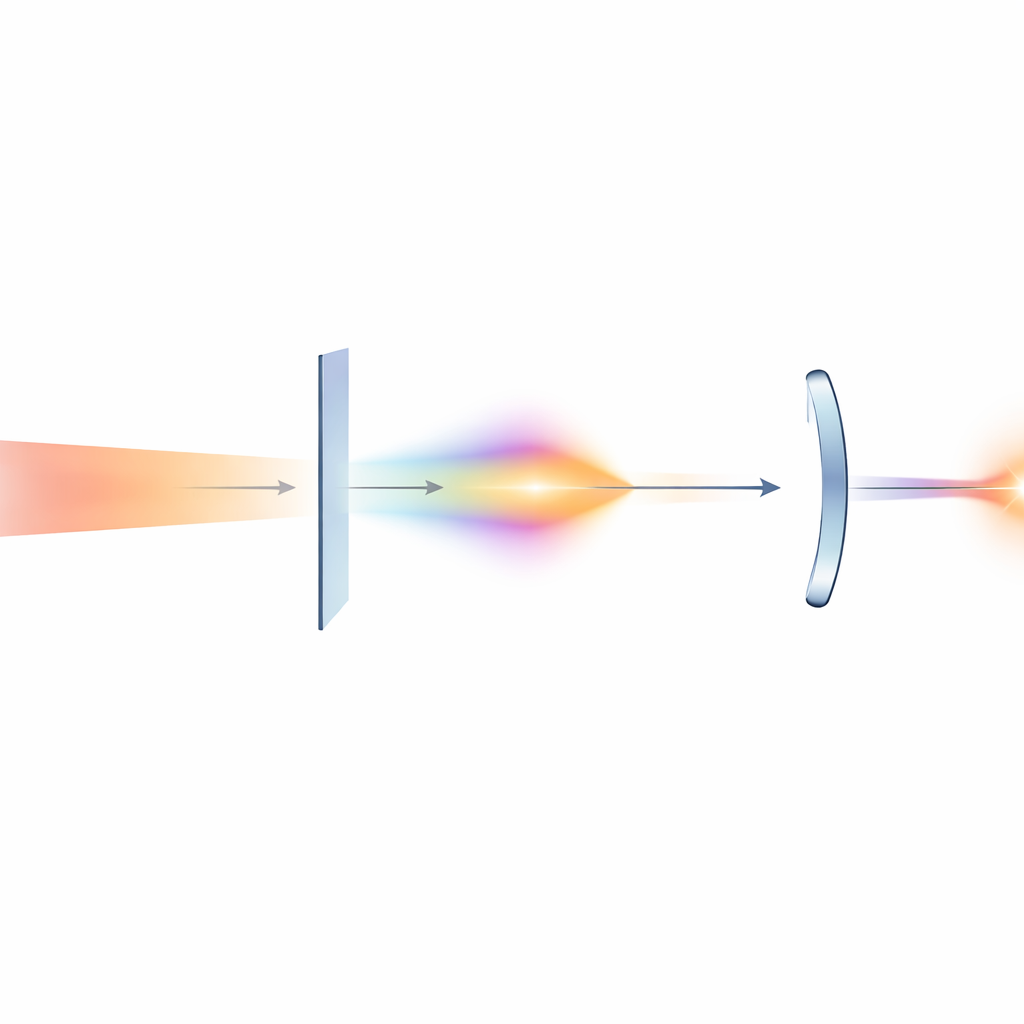
Turning a long flash into a tiny burst
The authors start with an advanced laser system that delivers very short, high‑energy pulses: 5 millijoules of energy packed into 7.7 femtoseconds at a wavelength near 800 nanometres. Rather than passing this beam through long gas cells or elaborate optical paths, they send a wide, flat‑topped beam into a single thin plate of fused silica glass only 1 millimetre thick. Inside the glass, the intense light slightly changes the material’s refractive index as the pulse passes, twisting the colour of the light in time. This self‑induced effect spreads the pulse’s spectrum across a wider range of colours, which in principle allows the pulse to be squeezed shorter in time.
Controlled broadening without messy side effects
When pulses are stretched too aggressively, their spectrum can become ragged, making them hard to recompress cleanly. Here, the team deliberately works in a moderate regime: the spectrum broadens by up to about a factor of three, but remains smooth, with only tiny ripples. At the most extreme setting, the spectrum could in theory support pulses as short as about 2.8 femtoseconds—just over a single cycle of the light field. For practical operation, they choose a slightly less extreme broadening that still yields sub‑4‑femtosecond pulses while avoiding the constant high stress on the glass that very intense operation would bring.
Squeezing and measuring the light wave
After the glass plate, the broadened pulse is sent through a compact compressor made of specially designed mirrors and thin glass wedges that introduce just the right delays for each colour. Using a precise measurement technique based on generating the second harmonic of the pulse and scanning its dispersion, the researchers reconstruct the pulse’s shape in time. They demonstrate pulses as short as 3.8 femtoseconds, corresponding to about 1.5 oscillations of the light field, with roughly two‑thirds of the ideal peak power preserved. A straightforward computer model that treats the beam as uniform in space successfully reproduces the measured spectra and main pulse features, showing that the complex process can be captured with relatively simple calculations.
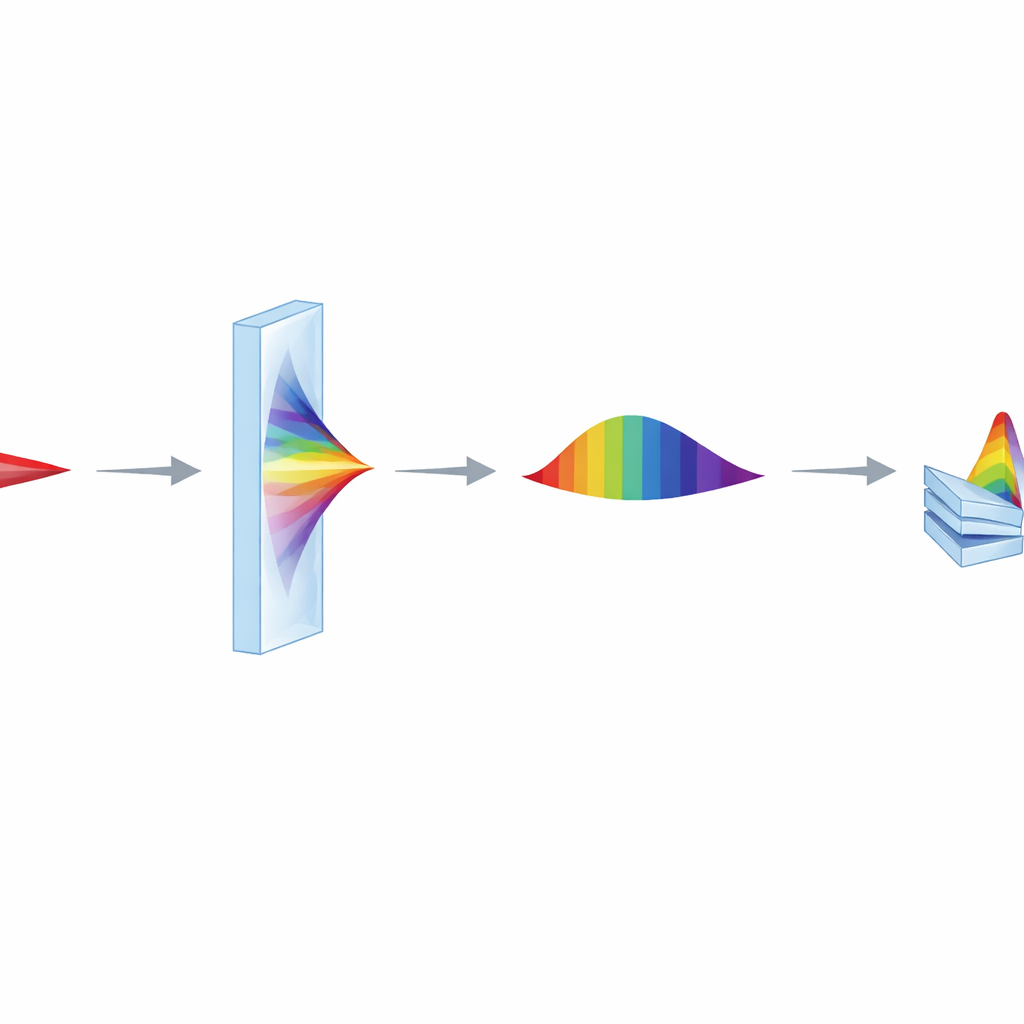
Keeping the beam clean and focused
Ultra‑short pulses are only useful if they can be tightly focused onto a target. Intense light in a solid can easily distort the beam’s shape, but the flat‑topped input profile helps keep the broadened spectrum nearly the same across the beam: the spatial‑spectral uniformity remains better than 97 percent. The authors also analyse the wavefront—the detailed shape of the beam’s phase—and find that although some distortions appear, especially astigmatism, these can be largely corrected using a deformable mirror. With this adaptive optic engaged, the beam’s focus quality, expressed as the Strehl ratio, reaches 0.88 even after strong nonlinear interaction, meaning most of the energy still lands in a sharp central spot.
What this means for extreme light science
By showing that a single, thin glass plate can turn already short, energetic pulses into nearly one‑cycle bursts while keeping the beam smooth and well focusable, this study points to a compact route toward even more powerful “few‑cycle” light sources. Such pulses are especially valuable for generating attosecond flashes in gases and for driving efficient plasma‑based particle accelerators, where performance improves strongly as pulse length shrinks. Because the setup scales naturally to higher energies and can be modelled with simple tools, it offers a practical blueprint for laboratories aiming to build next‑generation, ultra‑short, high‑energy laser systems.
Citation: Jansonas, G., Karvelis, D., Gadonaitė, P. et al. High energy 1.53-cycle pulses via homogeneous post-compression in a single thin-plate. Sci Rep 16, 10452 (2026). https://doi.org/10.1038/s41598-026-40980-y
Keywords: ultrashort laser pulses, spectral broadening, thin-plate post-compression, attosecond science, laser-plasma acceleration