Clear Sky Science · en
Crashworthiness and technoeconomic assessment of bioinspired GFRP PP tubes using experiments numerical modeling and artificial neural networks
Safer car fronts inspired by plants
When a car crashes, carefully designed parts at the front are meant to crumple in a controlled way so that people inside feel less of the hit. This study explores a new type of crash-absorbing tube inspired by bamboo and horsetail plants. By combining lightweight plastics and glass fibers, and adding modern computer tools, the researchers aim to make car structures that are both safer in a collision and cheaper to run over a vehicle’s lifetime.
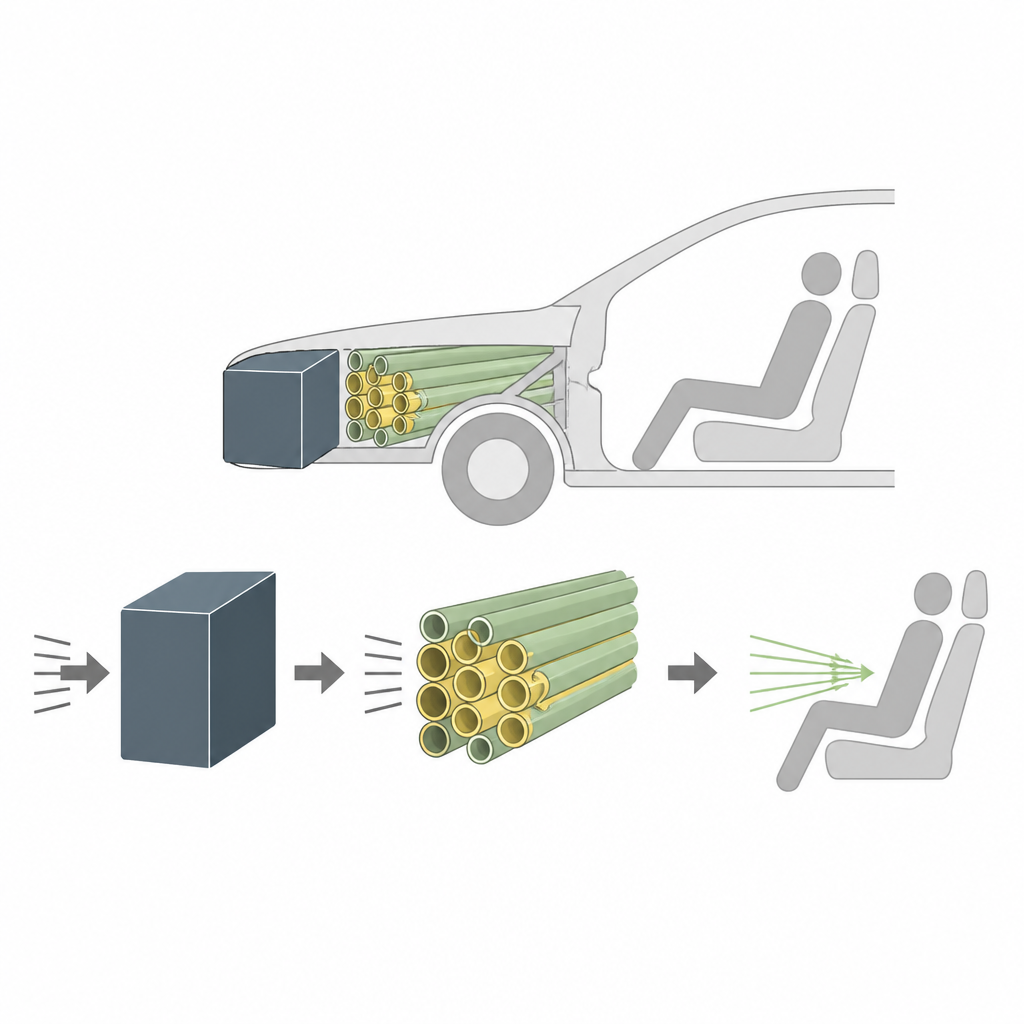
How plant-like tubes can tame a crash
The team focused on thin, hollow tubes that sit in the crush zone of vehicles and are meant to deform during a frontal impact. Instead of using solid metal, they built "sandwich" tubes made from an outer layer of polypropylene plastic and inner tubes made from glass fiber reinforced polymer, arranged in a pattern that echoes the layered, hollow structure of bamboo and horsetail stems. These tubes have a very high strength-to-weight ratio, meaning they can soak up a lot of crash energy for their mass, which is crucial for modern lightweight vehicles that must still protect passengers.
Putting the new tubes to the test
To see how these hybrid tubes behave, the researchers combined hands-on experiments with detailed computer simulations. They first made single plastic and glass fiber tubes in the lab and crushed them slowly in a testing machine to record how much force they could take and how much energy they absorbed as they folded or fractured. They then built and simulated 96 different sandwich tube designs, varying the wall thickness, overall height, and number of inner sub-tubes. Two key measures guided the work: the peak crushing force, which should be as low as possible to avoid a sharp jolt, and the specific energy absorption, which should be as high as possible so the structure gently soaks up the impact.
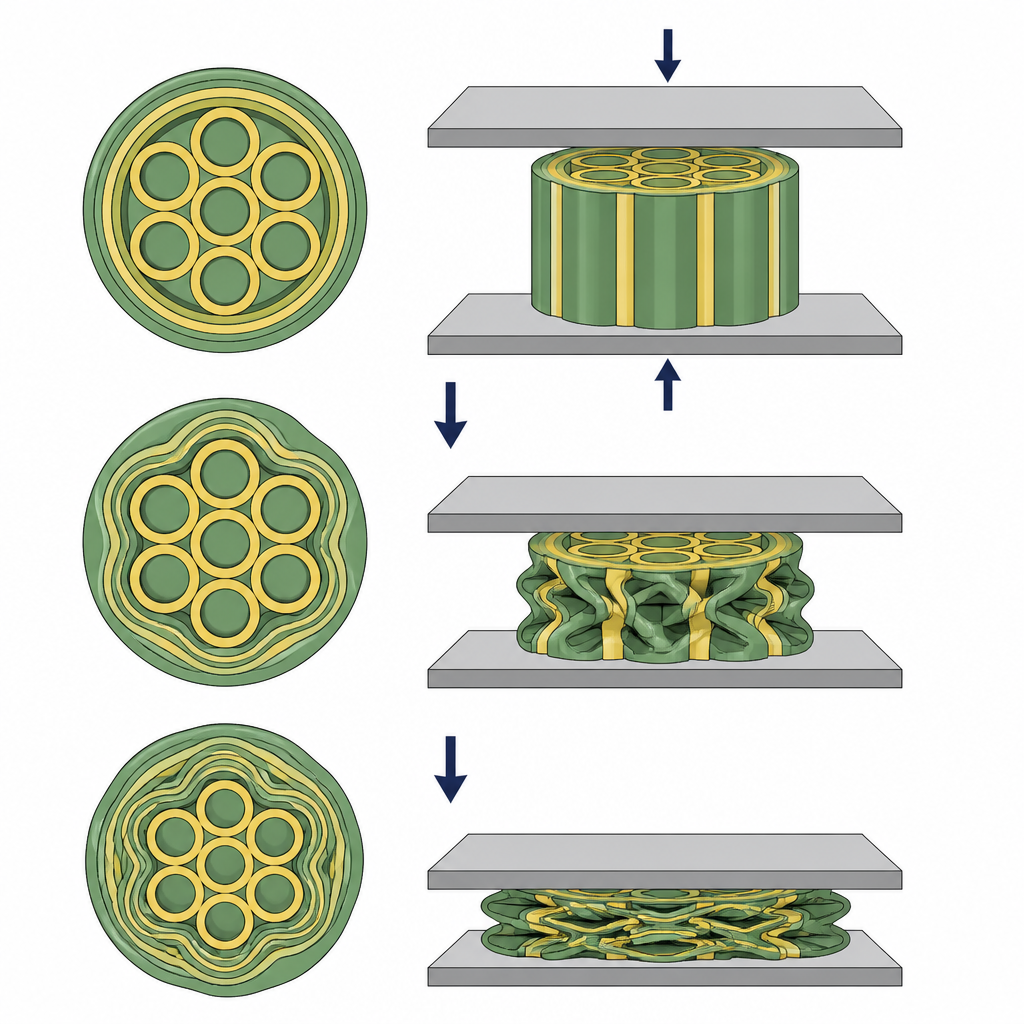
Letting algorithms search for the best design
Because trying every possible combination of tube sizes and layouts in the lab would be slow and costly, the team turned to machine learning. They trained an artificial neural network, a type of computer model that learns patterns from data, to predict peak force and energy absorption based on a tube’s geometry. Then they used a genetic algorithm, which imitates natural selection, to search through many possible designs and balance the two goals of low peak force and high energy absorption. This digital search pointed to an optimal tube: one with three glass fiber core tubes, a wall thickness of 1.2 millimeters, and a height of 80 millimeters. When the researchers actually built and crushed this design, its behavior closely matched both the simulations and the machine learning predictions.
Counting long-term costs and savings
The study did not stop at technical performance. The authors also asked whether swapping traditional steel or aluminum crash boxes for these glass fiber and plastic tubes would pay off over a car’s life. Using a standard financial tool called Net Present Value, they weighed higher upfront material and production costs against benefits like lower vehicle weight, reduced fuel use, and better crash energy absorption. Their calculations suggest that, over ten years of use, each car could yield a positive financial return when fitted with the lighter hybrid tubes instead of steel or aluminum crash structures, mainly thanks to fuel savings and durability gains.
What this means for future vehicles
In simple terms, the work shows that plant-inspired, glass fiber and plastic tubes can be tuned to crumple in helpful ways during a crash while also cutting weight and saving money over time. By blending physical tests, advanced simulations, and learning algorithms, the researchers found a design that absorbs a lot of energy without sending a violent spike of force into the rest of the car. Their economic analysis indicates that such tubes could be realistic options for automakers looking to build lighter, safer, and more efficient vehicles, making nature-inspired engineering a practical path toward safer roads.
Citation: Tian, Y., Zhou, P., Hassan, F.A. et al. Crashworthiness and technoeconomic assessment of bioinspired GFRP PP tubes using experiments numerical modeling and artificial neural networks. Sci Rep 16, 15592 (2026). https://doi.org/10.1038/s41598-026-40978-6
Keywords: crashworthiness, bioinspired structures, composite tubes, vehicle safety, techno economic analysis