Clear Sky Science · en
Intelligent tool wear monitoring using XGBoost, SVR, and DNN models in NMQL environment
Why this matters for real-world manufacturing
Every product that relies on high-performance metals—from jet engines to power plants—depends on sharp, long-lasting cutting tools. But machining tough alloys often chews through tools, wastes energy, and demands large amounts of oil-based coolant. This study shows how combining tiny carbon-based particles in a "green" oil with modern artificial intelligence can both extend tool life and make machining cleaner and smarter.
Making a tough metal easier to shape
The researchers focused on Hastelloy X, a nickel-based superalloy prized for its strength and heat resistance but notorious for being difficult to cut. Under normal conditions, machining this metal generates intense heat and friction, which quickly damage cutting tools. Traditionally, manufacturers rely on copious cutting fluids to keep tools cool and lubricated, but these fluids can be messy, expensive, and environmentally problematic. As a more sustainable alternative, the team used a strategy called minimum quantity lubrication, where only a tiny, precisely aimed mist of oil is sprayed into the cutting zone.
Boosting a green oil with nanotechnology
To make this low-oil approach effective on such a demanding material, the authors created a special lubricant by dispersing carbon nanotubes—cylindrical structures a few nanometers across—into a chemically modified palm oil. Careful preparation steps, including magnetic stirring, ultrasonication, and stabilizing additives, ensured the nanoparticles remained evenly suspended rather than clumping and settling. Optical measurements showed that a concentration of 0.6 percent nanotubes produced the most stable mixture, so this formula was chosen for detailed cutting tests on Hastelloy X.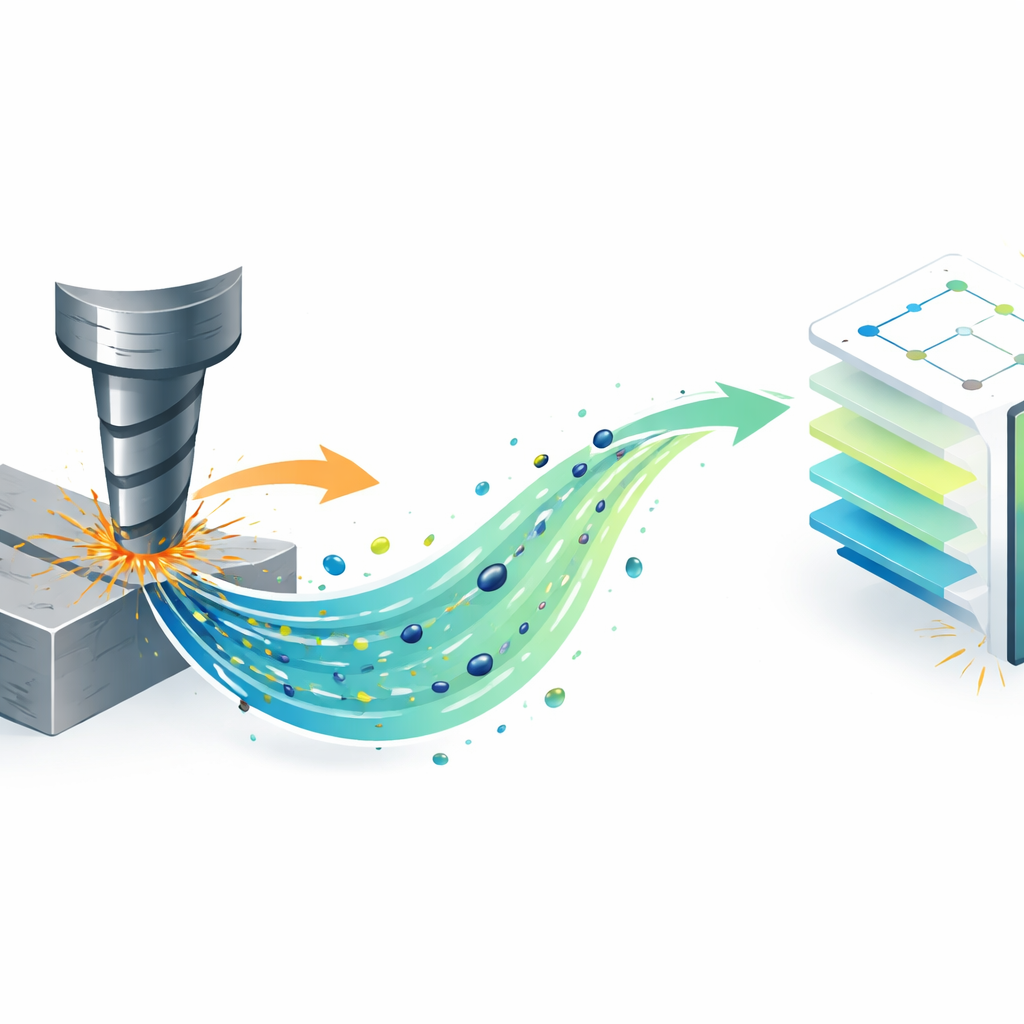
Watching tools wear down under different conditions
The team then carried out a series of milling experiments using coated carbide inserts to cut Hastelloy X plates on a computer-controlled machine. They compared several lubrication conditions, including dry cutting, compressed air, plain palm oil under minimum quantity lubrication, and the new nanotube-enriched oil. By examining the worn tools with microscopes and elemental analysis, they found that the dominant damage modes were adhesive wear, where fragments of the workpiece stick and tear at the tool surface, and abrasive wear, where hard particles scratch and groove the tool. With the carbon-nanotube lubricant at 0.6 percent, the maximum wear at the tool edge after 25 minutes of cutting was cut by nearly a quarter compared with dry cutting and substantially reduced compared with plain oil, thanks to better heat removal and a protective film at the contact zone.
Teaching machines to predict tool damage
Beyond improving lubrication, the study tackled a key Industry 4.0 challenge: predicting when a tool is about to fail so that it can be replaced just in time. Instead of mounting extra sensors, the researchers trained machine learning models to estimate tool wear directly from basic cutting settings: speed, feed rate, and depth of cut. They tested three advanced approaches—an ensemble method known as Extreme Gradient Boosting, a deep neural network with multiple layers, and a support vector regression model. All were trained on 81 experimental data points and tuned carefully. A statistical analysis showed that cutting speed had by far the strongest influence on wear, followed by feed rate, while depth of cut had little effect within the tested range.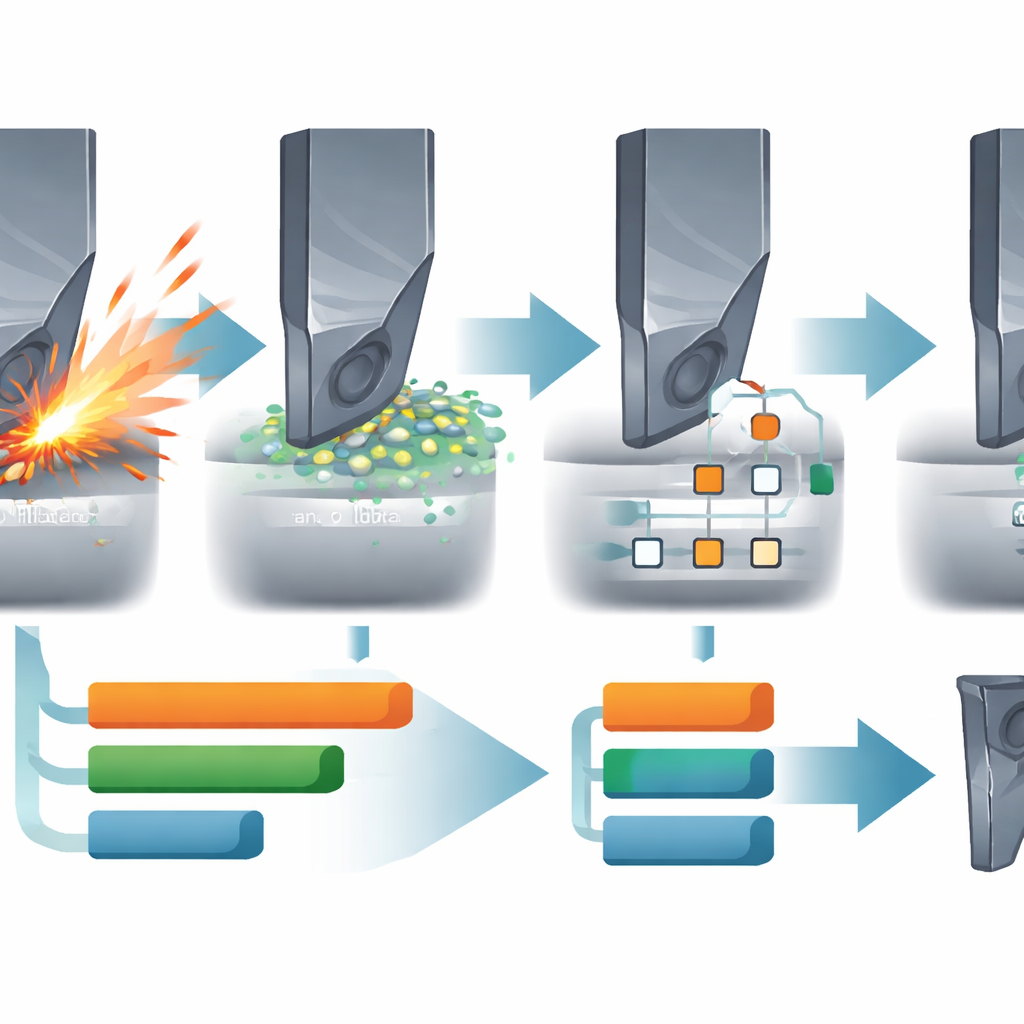
Finding the most accurate digital "wear forecaster"
When the models were compared, the boosting method stood out. Its predictions of tool wear matched the measured values extremely closely, with very small errors and a performance score (R²) near the theoretical maximum. The other two models, despite being powerful in principle, performed poorly on this particular dataset, sometimes doing worse than simply assuming a constant average wear. This contrast highlights that in practice, the right algorithm choice and data characteristics matter more than sheer model complexity.
What this means for cleaner, smarter factories
In simple terms, the study shows that a carefully engineered nano-enhanced green oil can keep cutting tools cooler and smoother, so they last longer when machining a notoriously stubborn alloy. At the same time, a well-chosen AI model can reliably forecast how quickly those tools will wear out, using only the basic machine settings. Together, these advances point toward machining systems that waste less lubricant, change tools only when needed, and maintain quality with minimal human intervention—an important step toward more sustainable, data-driven manufacturing.
Citation: Almomani, O., Venkatesh, B., Chaudhary, S.P. et al. Intelligent tool wear monitoring using XGBoost, SVR, and DNN models in NMQL environment. Sci Rep 16, 10030 (2026). https://doi.org/10.1038/s41598-026-40968-8
Keywords: tool wear prediction, nano-lubrication, Hastelloy machining, machine learning in manufacturing, sustainable metal cutting