Clear Sky Science · en
Two-stage-method-based calculation and analysis of the deformation of the existing subway tunnel caused by the diagonal crossing of the new tunnel
Why crossing subway tunnels matter to cities
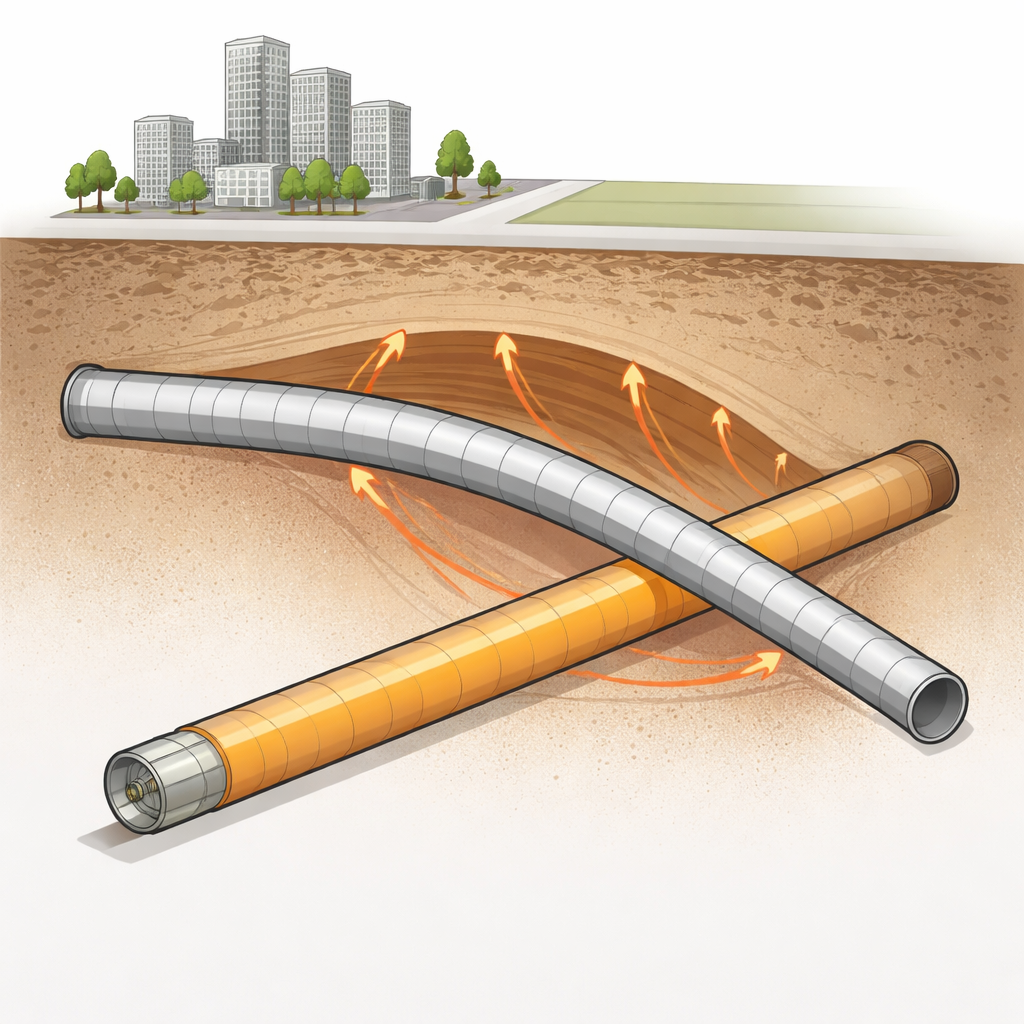
As cities grow and add new subway lines, fresh tunnels often have to weave past older ones already in service. Digging a new tunnel under a busy existing line risks nudging that older tunnel out of shape, which can affect ride comfort and long‑term safety. This study tackles a very practical question for urban planners and engineers: when a new tunnel cuts diagonally beneath a curved subway tunnel, how much will the existing tunnel move, and which design choices keep that movement small?
Breaking a complex underground problem into two steps
The authors propose a refined “two‑stage” calculation method that turns a messy underground construction problem into something that can be analyzed reliably on a computer. In the first stage, they estimate how much the ground around the existing tunnel is disturbed when a new shield‑driven tunnel is excavated below it. To do this, they use a well‑known solution from soil mechanics that describes how stress spreads through the ground from a buried load. This allows them to calculate the extra push and pull that the new tunnel excavation imposes on every point along the older tunnel, even when the two tunnels cross at an angle and the existing tunnel is curved rather than straight.
Treating the subway tunnel like a flexible beam in the ground
In the second stage, the existing subway tunnel is treated like a long, slightly flexible beam resting on an elastic bed that represents the surrounding soil. This bed not only compresses up and down, like many tiny springs, but also shears sideways, which makes the model more realistic while still being simple enough for routine design work. The calculated extra stresses from the first stage are applied along this beam to work out how much the tunnel bends and how far it moves vertically. The model also includes a “stress reduction factor” that accounts for zones where the soil around the tunnel has been strengthened by grouting, a common protective measure in subway construction.
Testing the method on a real subway project
To check whether the theory matches reality, the researchers applied their method to a real section of the Zhengzhou Metro, where a new line passed diagonally beneath an existing curved tunnel. They used local soil and tunnel properties, ran the calculations, and compared the predicted vertical movements with precise measurements taken during construction. The predicted maximum movement at the tunnel crown was slightly larger than the measured movement at the tunnel floor, which is expected because the roof generally deforms more. More importantly, the shape and size of the calculated deformation curve matched the monitoring data well, showing that the method can give engineers a dependable picture of what will happen underground.
Which design choices matter most underground
With the method validated, the authors explored how key design and construction parameters influence tunnel movement. They found that the vertical distance between the new and old tunnels has a clear effect: the closer the new tunnel passes beneath the existing one, the larger the upward movement of the older tunnel. The angle at which the tunnels cross is just as important. Shallow, almost parallel crossings cause larger deformations spread over a longer distance, while steeper, near‑right‑angle crossings significantly reduce the impact. By contrast, the curvature radius of the existing tunnel had very little effect on vertical movement, suggesting that moderate bends in plan are not a major concern in this type of crossing.
The role of ground strengthening around the tunnel
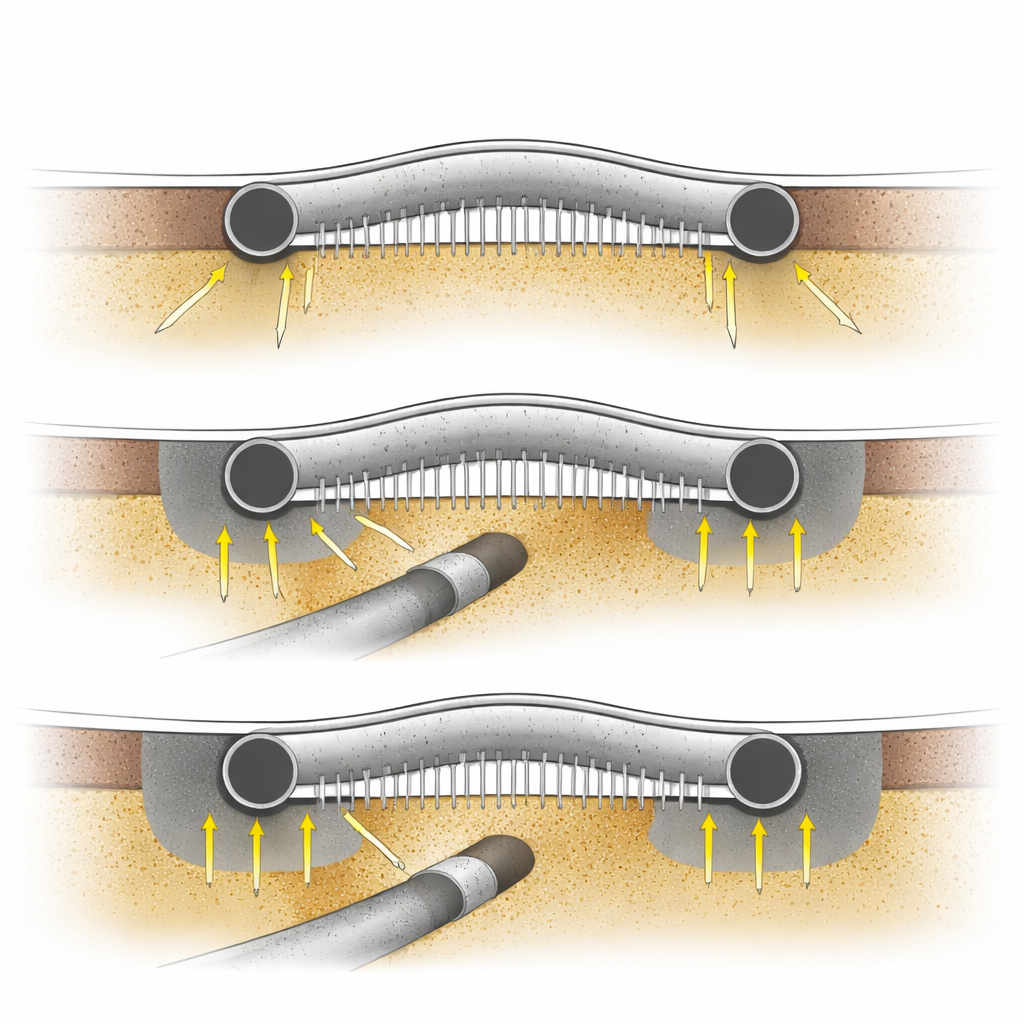
The study also examined how grouting—the injection of cement‑like material around the tunnel—helps control movement. Extending the grouted zone along the existing tunnel substantially reduced its vertical displacement, especially when going from no grouting to a moderate length of treated ground. Beyond a certain length, however, extra grouting brought only small additional benefits, pointing to a practical sweet spot between safety and cost. The precise compressibility behavior of the grouted soil, described by a parameter called Poisson’s ratio, turned out to have only a minor influence on tunnel movement within the tested range, compared with how far the grouting extends.
What this means for future subway construction
Overall, the work offers engineers a practical tool to predict how an existing subway tunnel will respond when a new shield tunnel passes diagonally beneath it, even when the older tunnel is curved and the soil has been reinforced. For non‑specialists, the takeaway is straightforward: keeping a reasonable gap between tunnels, arranging crossings to be as close to right angles as possible, and providing a well‑designed but not excessive length of ground strengthening are the most effective ways to keep an operating tunnel safe and comfortable when new lines are added below it.
Citation: Li, Y., Zhao, Y., Shi, G. et al. Two-stage-method-based calculation and analysis of the deformation of the existing subway tunnel caused by the diagonal crossing of the new tunnel. Sci Rep 16, 11460 (2026). https://doi.org/10.1038/s41598-026-40967-9
Keywords: subway tunnels, shield tunneling, tunnel deformation, ground reinforcement, underground construction