Clear Sky Science · en
Thirty years of contact angles reveal universal design rules for wetting control
Why water on surfaces matters in everyday life
From raindrops rolling off a jacket to ice refusing to stick on airplane wings, how water meets a surface quietly shapes technologies we rely on every day. Engineers control this behavior using coatings and textures that either make water spread out (for quick drying or cooling) or bead up and roll away (for self-cleaning and anti-icing). This paper looks back over thirty years of measurements to answer a surprisingly basic question: are there simple, universal rules that say when a surface is truly “water-loving” or “water-fearing,” no matter what it’s made of?
Finding simple cutoffs in a sea of data
The author assembled a carefully checked dataset of 110 measurements of how water and a few other liquids sit on solids, taken from studies published between 1995 and 2025. Each entry records the material, how its surface was prepared, the angle a droplet makes where it meets the surface, and the testing conditions. This angle is a standard way to describe wetting: small angles mean the droplet spreads out, large angles mean it beads up. By focusing only on measurements with clear methods and conditions, the study weeds out noisy or unreliable data and keeps a representative spread of polymers, metals, oxides, coated surfaces, and micro‑ and nano‑textured designs.
When the data are plotted, three clear bands appear along the scale of possible angles. At the low end, droplets nearly flatten out, defining a super‑wetting state. In the middle, most ordinary flat plastics and coated metals fall into a broad, moderate range. At the high end, some surfaces make droplets almost perfectly spherical, signaling extreme water repellency. The striking result is that values cluster strongly below about 20 degrees and above about 150 degrees, with relatively few measurements in between. This pattern suggests that “super‑wetting” and “super‑repelling” are not just marketing terms but distinct physical states that show up again and again across very different materials.
When chemistry leads and when shape takes over
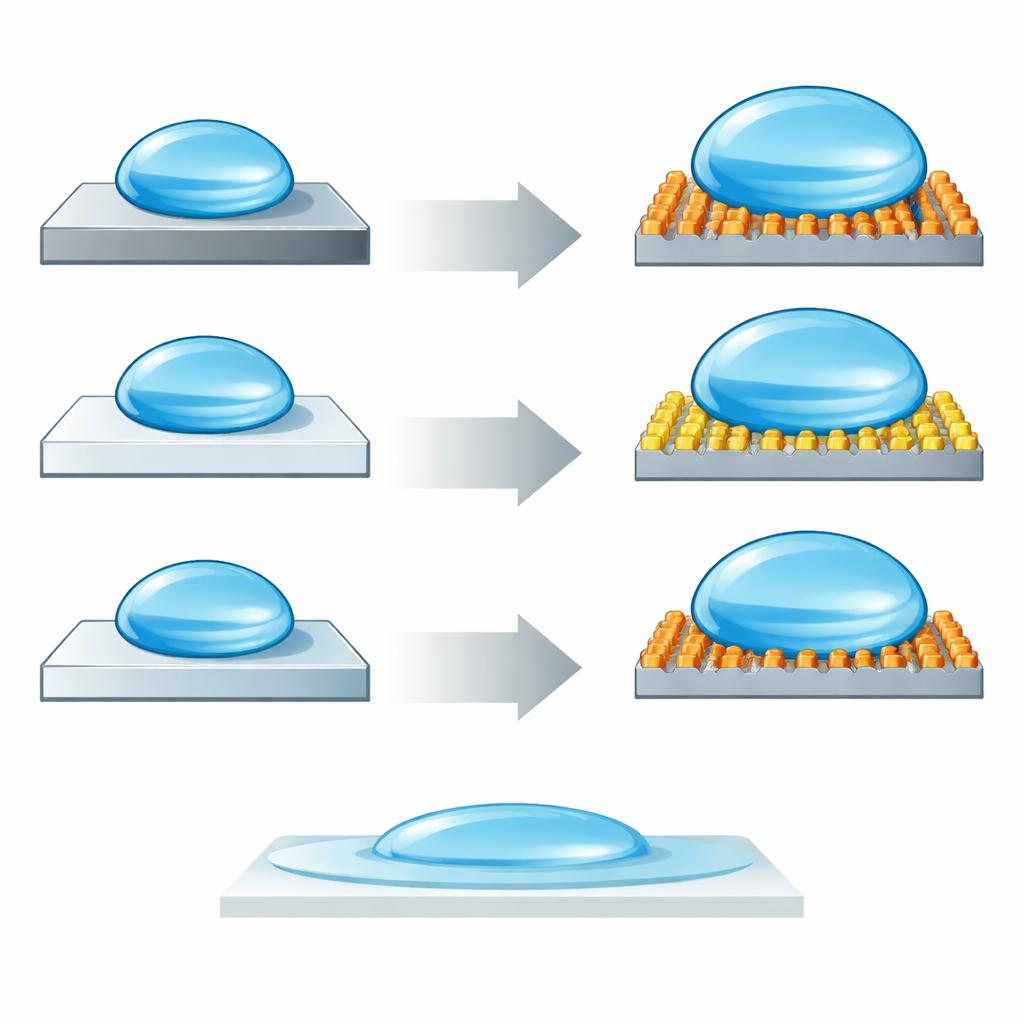
Diving deeper, the study separates flat surfaces from ones that have been deliberately roughened or patterned. For smooth, uniform surfaces, the droplet angle mainly reflects chemistry: materials with higher surface energy, like freshly cleaned metal oxides or glass, pull water into a thin puddle, while low‑energy coatings like certain plastics or fluorinated films let water bead up. In this “chemistry‑dominated” regime, changing the molecular makeup of the outermost layer moves the angle gradually, but even the best flat coatings top out at around 120 degrees. No reliably reported smooth surface in the dataset surpasses that limit.
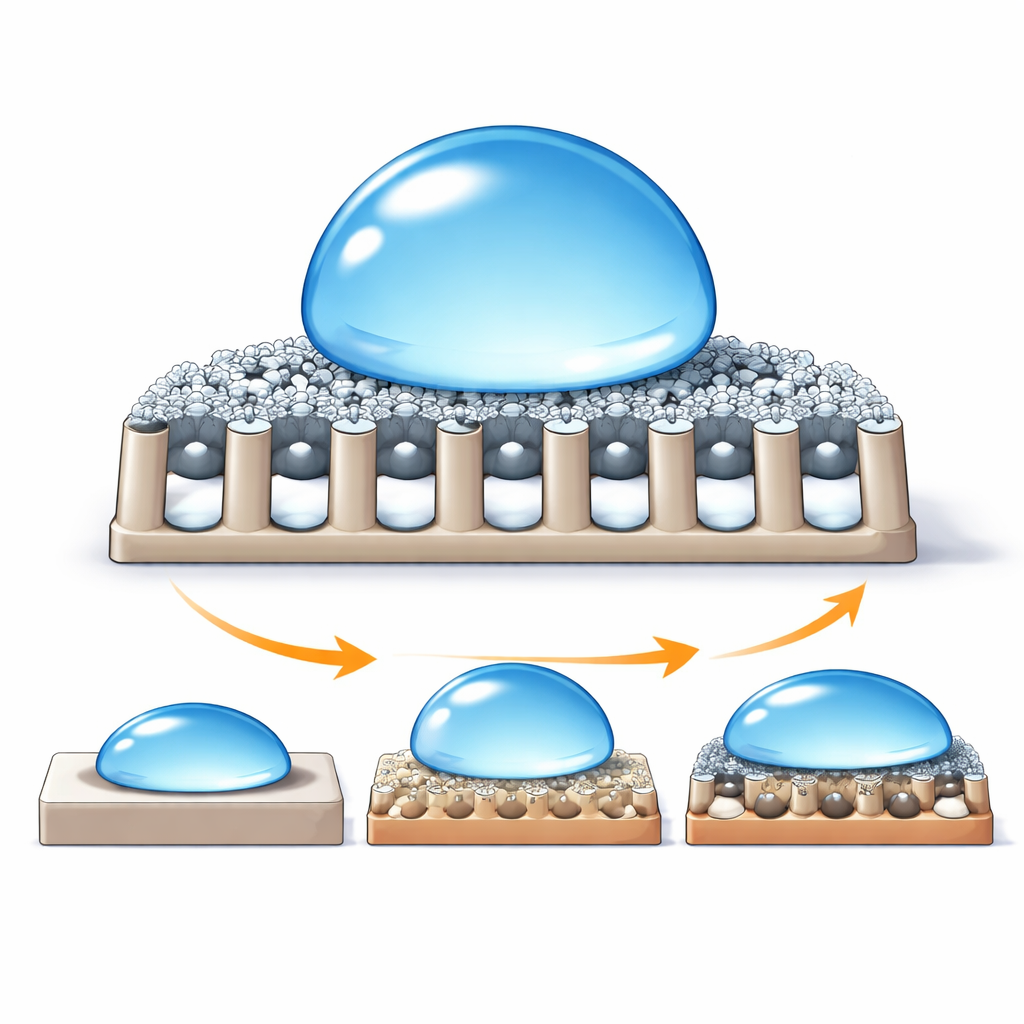
Textured surfaces tell a different story. Once micro‑ or nano‑scale bumps, pillars, or pores are introduced, the measured angles bunch up tightly in the super‑repellent band between about 150 and 170 degrees, almost regardless of what the underlying solid is made of. Here, the droplet perches on a mix of solid tips and trapped air pockets instead of lying flush. This “geometry‑dominated” regime shows that fine‑scale shape, not chemistry, is what lets engineers cross from merely hydrophobic to truly superhydrophobic behavior. The same logic applies in reverse at the low end: either very high‑energy flat surfaces or deeply porous structures can drive water to spread essentially completely, reaching angles near zero.
From decades of experiments to a design map
By organizing all the verified entries in a common format, the author builds a practical map that links two design knobs—surface chemistry and surface geometry—to four broad wetting outcomes: strongly water‑loving, moderately wetting, strongly water‑repelling, and slippery liquid‑infused states. Flat, high‑energy surfaces such as clean oxides naturally sit in the super‑wetting corner. Ordinary polymers and smooth water‑repellent coatings occupy the intermediate band, useful when designers want partial spreading or controlled adhesion rather than total rejection of liquids. Adding hierarchical texture moves many materials into the superhydrophobic corner, where drops roll off easily, while filling those textures with a lubricant creates slippery interfaces that shed many kinds of liquids with very little sticking, even if their static angles are not extreme.
What this means for future surfaces
To a non‑specialist, the core message is refreshingly simple: if you want gentle, complete wetting, aim below about 20 degrees; if you want robust, self‑cleaning water repellency, aim above about 150 degrees—and getting there almost always requires engineered texture, not just a new chemical recipe. Everything in between behaves more smoothly and can usually be tuned by changing chemistry alone. By showing that these thresholds hold across thirty years of measurements and many classes of materials, the study turns a patchwork of individual experiments into a shared rulebook. That rulebook will help researchers and product designers target the right combinations of coatings and micro‑structures without endless trial and error, and it offers a solid foundation for computer models and machine‑learning tools that predict how new surfaces will handle water.
Citation: Karimdoost Yasuri, A. Thirty years of contact angles reveal universal design rules for wetting control. Sci Rep 16, 10224 (2026). https://doi.org/10.1038/s41598-026-40965-x
Keywords: wettability, superhydrophobic surfaces, surface texture, contact angle, surface design