Clear Sky Science · en
Switching on the behavioral and neural rhythmicity to retrieve memories when the number of retained items exceeds four
Why remembering five things feels different from four
Learning a handful of new facts—like a few foreign vocabulary words—often feels easy, but trying to hold a slightly longer list in mind can suddenly become much harder. This study asks what changes inside the brain when that tipping point is crossed. By tracking tiny fluctuations in people’s reaction times and brain waves while they learned colored–letter pairs, the researchers found that the nervous system appears to "switch on" a hidden rhythm to help retrieve memories once the number of items becomes too large for our usual mental workspace.
A simple game to probe memory limits
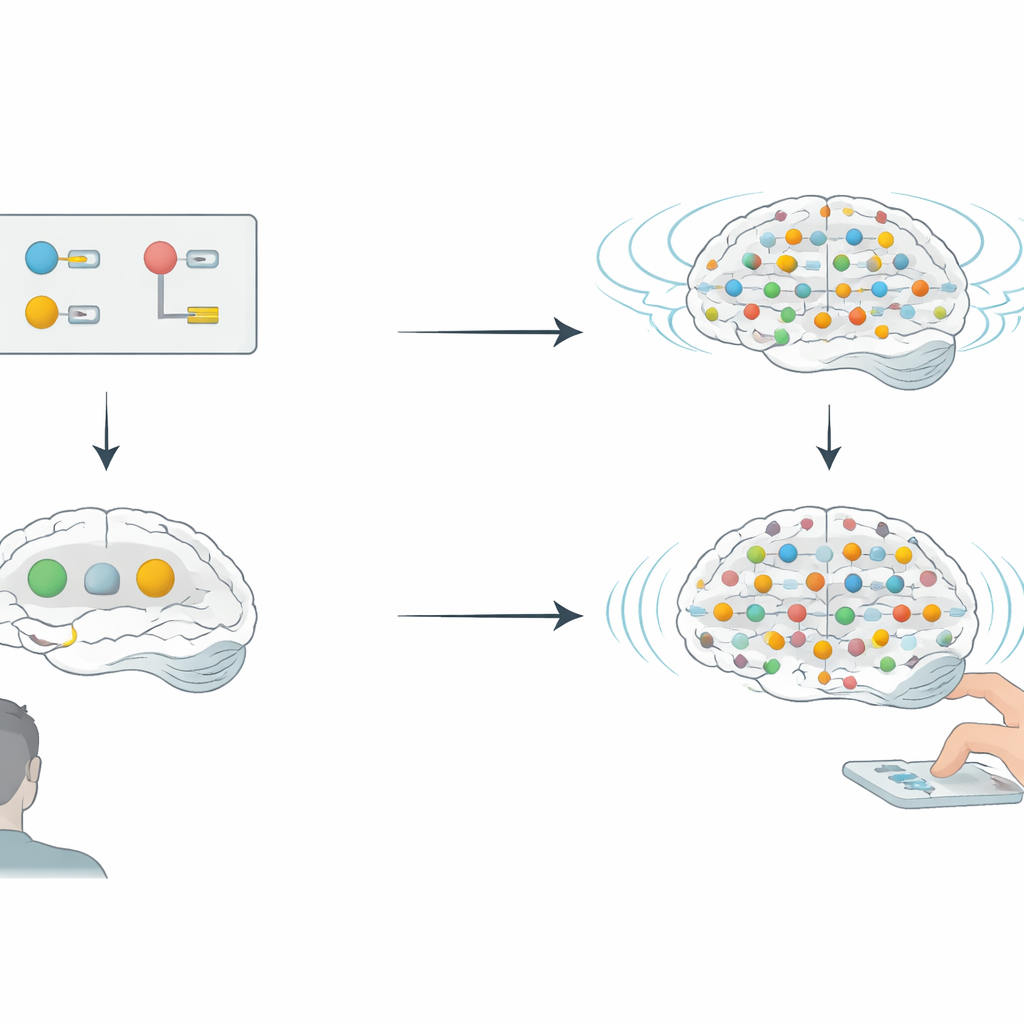
Volunteers played a computer task similar to cramming new vocabulary. They learned links between colors and keyboard letters and then had to press the matching key whenever a colored circle appeared. Sometimes they learned only two or three color–letter pairs, and sometimes up to five. The key measure was how quickly they responded, across hundreds of correct trials, and how these reaction times were distributed in time. In a separate set of sessions, the researchers also recorded electrical brain activity from the scalp using EEG while people did the same task.
Hidden beats in our reaction times
When people had to remember only two, three, or four color–letter pairs, their reaction times formed smooth, bell-shaped curves: responses were more or less evenly spread around an average. But when five pairs had to be kept in mind—and especially when the color on the current trial differed from the one just seen—reaction times bunched into several distinct peaks. These peaks recurred at intervals matching cycles in the so‑called theta–alpha range, about four to thirteen times per second. In other words, recalls tended to happen at preferred time points, as if the brain were sampling its memories in discrete rhythm-driven snapshots rather than continuously. This rhythmic pattern became clearer as participants repeated the task and the associations became well learned, even though their average reaction times actually grew shorter with practice.
Brain waves that switch on when memory is crowded
EEG recordings revealed a complementary rhythmic story in the brain’s electrical activity. After each colored circle appeared, the researchers examined the brief window of brain response that was tightly locked to the cue. In the five-pair condition, but not in the three-pair condition, they found stronger cue‑locked power in the same theta–alpha frequency range, especially over left parietal scalp regions near the back of the head. This pattern suggests that when memory demands overflow the usual working memory capacity of about four items, brain networks involving parietal cortex and deeper structures such as the hippocampus engage a rhythmic mode of operation to help retrieve the right association.
Different rhythms for correct and incorrect recalls
The timing of correct responses in the five‑pair condition tended to cluster around a particular phase of the behavioral rhythm, indicating that successful recalls were more likely to occur at a “good” moment in the cycle. Incorrect key presses, by contrast, did not show reliable alignment to that phase. Interestingly, the strength and exact frequency of the behavioral rhythm (seen in timing of responses) did not simply mirror the rhythms measured in the scalp EEG. The two signals were not tightly correlated across people and did not rise and fall together over the course of learning, suggesting that reaction-time rhythms and cortical rhythms are complementary windows onto a deeper, partly hidden oscillatory process in memory circuits.
What this means for everyday remembering
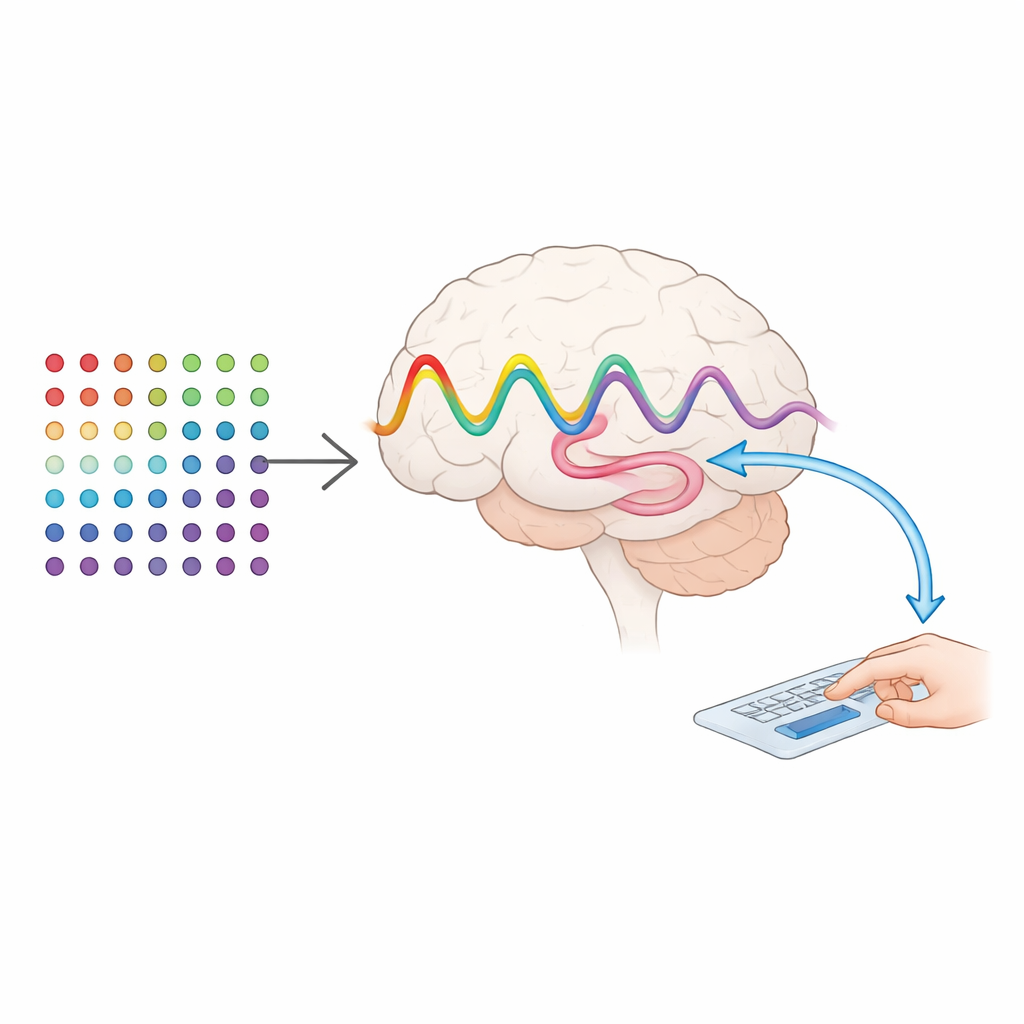
For a small number of items, the brain can keep everything actively in mind at once, allowing quick, smooth recall without needing special timing tricks. Once the list grows beyond roughly four items, some of those memories likely have to be stored in longer‑term systems and then briefly reactivated when needed. This study shows that, under those crowded conditions, the brain seems to recruit a rhythmic, theta–alpha–paced process that periodically brings candidate memories into an accessible state. The work suggests that the familiar feeling of strain when we juggle just a few too many things may reflect a real switch in the way our nervous system retrieves information—shifting from effortless, all-at-once access to a more structured, rhythm-guided search through long‑term memory.
Citation: Ideriha, T., Ushiyama, J. Switching on the behavioral and neural rhythmicity to retrieve memories when the number of retained items exceeds four. Sci Rep 16, 10321 (2026). https://doi.org/10.1038/s41598-026-40959-9
Keywords: memory retrieval, brain rhythms, working memory, theta oscillations, reaction time