Clear Sky Science · en
Multi-task survival modeling of dependent failure and reimplantation events in dental implants
Why this matters for people with dental implants
Dental implants are meant to be long-term replacements for missing teeth, but sometimes they fail and have to be replaced. For patients, what matters most is a simple question: “What are my chances this implant will last, and if it fails, what happens next?” This study introduces a new artificial intelligence (AI) model that follows implants over time, learning when they are likely to fail and when a second implant might be placed, even on the very same day. The goal is to give dentists and patients clearer, more personalized risk estimates to guide planning and follow-up care.
Following the full journey of an implant
The researchers focused on two linked events in a single tooth site: the failure of a dental implant and any later reimplantation at the same spot. In real life, these events are not independent. A second implant can only be placed after the first one has failed, and in some cases, the replacement is done immediately at the same visit. Traditional statistical tools for “survival analysis” usually look at only one event at a time and assume that different events are unrelated. That makes them poorly suited to such tightly connected, stepwise clinical pathways. To address this, the authors built a model that treats failure and reimplantation as stages of one clinical story rather than as separate, unrelated outcomes.
Real-world data from everyday dental practice
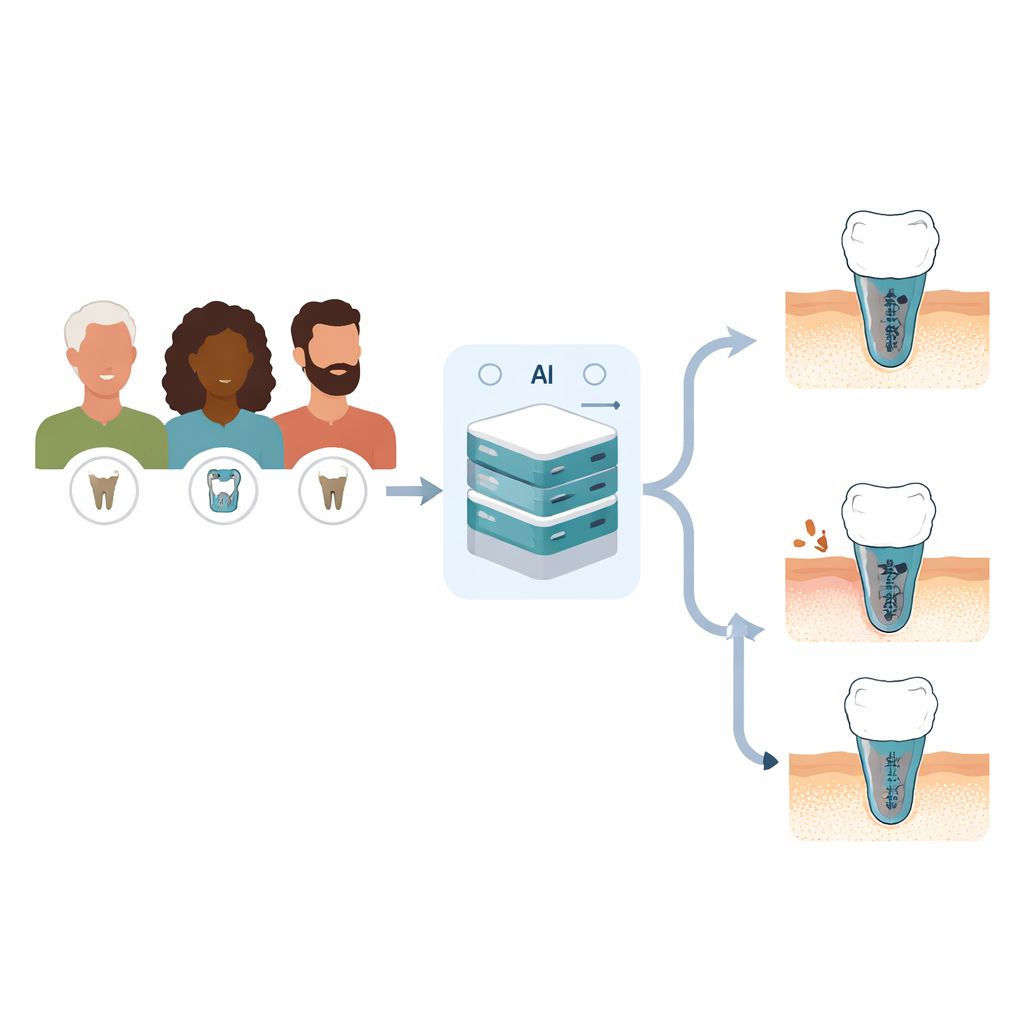
The team used records from 1,627 patients treated in multiple implant centers between 1998 and 2021. Each person contributed data for just one implant site so that the analysis would stay focused on that location’s history. Among these patients, 73 received a reimplantation after a failed implant, including 32 cases where the new implant was placed on the very same day the old one was removed. For every patient, the researchers assembled 57 pieces of information, covering general health (such as diabetes or osteoporosis), lifestyle factors (like smoking and diet), oral conditions (bone quality, gum type, periodontal disease), and detailed features of the implant site itself. Missing values were carefully filled in using standard medical statistics methods so that patterns in the data would not be distorted.
An AI model that understands time and dependency
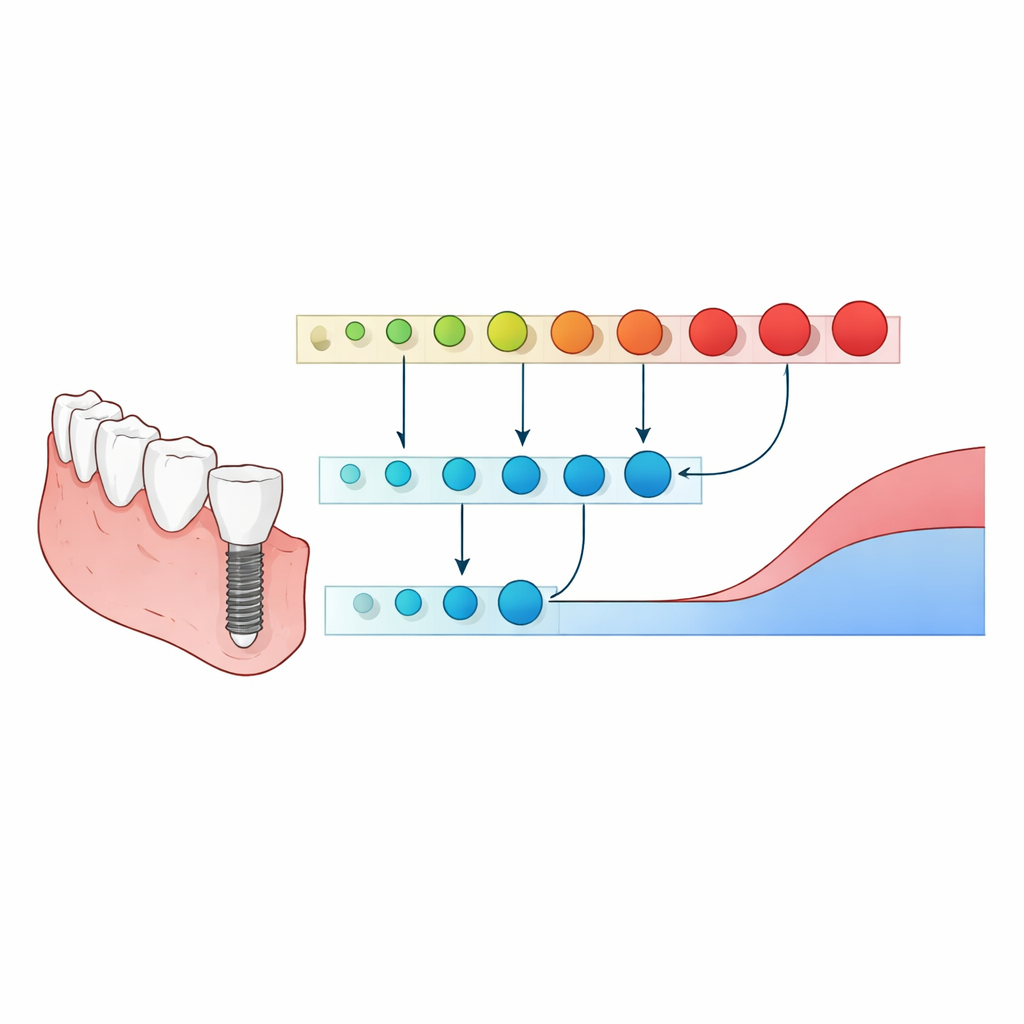
The new model, called SIMMT, treats time as a sequence of equal-length intervals instead of a continuous clock. For each interval, it estimates the chance that an implant will fail and, if failure happens, the chance that a reimplantation will occur. It uses a shared “encoder” that digests all of a patient’s clinical features, then splits into two connected branches—one for failure and one for reimplantation. A key innovation is a masking rule: the reimplantation branch is only allowed to learn from and make predictions in time intervals that come after failure, mirroring how care unfolds in practice. A special “simultaneity” flag tells the model when failure and reimplantation happened in the same interval, helping it learn from same-day replacement cases. Multi-head attention layers let the model discover which features matter most for each stage, while a monotonicity constraint gently pushes the overall risk over time to move in a realistic non-decreasing way.
How well did it work?
The model was tested using a rigorous cross-validation strategy, with the data split into five parts and each part in turn held back for testing. Time was divided into eight intervals spanning roughly 10 years, chosen to match typical dental follow-up phases. Under this setup, SIMMT achieved strong accuracy for predicting both events. For implant failure, it reached a concordance index of about 0.81, meaning it reliably ranked higher-risk patients above lower-risk ones. For reimplantation, which is predicted only after a failure, performance was even stronger, with a concordance index around 0.97. The model also produced well-calibrated probabilities—its predicted risks closely matched the actual observed frequencies when adjusted for patients who left the study early. Compared with standard methods such as the Cox proportional hazards model, Random Survival Forests, and deep-learning tools like DeepSurv and DeepHit, SIMMT consistently provided better ranking and similar or lower error in estimated probabilities.
What the model learns about risk factors
Beyond raw accuracy, the authors examined what the AI had learned about which factors drive risk. For the first implant, systemic health and local bone conditions were most important. Diabetes, bone quality and density, oral hygiene, allergic reactions, and the width of the toothless gap all played major roles, aligning with existing clinical knowledge. For reimplantation, patterns shifted: details of the implant treatment, the shape of the defect, blood pressure-related conditions, age, bone height, and use of bone grafting became more prominent. This suggests that the first stage is dominated by a mix of general health and local support for the implant, while the second stage reflects how surgeons and patients respond after a failure, including surgical complexity and medical considerations.
What this means for patients and clinicians
In everyday language, this study shows that an AI system can trace the life of a dental implant in two steps—first, whether it is likely to fail, and second, if and when a replacement might be placed—while respecting real-world rules like “no second implant before the first one fails” and “sometimes both happen the same day.” By capturing these dependencies and using many aspects of a patient’s health and mouth, the model produces individual risk curves rather than one-size-fits-all estimates. If validated further across more centers and populations, such tools could help dentists tailor follow-up schedules, discuss realistic timelines and risks with patients, and decide when preventive or corrective actions might be justified, moving implant care toward more truly personalized treatment planning.
Citation: Nooraldaim, A.S., Xue, Z., Lai, X. et al. Multi-task survival modeling of dependent failure and reimplantation events in dental implants. Sci Rep 16, 13303 (2026). https://doi.org/10.1038/s41598-026-40955-z
Keywords: dental implants, implant failure, reimplantation, survival modeling, clinical decision support