Clear Sky Science · en
Synthesis of the porous Co–N-doped carbon catalysts as a durable cathode for zinc–air battery
Why Better Batteries Matter
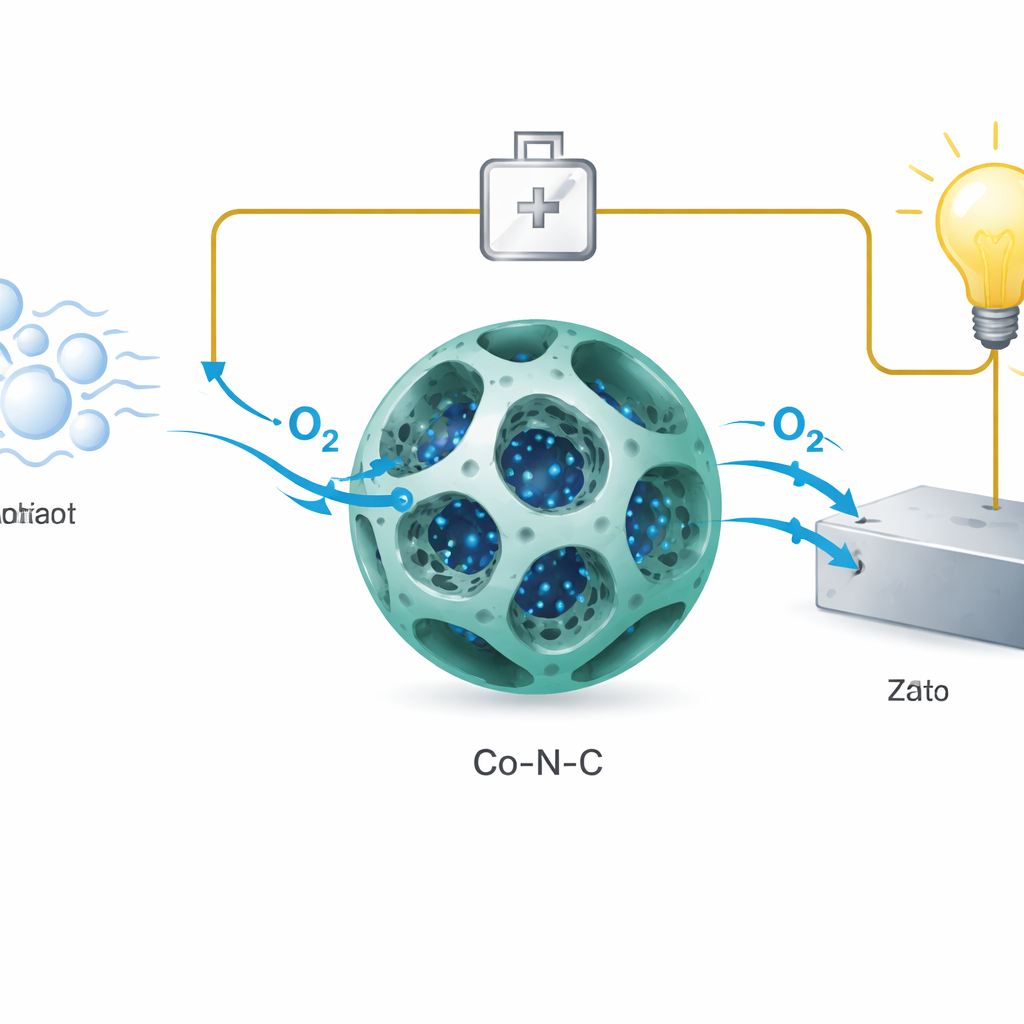
From electric cars to backup power for homes, we increasingly rely on rechargeable batteries. Zinc–air batteries are especially attractive because they use inexpensive materials, store a lot of energy, and are relatively safe. But a key bottleneck is how efficiently they can breathe: oxygen from the air must react smoothly at the battery’s air electrode, and today’s catalysts that help this reaction are either costly or degrade too quickly. This study explores a new, durable catalyst made from cobalt, nitrogen, and carbon arranged in a carefully engineered porous structure, aiming to make zinc–air batteries longer lasting and more practical.
Breathing Oxygen Inside a Battery
In a zinc–air battery, zinc metal reacts with oxygen from the air to generate electricity. The tricky step is the oxygen reduction reaction, where oxygen molecules are turned into charged particles that the battery can use. This step is normally helped by precious metals like platinum, which are expensive and can wear out. The authors focus on a cheaper alternative: a carbon-based material that is doped with cobalt and nitrogen. These added atoms create highly active spots on the carbon surface where oxygen can react more easily, potentially rivaling platinum but at far lower cost.
Building Tiny Porous Spheres
The researchers designed their catalyst as microscopic hollow spheres full of pores of different sizes. To build these, they used silica (SiO₂) particles as a removable template. They mixed cobalt salt, glucose (a simple sugar), a nitrogen-rich compound, and silica in water and treated the mixture in a sealed hot vessel. This process caused a carbon shell containing cobalt and nitrogen to form around the silica spheres. After heating at high temperature and washing away the silica with an alkaline solution, what remained were robust carbon microspheres doped with cobalt and nitrogen and riddled with pores. By tuning how much cobalt salt was added and how hot the material was heated, they created several versions of the catalyst with different pore structures and particle sizes.
Why the Pores Make a Difference
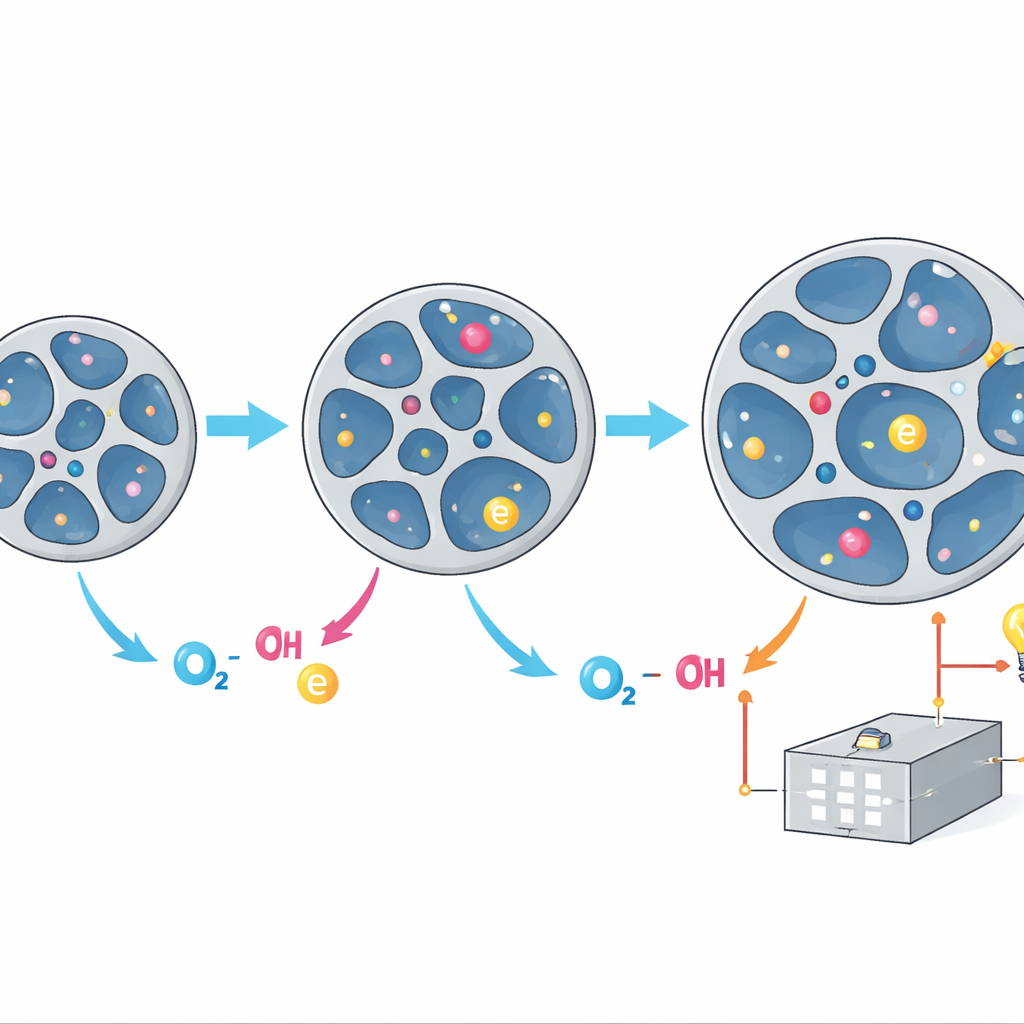
The way these pores are arranged turns out to be critical. Small pores provide a large surface area and many active sites where the oxygen reaction can occur. Medium-sized pores help oxygen and the liquid electrolyte reach those sites, while large pores act like tiny tanks that can store reactants and keep pathways open. Detailed imaging and surface measurements showed that one catalyst in particular, labeled Co-900-100, contained all three types of pores—small, medium, and large—embedded in sturdy carbon shells. Another version, Co-900-50, had a higher surface area but fewer large pores. Both materials showed good oxygen reaction performance in lab tests, but their behavior inside full zinc–air batteries differed in important ways.
Putting the New Materials to the Test
When built into working zinc–air batteries, both catalysts enabled stable discharge over a wide range of current levels, meaning they could deliver power steadily. The battery using Co-900-100 delivered a higher peak power density and showed especially impressive long-term stability. Over 100 hours of continuous discharge, its voltage actually rose slightly rather than fading. In rapid charge–discharge cycling over 300 cycles, this battery held its discharge voltage at about 1.24 volts with almost no loss. In contrast, the version using Co-900-50 slowly lost performance. Microscopy after cycling revealed why: Co-900-50’s surface became heavily coated with zinc oxide, a by-product that clogs active sites and raises resistance. Co-900-100’s larger pores and more open framework resisted this buildup, leaving more of the catalyst surface accessible even after extended use.
What This Means for Future Power
For non-specialists, the main message is that the inner architecture of a catalyst—how many pores it has, how big they are, and how they connect—can be just as important as what it is made of. By carefully shaping cobalt and nitrogen-doped carbon into strong, multi-scale porous spheres, the authors created a cathode material that helps zinc–air batteries run efficiently and stay stable over long periods. While these catalysts do not yet outperform the very best lab prototypes in every metric, their durability and relatively simple preparation route make them promising candidates for practical, low-cost metal–air batteries that could one day power vehicles, electronics, and backup systems with cleaner and more reliable energy.
Citation: Niu, F., Liu, JA., Zhao, LT. et al. Synthesis of the porous Co–N-doped carbon catalysts as a durable cathode for zinc–air battery. Sci Rep 16, 11426 (2026). https://doi.org/10.1038/s41598-026-40942-4
Keywords: zinc–air batteries, oxygen reduction catalyst, porous carbon, cobalt–nitrogen doping, energy storage