Clear Sky Science · en
Multimodal fusion for equipment health status assessment based on dynamic attention mechanism
Why smarter machine checkups matter
From wind turbines to factory robots, modern machines are covered in sensors and constantly generating data. Yet unexpected breakdowns still happen, because today’s monitoring systems often miss the earliest hints of trouble hiding in that data. This paper explores a new way to listen to many types of signals at once—vibration, sound, electrical measurements and even text-like descriptions—so that machines can warn us of faults earlier and more reliably, without demanding huge computing power.
Many signals, one health story
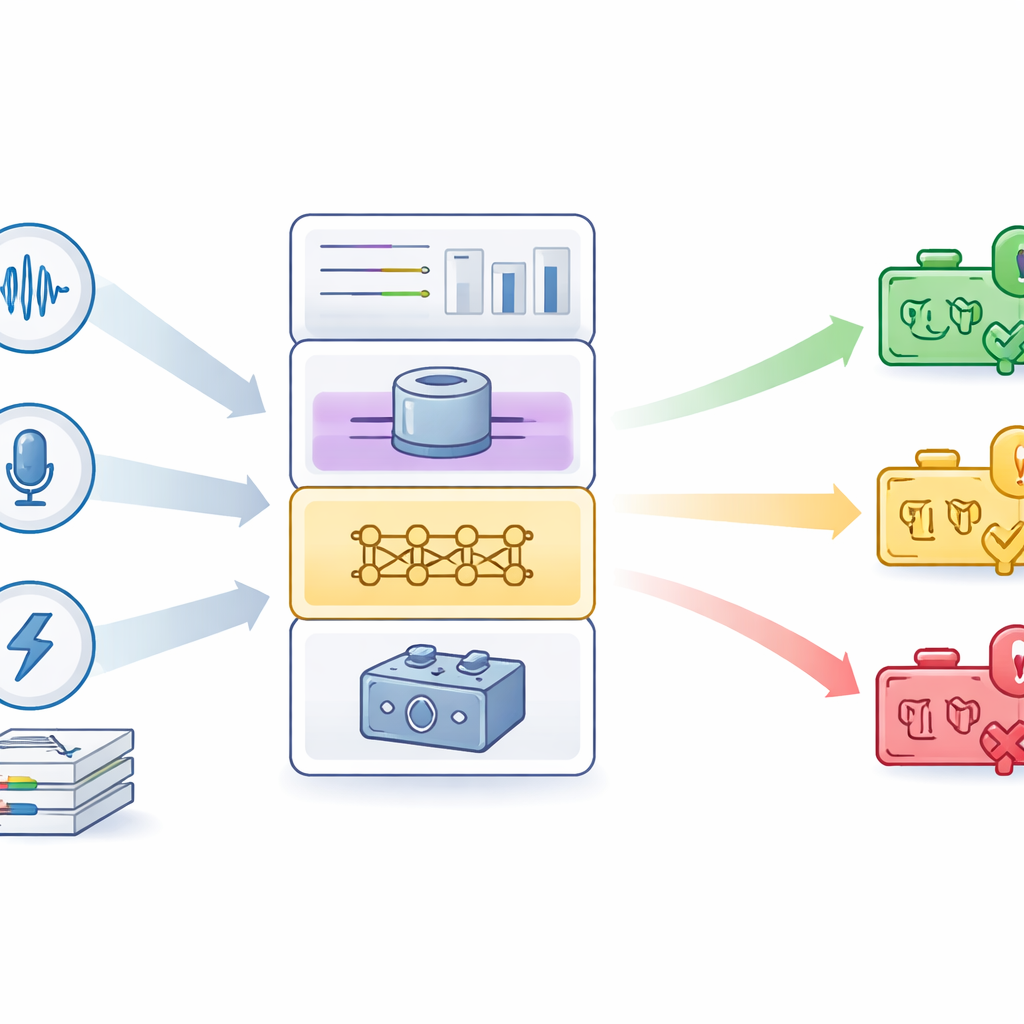
Industrial equipment no longer speaks in a single "voice." It hums, shakes, warms up and produces maintenance logs, all at the same time. Traditional monitoring tools usually look at just one of these information streams, such as vibration. They also tend to treat the importance of each signal as fixed, even though what matters most can change as a fault develops: a slight noise may appear first, followed later by strong vibration or changes in electrical load. The authors argue that to really understand a machine’s health, a monitoring system must fuse these different signals and track how their importance shifts over time.
Letting the model pay attention dynamically
The heart of the proposed method is a “dynamic attention” mechanism that constantly adjusts which signals to focus on. The system first converts equipment logs into compact numerical summaries using a language model originally designed for human text. These act as a kind of narrative anchor—describing whether the machine seems normal, slightly abnormal, or clearly faulty. In parallel, vibration and other sensor signals are broken down into patterns over time and frequency, highlighting tiny bursts of energy in specific bands that often mark a fault’s early stages. A special memory-based module then looks back over recent history and decides, moment by moment, how much weight to give each kind of feature when judging the machine’s condition.
From raw waves to clear warning signs
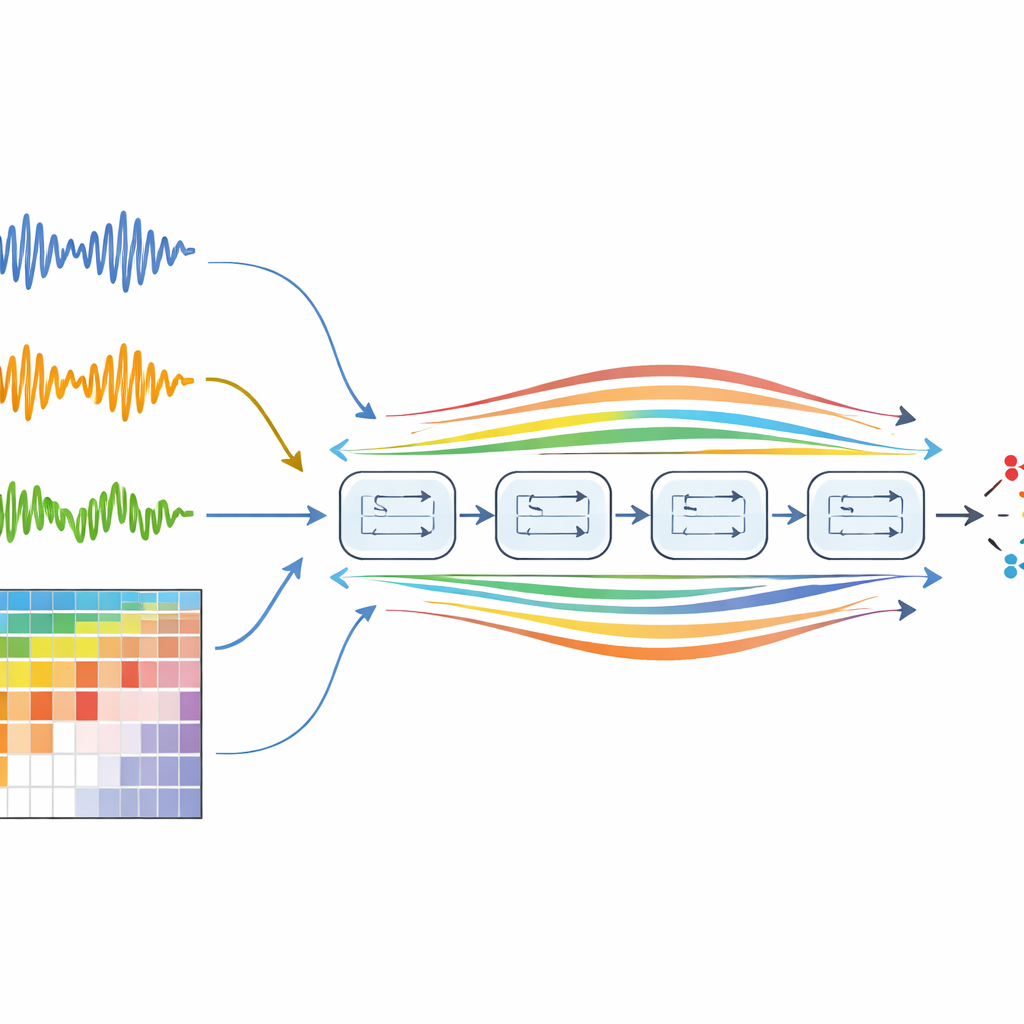
To make sense of the raw signals, the framework uses a stacked set of well-known analysis tools that each play a different role. One focuses on brief, subtle bursts that signal the very beginning of damage. Another picks out repeating frequency peaks tied to specific fault types, such as a worn bearing surface. A third step compresses the combined information into a more compact form that is less sensitive to changes in load and background noise. This sequence turns a messy stream of sensor readings into a cleaner map of how energy is distributed across frequencies and over time, which the attention mechanism can then interpret alongside the text-based clues.
Putting the approach to the test
The researchers evaluated their method on three widely used datasets that record real measurements from bearings and gearboxes under many operating conditions and fault types. For each, they generated synthetic text descriptions that mirror what a technician’s notes might say about the machine’s behavior at different stages. Compared with existing attention-based methods that treat signal importance as fixed or lack memory of past states, the dynamic system achieved higher accuracy—above 90 percent in all cases—and was especially good at spotting the earliest, hardest-to-detect faults. At the same time, by keeping the model compact and compressing features smartly, they reduced the processing delay and floating-point operations, making the method more suitable for real-time use on industrial hardware.
What this means for everyday reliability
In plain terms, this work shows that giving a monitoring system the ability to “change its mind” about what signals matter, and to combine sensor readings with simple textual descriptions, can lead to earlier and more trustworthy fault warnings without overwhelming computing resources. Instead of waiting until a machine is clearly failing, the model can pick up on small but meaningful changes and relate them to likely fault types, even in noisy, changing environments. If adopted in real plants, such an approach could support preventive maintenance: scheduling repairs before breakdowns occur, reducing downtime and costs, and making the complex machines we rely on every day more dependable.
Citation: Lei, Y., Zhao, J., Lv, W. et al. Multimodal fusion for equipment health status assessment based on dynamic attention mechanism. Sci Rep 16, 10271 (2026). https://doi.org/10.1038/s41598-026-40926-4
Keywords: equipment health monitoring, multimodal sensors, predictive maintenance, fault diagnosis, attention mechanisms