Clear Sky Science · en
Selecting suitable moss indicators for routine bioindication of roadside air pollution
Why moss on trees can reveal what is in the air
Most of us think of moss as a simple green carpet on rocks and tree trunks. This study shows that these modest plants can act as sensitive natural gauges of roadside air pollution. By carefully choosing the right moss species and combining them with a quick magnetic test, the researchers outline a low-cost way for cities and communities to track harmful particles from traffic without relying solely on expensive machinery. 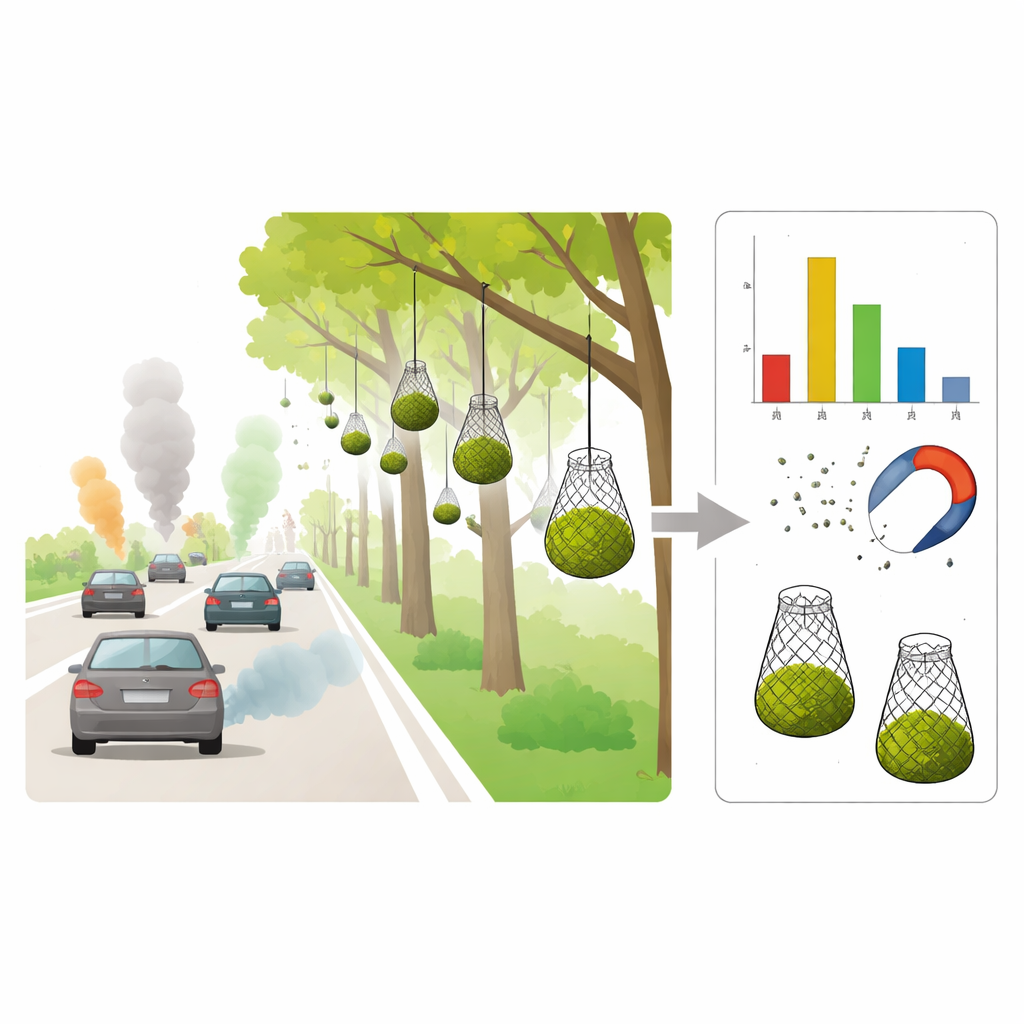
Watching traffic through tiny green sentinels
Modern life depends on cars and trucks, but their exhaust, brake wear, and tire dust release a fog of metal-rich particles into the air. Traditional air monitors are precise yet costly and sparse, leaving many neighborhoods unmeasured. Mosses offer a clever alternative because they absorb most of their water and nutrients directly from the air, not from soil. With no protective outer skin and a large surface area, they act like living sponges for pollution. The team focused on five common moss species that are easy to find across temperate regions, testing whether some are especially good at soaking up traffic-related metals such as zinc, copper, nickel, and lead.
Hanging moss bags beside busy roads
To compare species fairly, the scientists collected moss from a relatively clean mountain foothill and sealed each species separately into small mesh “moss bags.” They then hung these bags on trees along two similar roadside corridors in the Polish city of Opole, where thousands of vehicles pass each day. After one, three, and six months of exposure, they brought the bags back to the lab. There, they measured two things: the actual amounts of eight metals trapped in the moss and the moss’s magnetic susceptibility, a property that increases as more magnetic particles, such as iron-rich dust, accumulate. This second test is quick, non-destructive, and much cheaper than full chemical analysis.
Which mosses work best as natural monitors
The results revealed that not all mosses are equal as pollution watchers. Two species, Plagiomnium affine and Climacium dendroides, consistently trapped more metals and showed higher magnetic signals than the others. Both have relatively large, thin leaves and a loose, open leaf arrangement, which exposes more surface to passing air and falling dust. In contrast, mosses with very dense, tightly pressed leaves, such as Thuidium tamariscinum, captured much less pollution. Over time, all species showed rising magnetic susceptibility, confirming that moss bags record a cumulative history of exposure, but the increase was strongest and clearest in the two top-performing species. 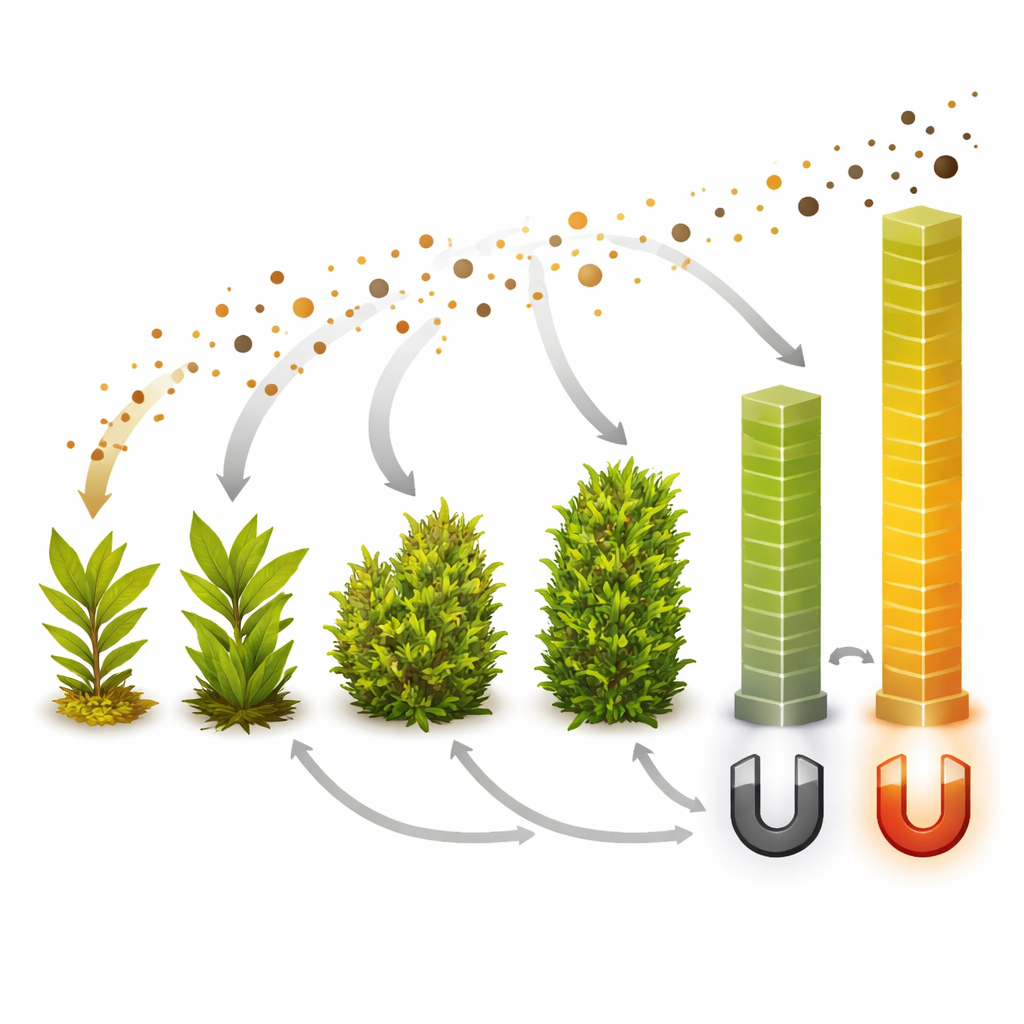
Leaf shape and thickness as the hidden advantage
To understand why some mosses worked better, the researchers linked metal buildup to simple leaf traits. Mosses with a high specific leaf area—meaning a large leaf surface for a small amount of dry mass—tended to hold more pollutants. Smooth, broad leaves that are spaced apart along the stem seem to catch and keep airborne particles more effectively than tiny, tightly packed, or bump-covered leaves. A statistical analysis confirmed that species with larger and thinner leaves clustered together with higher levels of metals like zinc, lead, and cadmium. These findings suggest that we can often predict how good a moss will be as a bioindicator just by looking at its growth form and leaf structure.
Magnetism as a shortcut to pollution levels
The magnetic readings in the moss told a similar story. Higher magnetic susceptibility generally went hand in hand with higher concentrations of metals linked to traffic and industrial dust, especially iron, manganese, copper, chromium, and nickel. This means that a simple magnetic test can serve as a fast screening tool to spot pollution hot spots before more detailed chemical work is done. However, the match was not perfect for every metal or species—for instance, lead and cadmium did not always show strong magnetic signals—so magnetism cannot fully replace chemical analysis. Instead, it provides a powerful first pass that is inexpensive and easy to repeat over wide areas.
What this means for cleaner air
From a lay perspective, the key message is that ordinary moss, when carefully chosen and deployed, can become an effective part of our environmental toolkit. The study recommends using species like Plagiomnium affine and Climacium dendroides in roadside moss bags for at least one month—ideally three to six—and pairing their use with quick magnetic checks. This combination offers a practical, low-cost way for local authorities, researchers, and even community groups to keep an eye on invisible traffic pollution, helping identify trouble spots and track improvements as cleaner transport policies are introduced.
Citation: Plášek, V., Łuczak, K., Kusza, G. et al. Selecting suitable moss indicators for routine bioindication of roadside air pollution. Sci Rep 16, 10275 (2026). https://doi.org/10.1038/s41598-026-40922-8
Keywords: moss biomonitoring, roadside air pollution, heavy metals, magnetic susceptibility, traffic emissions