Clear Sky Science · en
Enhanced maximum power point tracking using hippopotamus optimization algorithm for grid-connected photovoltaic system
Why smarter solar power matters
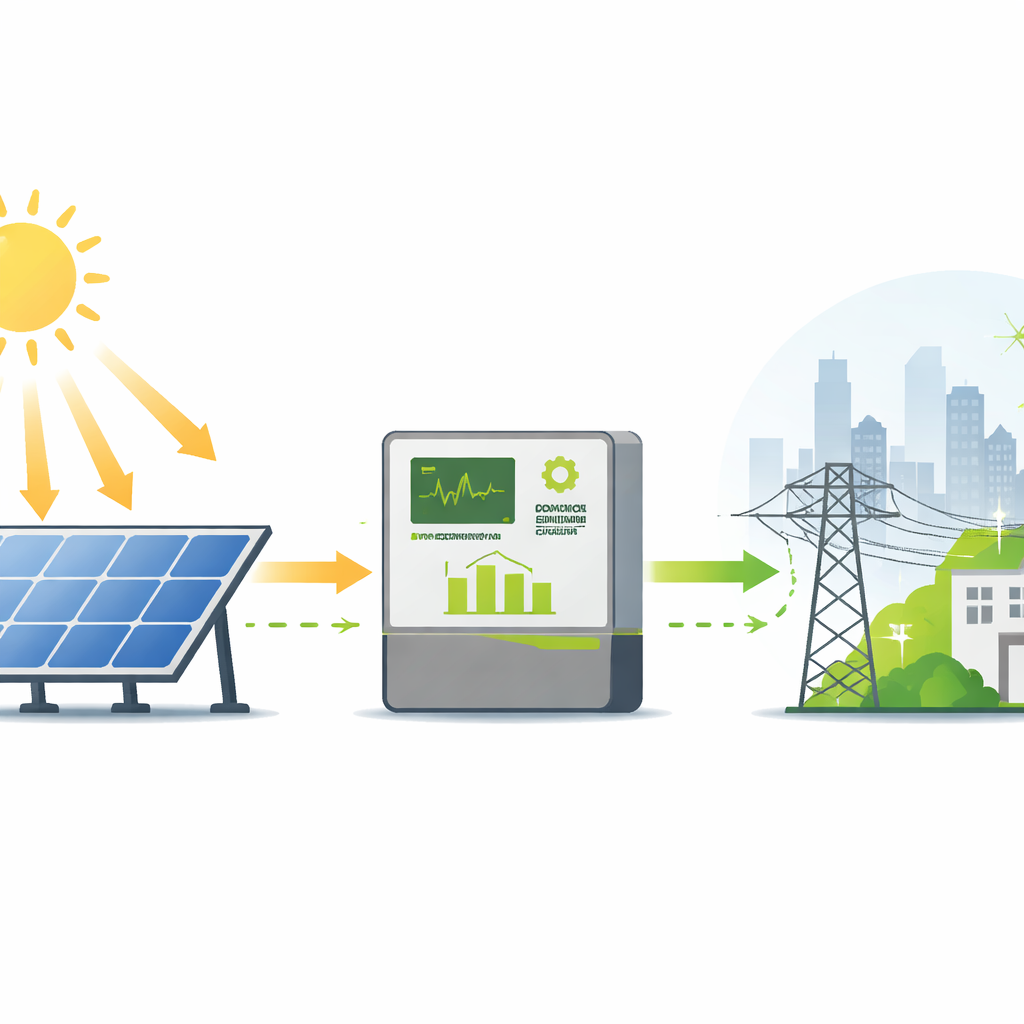
As solar panels spread across rooftops and solar farms, a stubborn problem remains: they rarely operate at their absolute best. Clouds, changing temperatures, and even the way panels are wired can keep them from delivering all the energy they could. This paper explores a new way to squeeze more usable electricity from a grid-connected solar plant by borrowing ideas from an unlikely source—the behavior of hippopotamuses—turning animal-inspired math into extra clean power for the grid.
Getting the most from sunshine
Solar panels do not produce power in a simple, linear way. For every combination of sunlight and temperature, there is one “sweet spot” where the panel delivers maximum power. Finding and staying at this point is called maximum power point tracking, or MPPT. Conventional MPPT methods work reasonably well, but they can be slow to react when clouds move quickly or when temperatures swing, causing energy losses. The authors focus on a common technique called Incremental Conductance, which judges whether the operating point is to the left or right of the sweet spot and then nudges the system accordingly. How effectively this works, however, depends heavily on how its underlying electronic controller is tuned.
New control with animal-inspired search
Most industrial solar systems rely on simple controller types—integral (I) or proportional–integral (PI)—to regulate voltage and power. A more flexible option, the fractional‑order PI (FOPI) controller, can respond more smoothly and precisely but is harder to tune because it introduces an extra degree of freedom. Instead of adjusting controller settings by trial and error, the authors use a fresh optimization method called the Hippopotamus Optimization Algorithm. This algorithm mimics how hippos explore rivers, defend against threats, and escape toward safer zones, translating these behaviors into a structured search through thousands of possible controller settings to find combinations that minimize power errors and response time.
Building and testing the virtual solar plant
The team models a 100 kilowatt grid-connected solar system in MATLAB/Simulink. The digital plant includes detailed models of the solar cells, a high-voltage boost converter, and a grid-tied inverter feeding a medium-voltage network. On top of this, they place the Incremental Conductance MPPT loop, driven by three alternative controllers: I, PI, and FOPI. For each controller type, the hippopotamus-inspired algorithm searches for settings that minimize four standard error measures, all of which penalize slow or inaccurate tracking of the maximum power point. Two other nature-inspired optimizers—the Arithmetic Optimization Algorithm and the Grey Wolf Optimizer—are used as benchmarks to see whether the hippo-based approach truly offers an advantage.

How the new method performs under shifting weather
The researchers test the system under four realistic scenarios: sudden jumps in sunlight at constant temperature, gradual ramps of sunlight and temperature, several discrete irradiance levels at fixed temperature, and finally both sunlight and temperature changing together. Across these conditions, they compare how quickly each MPPT scheme reaches the new power point, how much it overshoots or oscillates, and how much energy it ultimately extracts. The hippopotamus-tuned FOPI controller consistently responds rapidly—settling in fractions of a millisecond in many tests—while keeping the solar array voltage smooth and close to its ideal value. It reaches slightly higher maximum power (around 100.7 kilowatts from a 100 kilowatt array) and lower tracking errors than the competing methods, even though in a few narrow metrics the grey wolf algorithm performs marginally better.
What this means for future solar farms
For a non-specialist, the takeaway is straightforward: better control software can make existing solar hardware more productive and more stable on the grid. By letting a hippo-inspired search algorithm tune an advanced controller, the authors show that a solar plant can react faster to passing clouds, capture more of the available sunlight, and deliver power more reliably to the utility network. While these results come from simulation, they point toward smarter, nature-inspired control systems that could, when implemented in real hardware, translate into higher energy yields and lower costs for large-scale solar installations.
Citation: Taha, S.A., Abdulsada, M.A., Mohamed, M.A.E. et al. Enhanced maximum power point tracking using hippopotamus optimization algorithm for grid-connected photovoltaic system. Sci Rep 16, 9991 (2026). https://doi.org/10.1038/s41598-026-40918-4
Keywords: solar energy, photovoltaic systems, maximum power point tracking, optimization algorithms, renewable power grids