Clear Sky Science · en
Unraveling children’s mental rotation: insights from behavior and eye tracking
Why turning shapes in the mind matters
Imagine looking at two pictures of a toy and trying to decide whether one could be turned to match the other. This simple-looking challenge, called mental rotation, quietly supports everything from reading maps to building with blocks and succeeding in science and math. The study described here asks how children between 5 and 15 years old handle this kind of mental turning, and what their eye movements reveal about how hard their brains are working. By tracking where children look and how their pupils change, the researchers uncover a richer story than test scores alone can tell.

Peeking inside children’s thinking
The researchers worked with 41 children who sat in front of a screen showing two images side by side. On each trial, the left image was the original, and the right image was either the same figure rotated or its mirror image. The pictures were familiar things—numbers, letters, arrows, people, and motorcycles—turned by different amounts, such as 60, 120, or 180 degrees. The child’s job was to decide, within ten seconds, whether the right image could be made to match the left simply by turning it. At the same time, a small device under the screen carefully recorded how long the child looked at the images, how many separate glances they made, and how wide their pupils became.
Harder turns mean heavier mental work
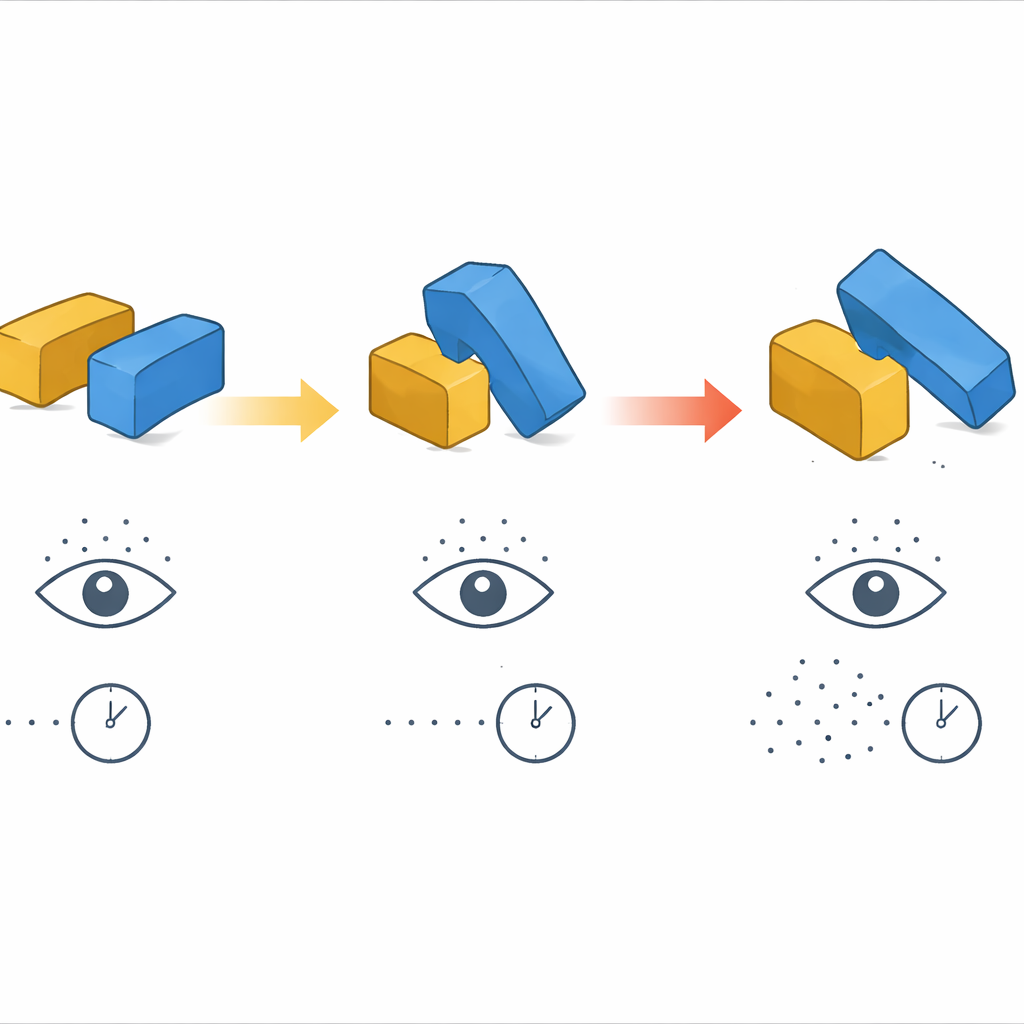
When the shapes were only slightly turned, children were more accurate and answered more quickly. As the angle grew larger—especially around 180 degrees—accuracy dropped and reaction times stretched out by more than half a second on average. Their eyes told a matching story. With easier angles, children spent less time staring at the rotated shape and needed fewer separate fixations. With harder angles, they looked longer and jumped their gaze around more often, as if piecing together the rotated object bit by bit. Their pupils also widened slightly but reliably, a well-established sign that the brain is investing more mental effort. These patterns appeared in both younger and older children, suggesting that the basic link between angle and difficulty is already firmly in place by early school age.
Self-control and the hidden cost of effort
The team also wanted to know whether children’s self-control skills were related to how they handled this visual puzzle. Each child completed a questionnaire about everyday habits, such as resisting impulses and staying focused. One aspect—impulse control—stood out. Children who reported having more trouble holding back impulsive actions tended to look at the shapes for longer and showed larger pupil sizes during the task. In other words, they seemed to pay a higher mental cost to perform the same kind of rotation. Interestingly, these self-control scores were not clearly tied to how fast or how accurately children answered. Two children could end with similar scores, yet one might reach them with lean, efficient processing while the other worked much harder behind the scenes.
Two working parts behind mental rotation
Drawing these threads together, the authors propose that mental rotation in children depends on two interacting ingredients. One is the spatial turning itself: twisting an inner picture of the object, which becomes more demanding as the angle grows. The second is a control system that manages attention, keeps the task goals in mind, and prevents snap judgments from taking over. Larger angles strain the first part; weaker impulse control strains the second. When either side is pushed, children appear to compensate by looking longer, making more fixations, and drawing more heavily on their mental resources, as reflected in pupil size. This “dual-process” view helps explain why some children seem to manage complex spatial tasks more smoothly than others, even when their final scores look similar.
What this means for learning and everyday life
For a layperson, the key message is that success on spatial tasks is not just about having a good “inner eye.” It also depends on how well children can steady their focus and regulate their impulses when a problem gets tough. By combining test performance with detailed eye and pupil measures, this study shows that mental effort leaves visible traces in how children look at the world. In classrooms and at home, supporting both spatial play and self-control skills may help children handle the mental twists and turns that underlie many challenges in school and daily life.
Citation: Wang, H., Zhao, X., Zhao, X. et al. Unraveling children’s mental rotation: insights from behavior and eye tracking. Sci Rep 16, 11690 (2026). https://doi.org/10.1038/s41598-026-40912-w
Keywords: mental rotation, spatial cognition, eye tracking, cognitive load, child development