Clear Sky Science · en
A non-parametric adaptive conformal inference based probabilistic hour-ahead solar PV power forecasting method
Why better solar forecasts matter
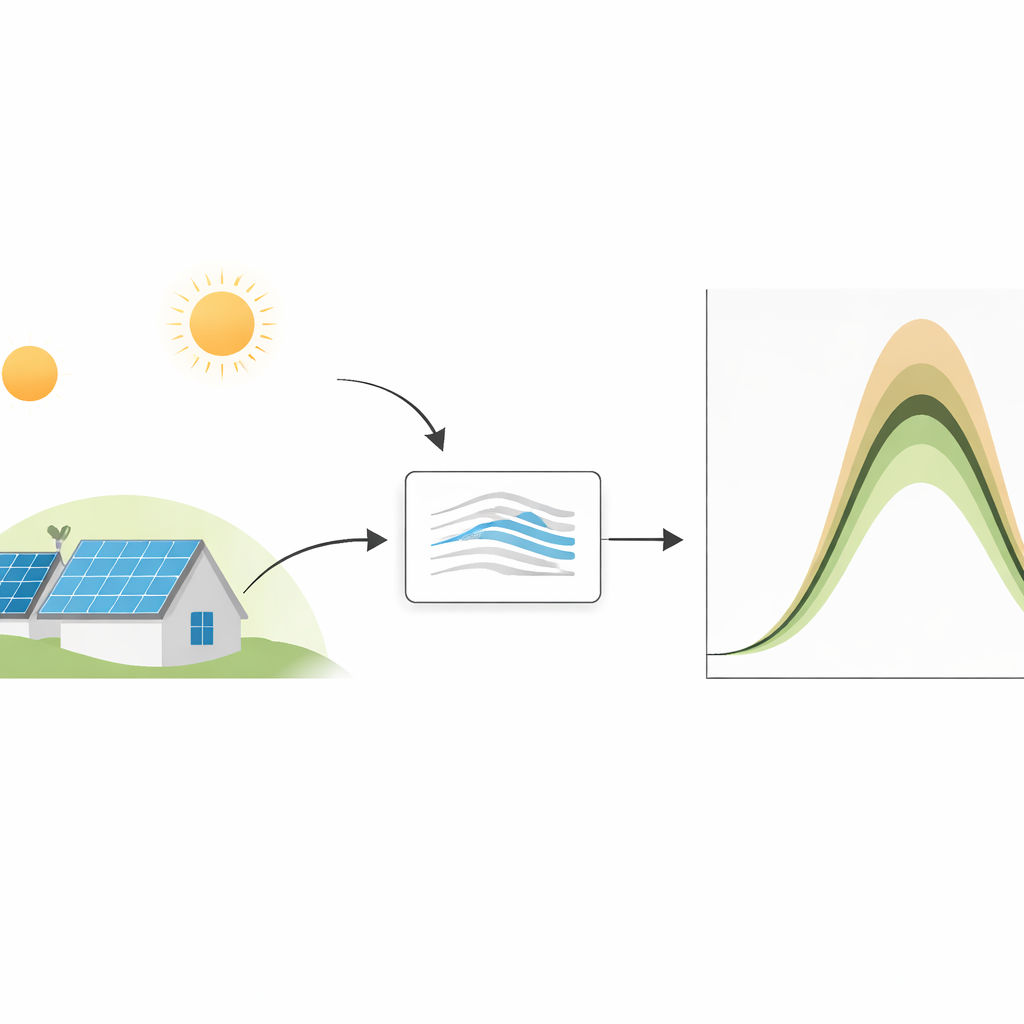
As more homes, businesses, and utilities turn to solar panels for clean electricity, power grids must juggle a resource that changes with every passing cloud. Grid operators need to know not just how much solar power is likely to be available an hour from now, but also how uncertain that forecast is. This paper presents a new way to put “error bars” around short‑term solar power predictions so that planners can keep the lights on while relying more confidently on the sun.
From single guesses to risk‑aware forecasts
Traditional solar forecasts often boil the future down to a single number, such as “2.5 kilowatts next hour.” In reality, solar output swings with weather and time of day, and grid decisions—like how much backup power to schedule—depend on how sure we are about those numbers. Modern approaches therefore use probabilistic forecasting: instead of one value, they provide a range of likely outcomes along with an indication of how often the true value should fall inside that range. This study focuses on hour‑ahead forecasts for rooftop panels at a university in Wroclaw, Poland, using five years of historical data. The aim is to produce prediction intervals that are both reliable (they contain the true power most of the time) and sharp (the intervals are as narrow as possible, avoiding uselessly broad ranges).
A smarter way to adjust uncertainty
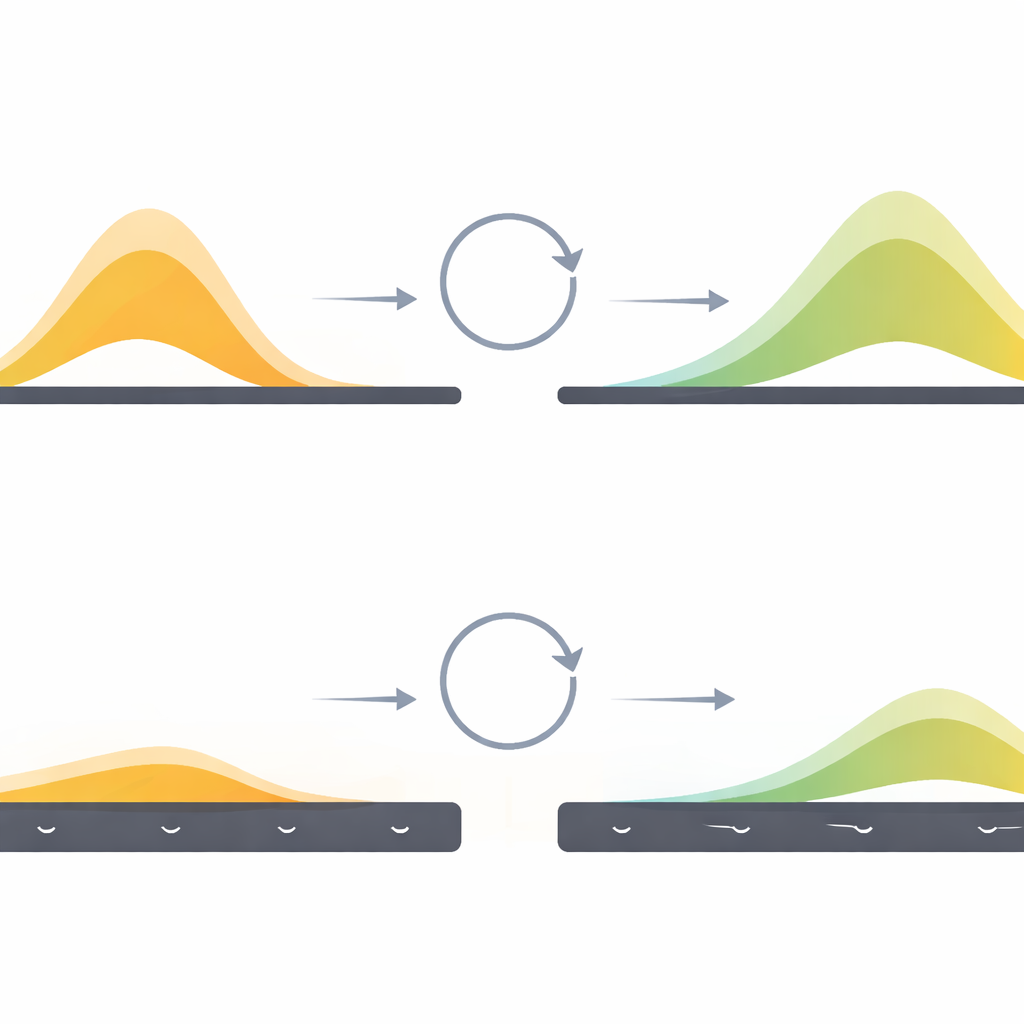
The central technique explored here is Adaptive Conformal Inference, or ACI. In simple terms, ACI wraps around any forecasting model—here, a deep learning network called a stacked LSTM—and looks at recent forecast errors to decide how wide the next prediction interval should be. If recent predictions have missed the mark, ACI automatically widens the interval; if they have been accurate, it tightens the range. Standard ACI, however, assumes that data change smoothly over time. Solar power does not: every night, output drops to zero, and the first rays of morning bear little resemblance to what happened the previous evening. This diurnal stop‑and‑start pattern can cause the ACI adjustment parameter to drift, inflating intervals over time.
Resetting each day for a fresh start
To fix this mismatch, the authors introduce a simple but powerful twist: they reset ACI’s internal “miscoverage” parameter at the beginning of each day. Conceptually, this tells the algorithm to forget the long, uneventful hours of darkness and recalibrate based only on daytime behavior. The base LSTM still learns patterns from years of data, including seasonal changes and typical daily shapes, but the ACI layer no longer lets nighttime zeros distort its sense of uncertainty. This daily reset keeps the intervals from becoming unnecessarily large after sequences of low‑information periods and allows the method to adapt quickly to each day’s sunlight conditions, whether clear, cloudy, or highly variable.
How the new method stacks up
The study compares four ways of expressing uncertainty around solar forecasts: the modified ACI, a deep model trained to predict several quantiles directly (Deep Quantile Regression), a Bayesian version of the LSTM that estimates uncertainty internally, and a powerful tree‑based algorithm called CatBoost tuned for quantile prediction. Tests are run on one year of unseen data. The modified ACI achieves the highest reliability, with its intervals containing the true power about 91% of the time, close to the intended target, while keeping the interval width modest. The Bayesian LSTM comes next in reliability but produces somewhat wider ranges. CatBoost delivers the tightest intervals but misses the real values more often, underestimating uncertainty. Deep Quantile Regression performs worst overall, combining lower coverage with wider intervals and higher penalty scores. Importantly, the improved ACI accomplishes its strong performance with only a small computational cost added on top of the base LSTM model.
What this means for future solar grids
In practical terms, the work shows that better handling of the day‑night rhythm can noticeably improve the quality of solar power risk estimates. By resetting its calibration each morning, the modified ACI approach provides confidence bands that are both trustworthy and reasonably narrow, making it easier for grid operators and energy managers to plan reserves, trade power, and integrate more solar without overreacting to uncertainty. Because ACI is model‑agnostic and does not rely on detailed weather forecasts, the authors argue that this daily‑reset scheme could be applied broadly to other solar installations and forecasting tools, offering a robust, data‑driven way to make the sun a more predictable partner in tomorrow’s energy systems.
Citation: Suresh, V., Revathi, B.S. & Guerrero, J.M. A non-parametric adaptive conformal inference based probabilistic hour-ahead solar PV power forecasting method. Sci Rep 16, 11730 (2026). https://doi.org/10.1038/s41598-026-40911-x
Keywords: solar power forecasting, probabilistic prediction, uncertainty quantification, conformal inference, renewable energy grids