Clear Sky Science · en
Quantum linear solvers for scientific computing: a comparison of VQLS, HHL and quantum annealing on time-fractional diffusion problems
Why this quantum story matters
Many real‑world processes—from how contaminants spread in groundwater to how medicines move through tissue—do not diffuse in the smooth, predictable way described in school textbooks. Capturing this "anomalous" spreading accurately leads to very hard math problems that stretch today’s computers. This paper asks a timely question: can different kinds of quantum machines help solve these tough diffusion calculations faster or more efficiently, and if so, how do they compare?
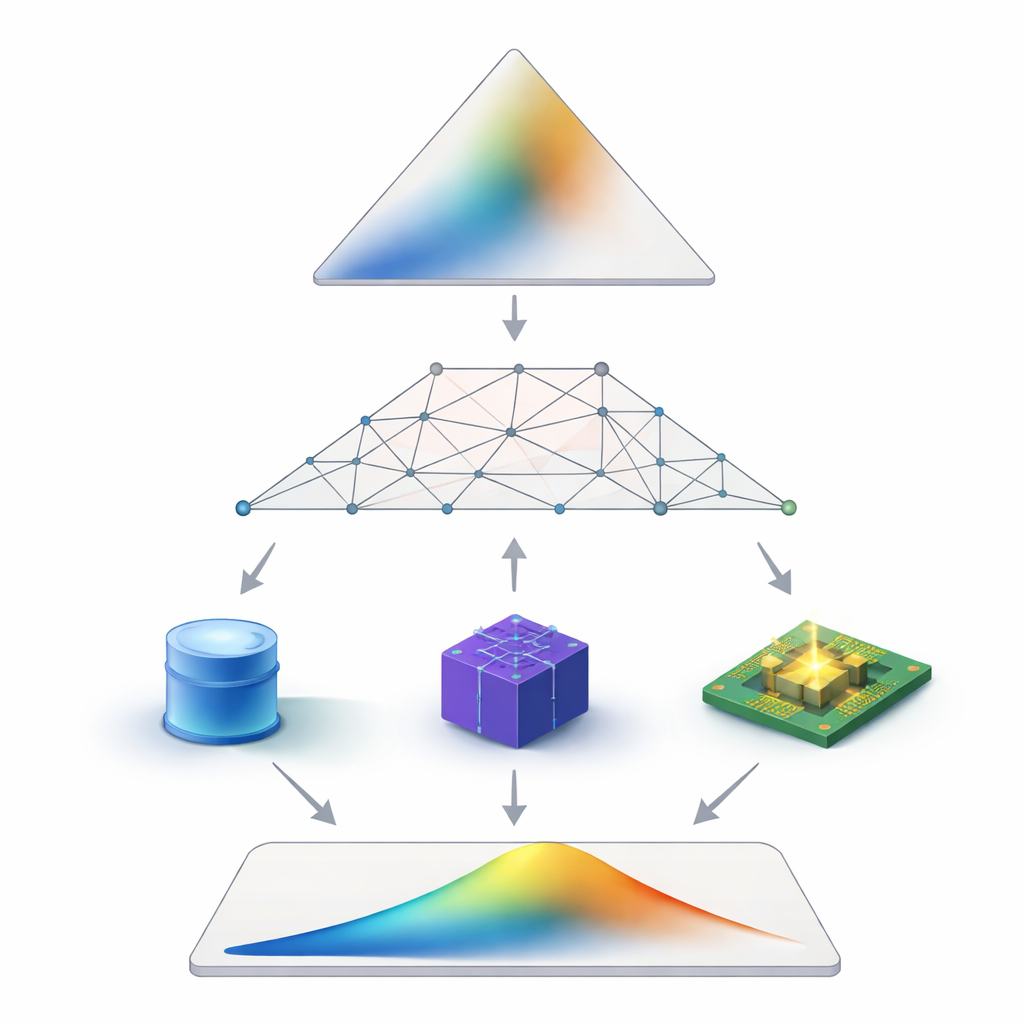
Strange spreading in real materials
The work centers on time‑fractional diffusion equations, a modern twist on the classic diffusion equation. Instead of assuming that particles wander randomly with short memory, these models explicitly build in history: what happened long ago can still affect how things spread now. That makes them powerful for describing slow, sticky, or jumpy transport in physics, biology, and engineering. The downside is that this “memory” makes the equations much harder to solve on a computer, especially when fine detail in both space and time is required.
Turning the physics into a solvable puzzle
Before any quantum hardware can step in, the continuous equation must be translated into a finite system of linear equations. The author does this with a specialized numerical technique called the WEB‑spline finite element method. In simple terms, the region of interest is cut into a carefully chosen grid, and smooth building blocks are used to approximate the solution while respecting boundaries. The result is a family of large, sparse, and well‑behaved matrices that faithfully capture the peculiar diffusion behavior. As the grid is refined, these matrices grow in size but remain mostly filled with zeros—exactly the structure that many quantum algorithms are designed to exploit.
Three quantum routes to the same goal
With the hard physics now encoded as linear systems, the paper evaluates three quantum strategies for solving them. The variational quantum linear solver (VQLS) uses a hybrid approach: a short, tunable quantum circuit proposes a candidate answer and a classical optimizer repeatedly tweaks the circuit to reduce the mismatch with the right‑hand side. This design fits current noisy devices and achieves high accuracy on test problems, but at the cost of many optimization steps and growing circuit complexity as the system size increases. The Harrow–Hassidim–Lloyd (HHL) algorithm instead follows a more rigid recipe built on quantum phase estimation. For the same matrices, HHL can, in principle, prepare an almost exact solution state with an exponential speed advantage in problem size, but only if one has deep, precise circuits and low noise—features expected from future fault‑tolerant quantum computers rather than today’s prototypes.
Quantum annealing as an energy‑minimizing shortcut
The third route, quantum annealing, reformulates the linear system as an energy landscape: the best solution corresponds to the lowest energy configuration of many interacting binary variables. Specialized annealing devices, or their classical emulators, then search this landscape by slowly transforming an initial simple state into one that prefers low‑energy patterns. In the study, this is implemented through a quadratic unconstrained binary optimization (QUBO) model. Annealing successfully produces approximate solutions using only classical bitstrings at the output—no delicate quantum state reconstruction is needed—but its accuracy plateaus around a fixed error level while its runtime grows steeply with both problem size and the number of binary digits used in the encoding.
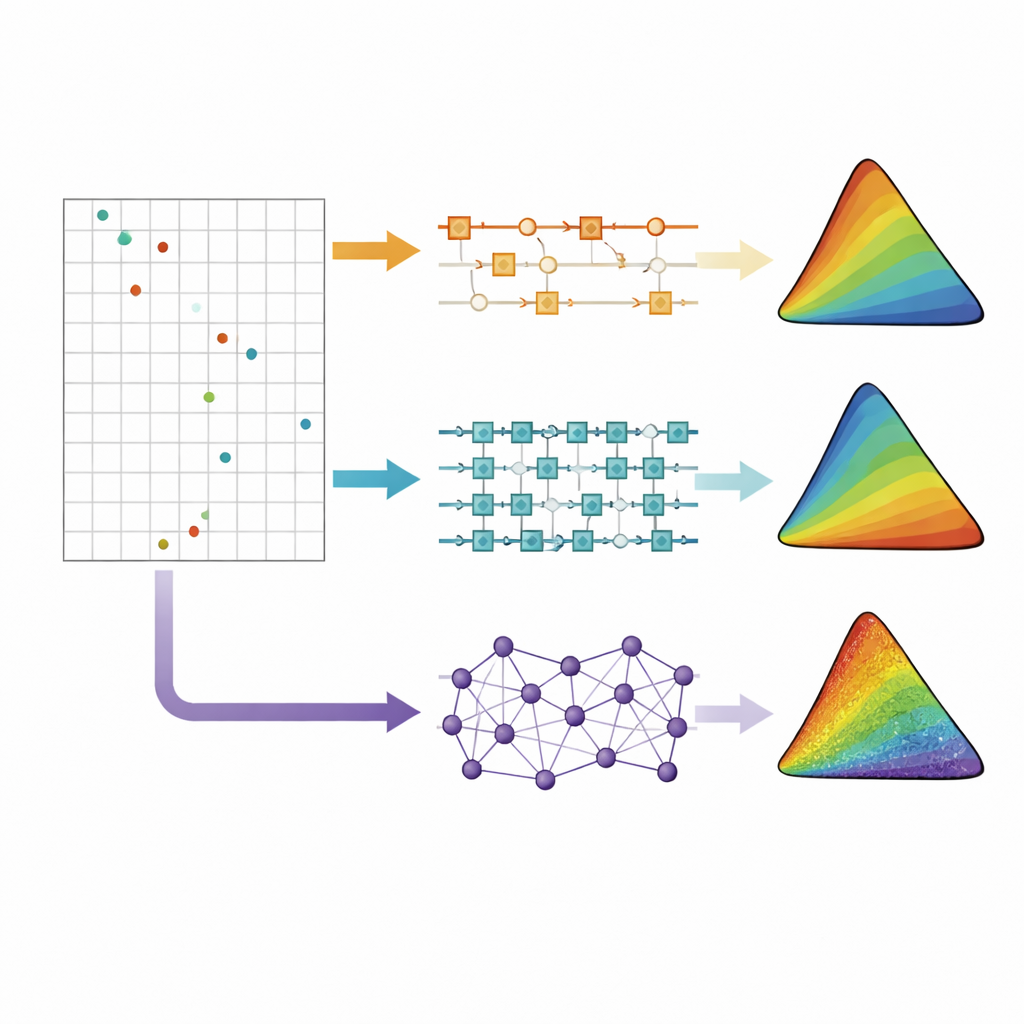
What the head‑to‑head tests reveal
To compare these approaches fairly, the author runs all three on the same benchmark time‑fractional diffusion problem built from the WEB‑spline discretization. The tests track how many qubits are needed, how deep the circuits must be, how long simulations take, and how close the answers come to a high‑quality classical solution. VQLS consistently reaches very small residual errors when given sufficiently expressive circuits, with modest qubit counts but nontrivial optimization time. HHL circuits grow deeper and require more qubits as precision increases, yet they deliver sharp improvements in error for each extra slice of phase‑estimation accuracy. Quantum annealing, by contrast, shows roughly constant solution quality regardless of mesh refinement, while total runtime and effective qubit demand increase rapidly with problem size.
Take‑home message for future quantum solvers
Seen through a non‑specialist lens, the paper’s message is that no single quantum approach wins outright. Variational methods look most practical for the current generation of quantum processors, trading guaranteed speedups for flexibility and robustness to noise. HHL showcases the kind of exact, asymptotically powerful algorithm that could shine once fault‑tolerant quantum computers arrive. Quantum annealing, finally, offers a direct way to get usable, classical answers for certain structured problems but struggles to improve accuracy as the physics model is refined. Together, these results show that carefully combining advanced numerical discretization with different quantum strategies can open new paths to simulating complex, memory‑rich transport—hinting at a future where quantum‑enhanced solvers become a standard tool in scientific computing.
Citation: Shayegan, A.H.S. Quantum linear solvers for scientific computing: a comparison of VQLS, HHL and quantum annealing on time-fractional diffusion problems. Sci Rep 16, 10278 (2026). https://doi.org/10.1038/s41598-026-40910-y
Keywords: quantum linear solvers, fractional diffusion, variational quantum algorithms, HHL algorithm, quantum annealing