Clear Sky Science · en
Policy-driven carbon sink enhancement in dryland cities: a case study of Urumqi, a core city on China’s New Silk Road
Why this desert city matters for the climate
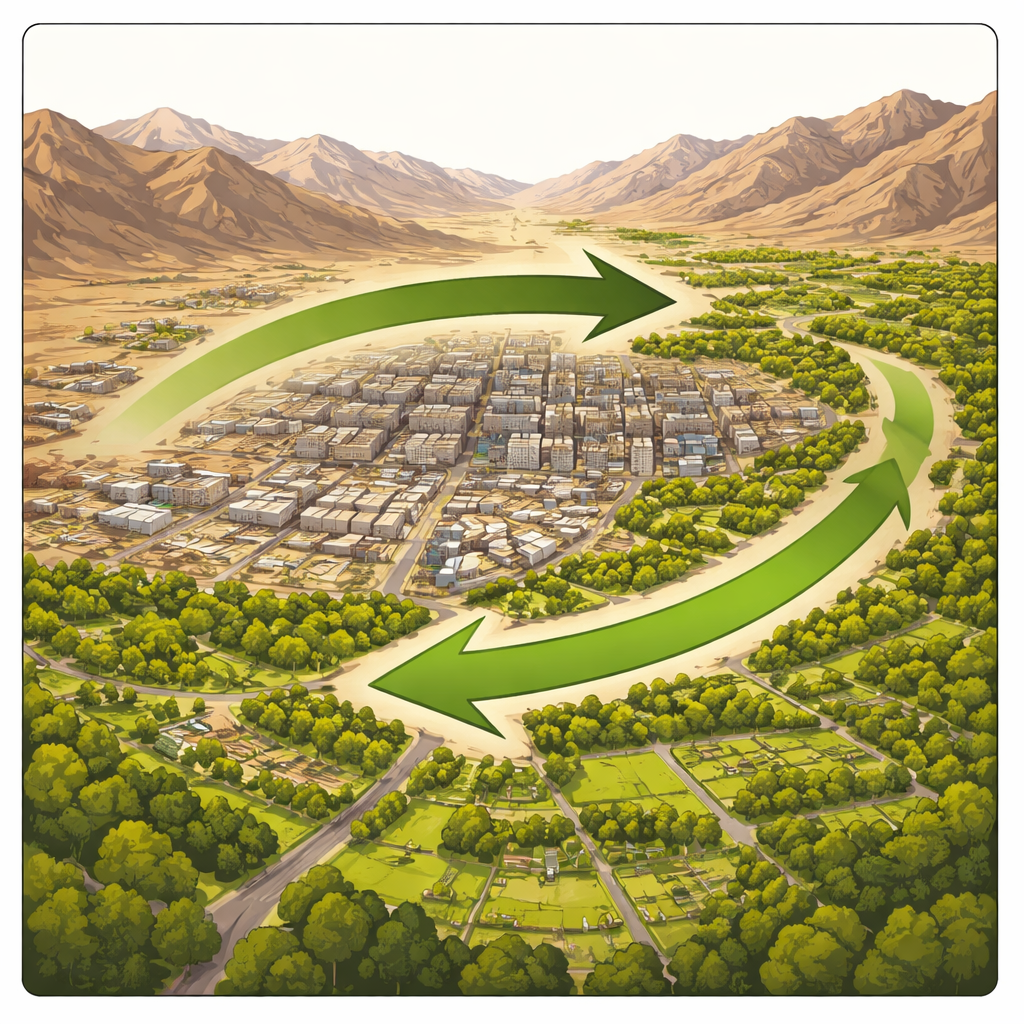
Dryland cities are often seen as environmental trouble spots: fast-growing, short on water, and surrounded by fragile landscapes. This study looks at Urumqi, a major city on China’s New Silk Road, to ask a hopeful question: can careful planning turn such a place into a stronger “carbon sponge” that pulls heat‑trapping carbon dioxide out of the air, even while it continues to grow?
Taking the pulse of a city’s green life
The researchers focused on a measure called net ecosystem productivity, which is essentially the balance between how much carbon plants in an area absorb and how much is released back to the air from soils. Using a suite of satellite data and climate records at a fine 30‑meter scale, they tracked this balance across Urumqi from 2005 to 2020. They combined an established plant growth model with a soil breathing model to estimate where the land acts as a carbon sink (taking in more carbon than it releases) and where it behaves as a carbon source. This approach let them “map” the city’s invisible carbon flows over time and space, rather than treating the urban area as a single average number.
Where the city breathes in and where it breathes out
The maps revealed a striking pattern. Urumqi’s greener southern suburbs and nearby mountain areas behaved as strong carbon sinks, with some spots storing far more carbon than they released each year. In contrast, the heavily built and industrial north showed patches that were slight carbon sources, where soil and human activities outweighed plant uptake. Overall, the city’s land remained a net sink over more than 90% of its area, and total sink strength grew by about a quarter over 15 years. Yet most places changed only slightly, suggesting that the city’s overall carbon‑absorbing power was stable rather than booming.
How rules on land use change the outcome
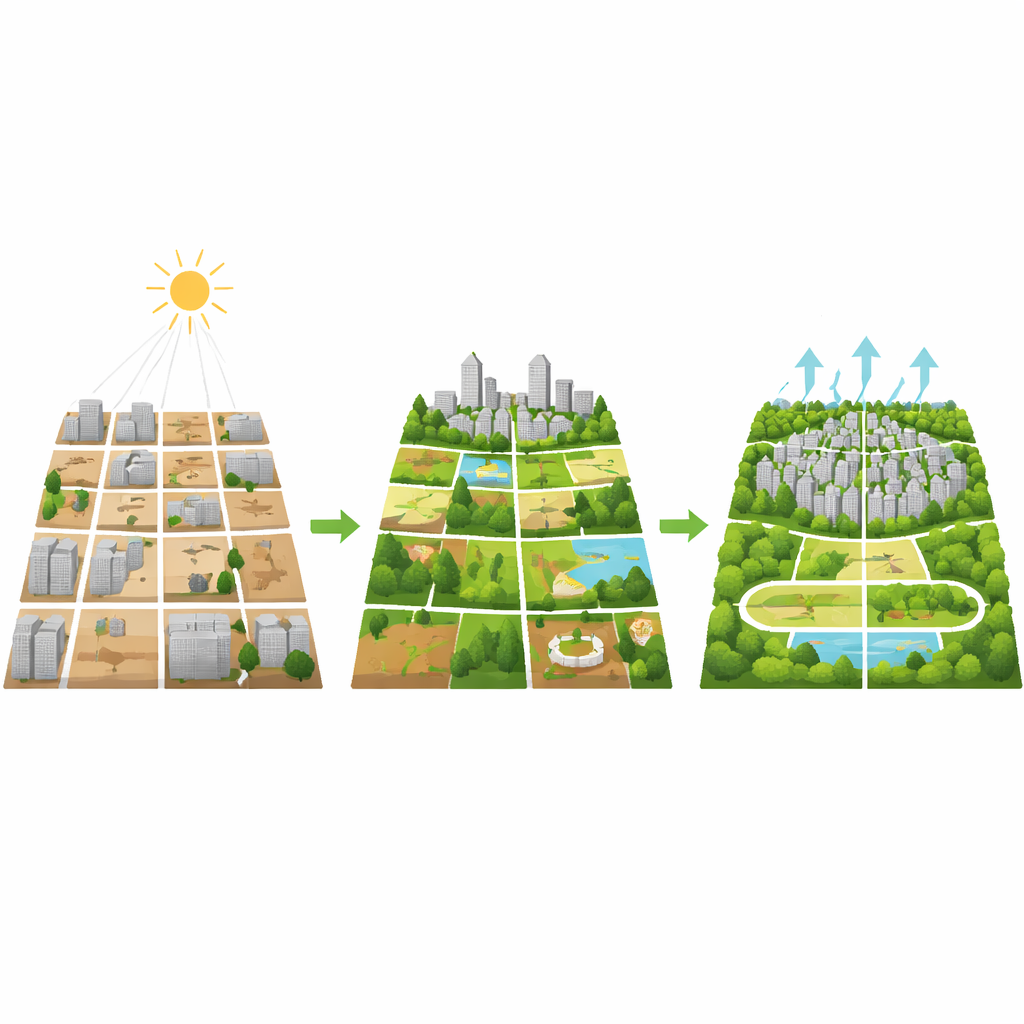
A key turning point came around 2010, when “ecological redline” policies began to protect and restore sensitive land, such as forests, croplands, and grasslands. By comparing time trends and applying machine‑learning methods, the team could tease apart the effects of climate swings from the effects of policy and land planning. They found that areas targeted by these rules showed clear boosts in carbon sink strength—almost a 19% average rise in high‑response zones—while most of the city showed no statistically strong trend. In other words, new protections and green projects did not lift the entire urban area equally, but they did create powerful local “hotspots” of carbon storage where land use was changed on purpose.
Nature, people, and policy working together
To understand what mattered most, the authors fed many possible influences into a random‑forest machine‑learning model, including vegetation condition, rainfall, temperature, population, economic activity, night‑time lights, and land‑use type. The clear winner was land use and land cover change: how much of the surface was cropland, forest, grassland, water, built‑up, or unused. This factor outweighed individual climate measures or economic indicators. Greener, better‑connected patches of vegetation reliably went hand‑in‑hand with stronger carbon sinks, while more intense urban lighting—standing in for denser development—tended to pull in the opposite direction.
What this means for dryland cities everywhere
For non‑specialists, the message is both sobering and encouraging. Rapid growth in a dry place does not automatically doom a city to lose its natural carbon‑absorbing capacity, but progress will not happen by accident. In Urumqi, strong planning rules and targeted restoration reshaped certain districts into robust carbon sinks, even as other areas remained under pressure from sprawl and a warming, drying climate. The study shows that with smart land use—protecting key green belts, improving the continuity of parks and fields, and steering expansion away from fragile zones—dryland cities can strengthen their role as allies in climate action while still pursuing development.
Citation: Zhang, W., Baidourela, A., Ma, F. et al. Policy-driven carbon sink enhancement in dryland cities: a case study of Urumqi, a core city on China’s New Silk Road. Sci Rep 16, 11083 (2026). https://doi.org/10.1038/s41598-026-40905-9
Keywords: urban carbon sinks, dryland cities, land use planning, ecological restoration, remote sensing