Clear Sky Science · en
Assessing graphite schist as a supplementary cementitious material in concrete for antifungal activity, strength, hydration, microstructure, and radiation shielding
Cleaner concrete for a warming world
Concrete is everywhere in our built environment, but making its key ingredient, Portland cement, releases large amounts of carbon dioxide. This study explores whether a naturally occurring rock called graphite schist can partly replace cement in concrete. If it works, we could cut emissions from construction, gain resistance to harmful fungi, and even fine‑tune how concrete blocks radiation in hospitals and nuclear facilities.
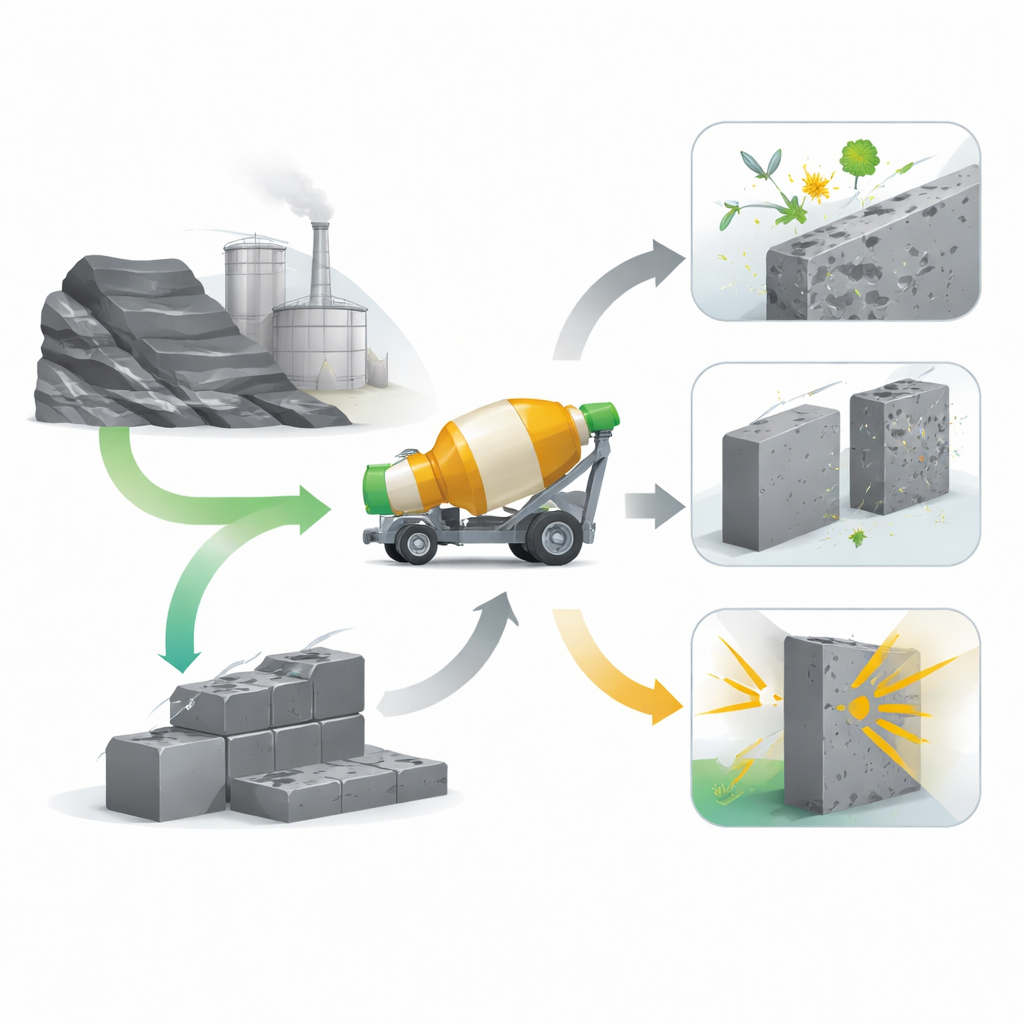
Turning a common rock into a helpful ingredient
Graphite schist is a layered metamorphic rock found in Egypt’s Eastern Desert. The researchers crushed and ground this rock into a fine powder and blended it into concrete, replacing either 10 or 15 percent of the cement by weight. They then compared these mixes with ordinary concrete, checking not only strength and durability but also how the concrete behaved under heat, fungal attack, and exposure to different types of radiation. Because the schist’s main minerals have low density and smooth, plate‑like shapes, the team expected it to act more as a space‑filling additive than as a highly reactive cement substitute.
What happens inside the concrete
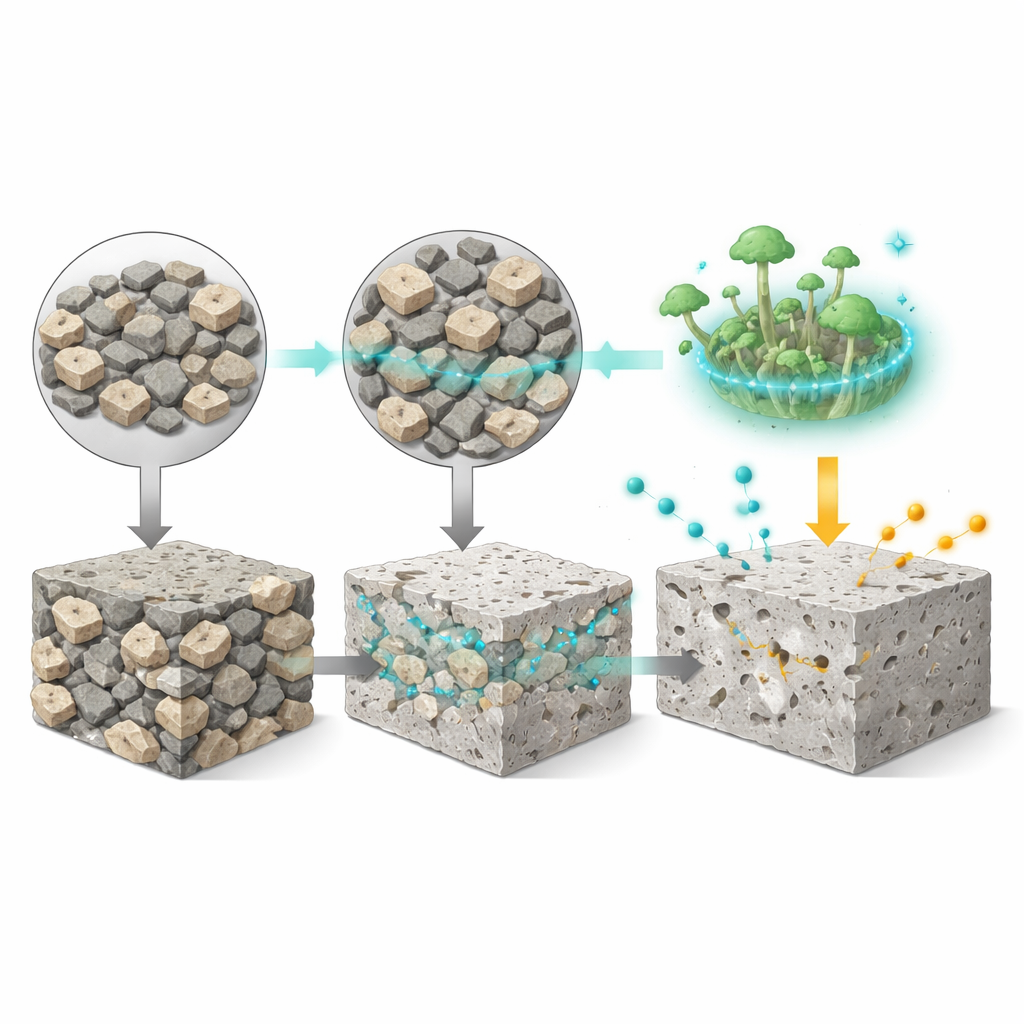
At the microscopic level, the graphite schist particles were smaller and had roughly twice the surface area of cement grains. This allowed them to slip into gaps between cement particles, helping pack the mixture more tightly. However, chemical tests showed that the schist itself did not significantly join in the cement’s hardening reactions. Instead, it behaved mainly as an inert filler. In mixes with 10 percent replacement, this packing effect modestly improved the internal structure around the sand and stone grains, especially at the thin border region where cracks often start. At 15 percent replacement, the benefits were outweighed by problems: more unreacted cement grains, extra pores, and microscopic cracks that weaken the material.
Balancing strength, fungi, and fire
The concrete containing 10 percent graphite schist lost some early strength compared with ordinary concrete, but the gap narrowed over six months as the remaining cement continued to hydrate. By contrast, the 15 percent mix showed a clearer drop in strength. Despite this, the rock powder brought notable advantages. It remained stable when heated up to 800 degrees Celsius, suggesting that concrete with this additive could fare better in severe fires. In separate petri‑dish tests, the graphite schist strongly inhibited the growth of several troublesome fungi, often more effectively than cement alone. This antifungal behavior appears to arise from its high surface area and mineral content, which together stress and damage fungal cells.
Shaping how concrete blocks radiation
Because concrete is frequently used to shield people and equipment from radiation, the team also tested how the new mixes handled fast neutrons and gamma rays. Adding graphite schist slightly improved the blocking of fast neutrons, thanks to light elements such as hydrogen and carbon in its minerals that are good at slowing these particles. But the same addition reduced the concrete’s density and increased its porosity, which harmed its ability to stop highly penetrating gamma rays. The 10 percent mix offered only a small gain in neutron shielding while suffering a noticeable loss in gamma‑ray protection, and the 15 percent mix performed even worse in this respect.
Where this new concrete could fit
Overall, the study suggests that graphite schist can serve as a multifunctional mineral additive when used at about 10 percent replacement of cement. In that range it helps cut cement use and associated emissions, adds promising antifungal and fire‑resistant features, and gives a mild boost to neutron shielding, though at the cost of weaker gamma‑ray protection and slightly lower strength. Such concrete may be best suited for non‑critical structural elements or specialized applications where fungal resistance and fire stability matter more than maximum strength or top‑tier radiation shielding. With further tuning of the mix and water content, graphite schist could become a useful tool for making smarter, more sustainable concrete.
Citation: Serry, M., Zayed, A.M., Tagyan, A.I. et al. Assessing graphite schist as a supplementary cementitious material in concrete for antifungal activity, strength, hydration, microstructure, and radiation shielding. Sci Rep 16, 12019 (2026). https://doi.org/10.1038/s41598-026-40900-0
Keywords: low-carbon concrete, cement replacement, antifungal materials, radiation shielding, graphite schist