Clear Sky Science · en
Interpretable Taxi-Out Time Prediction of Departure Flights Using Stacking Ensemble Learning and SHAP Analysis
Why Time on the Tarmac Matters
Anyone who has sat on a plane waiting to take off knows how frustrating those extra minutes on the ground can be. Beyond annoyance, long waits before takeoff waste fuel, pump more carbon dioxide into the air, and ripple through the flight schedule for the rest of the day. This study looks at how to predict that "taxi-out" time more accurately and, just as important, in a way that airport staff can actually understand and trust when making real-time decisions.
What Happens Between Leaving the Gate and Takeoff
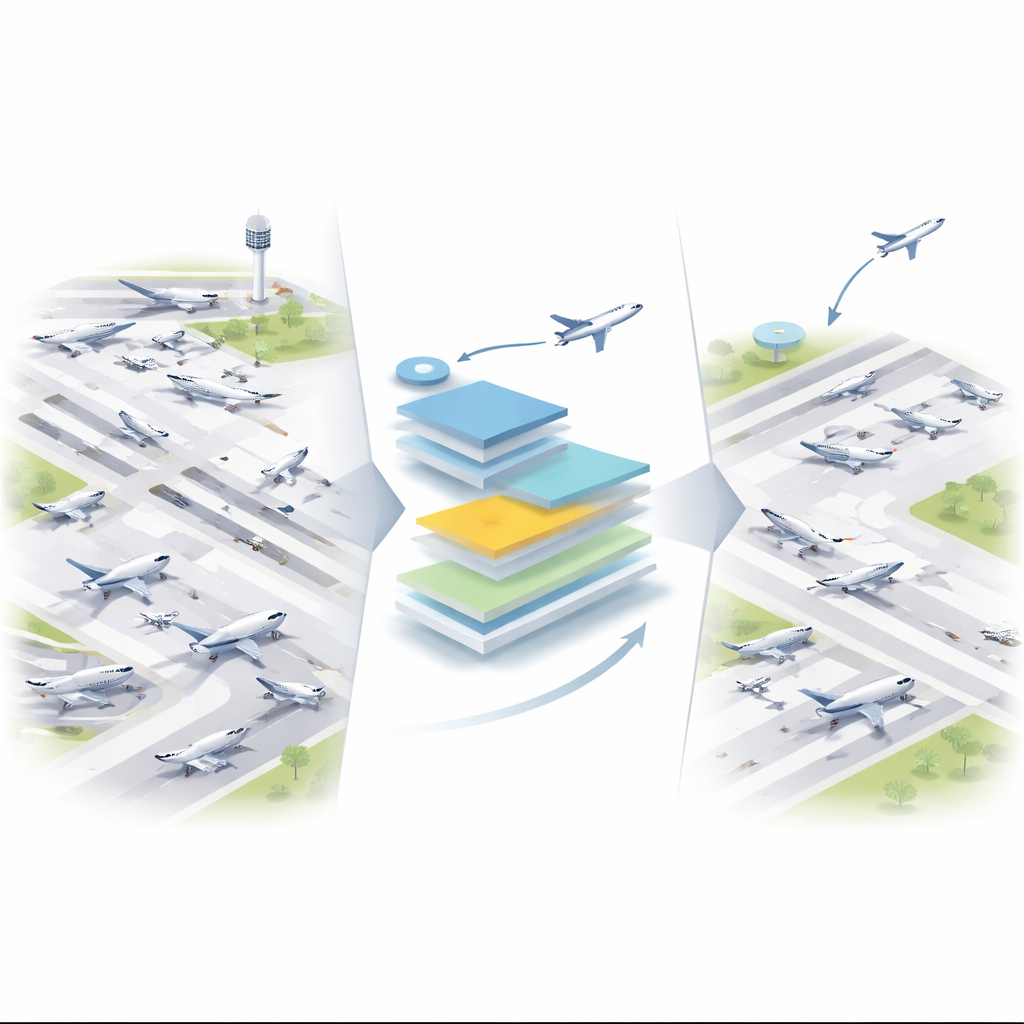
Taxi-out time is the stretch between when an aircraft pushes back from the gate and when it finally lifts off. It depends on two broad pieces: how the airport is built and how busy it is at that moment. The authors separate taxi-out time into an "unimpeded" portion—the fastest the plane could reasonably move across the airfield with no congestion—and a "dynamic" portion that captures extra delay from queues and conflicts with other aircraft. This split lets them ask a simple question: which factors are tied to the layout of the airport itself, and which are tied to crowding on the runways and taxiways?
Turning Airport Operations into Data
The team used detailed records from Shenzhen Bao’an International Airport in China, covering 14 busy days and more than 12,000 flights. From the airport’s decision-support system they extracted times for gate departure, landing, pushback, and takeoff, then cleaned the data to remove abnormal values. They turned the complex surface dance of planes into a set of numeric features: how many planes were taking off or landing during a given aircraft’s taxi, how long flights had been taking on average in the last half hour, how far the aircraft had to travel from its stand to the runway, and how stands, airlines, and aircraft types tended to behave based on historical patterns. Together, these factors describe both the fixed layout of the airfield and the constantly changing traffic picture.
A Layered Learning Approach to Prediction
Rather than rely on a single prediction method, the study uses a technique called stacking, which combines several machine learning models like layers in a cake. Each base model makes its own guess about taxi-out time; a final "meta" model then learns how best to blend those guesses. This layered approach, trained and tested with rigorous cross-validation, achieved state-of-the-art accuracy: about 41 percent of flights were predicted within one minute, and over 96 percent within five minutes. The authors also compared one-shot prediction of total taxi-out time with a phase-based approach that predicts unimpeded time and extra delay separately. The all-at-once method was slightly more accurate, but the two-phase method made it clearer how different factors shape different parts of the taxi.
Opening the Black Box with Clear Explanations
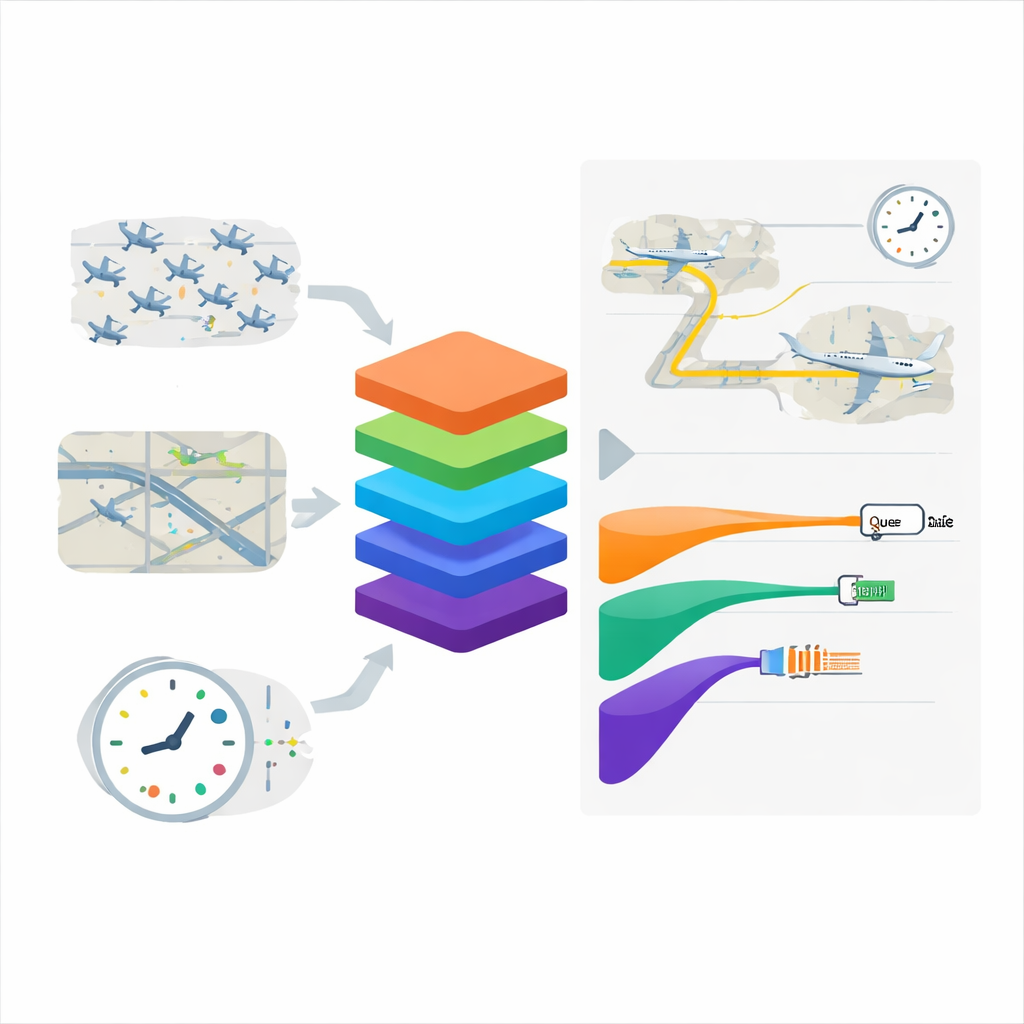
High accuracy alone is not enough when safety and capacity decisions are on the line; controllers need to know why a model makes a given prediction. To tackle this, the authors apply a tool called SHAP, which assigns each input factor a contribution to the predicted taxi-out time for a specific flight. This reveals that crowding-related factors—how many planes are in the departure and arrival queues, and how long recent taxis have taken—dominate the extra delay portion. In contrast, infrastructure-related features such as stand location, airline habits, and taxi distance mainly shape the baseline unimpeded time. By combining correlation checks with SHAP scores, the team also trims away less useful inputs, keeping the model simpler without sacrificing performance.
What This Means for Passengers and the Planet
Put plainly, the study shows that we can forecast how long a plane will spend between gate pushback and takeoff with high precision, and we can explain those forecasts in a way that lines up with how airports actually work. The model not only predicts when a flight is likely to get off the ground, it also highlights which factors—like a growing arrival queue or a surge of simultaneous pushbacks—are driving extra delay. That insight gives airports a practical way to adjust pushback times, manage queues, and cut down on idle fuel burn. For travelers, that could mean fewer mysterious waits on the tarmac; for airlines and airports, it offers a path toward smoother operations and lower emissions.
Citation: Wu, T., Mao, Y., Huang, J. et al. Interpretable Taxi-Out Time Prediction of Departure Flights Using Stacking Ensemble Learning and SHAP Analysis. Sci Rep 16, 10066 (2026). https://doi.org/10.1038/s41598-026-40898-5
Keywords: taxi-out time prediction, airport surface operations, machine learning in aviation, flight delay management, air traffic congestion