Clear Sky Science · en
Development of a spontaneous disease diagnosis tool by executing an enhanced convolutional neural network model for citrus fruits and leaves
Why smart tools for sick citrus matter
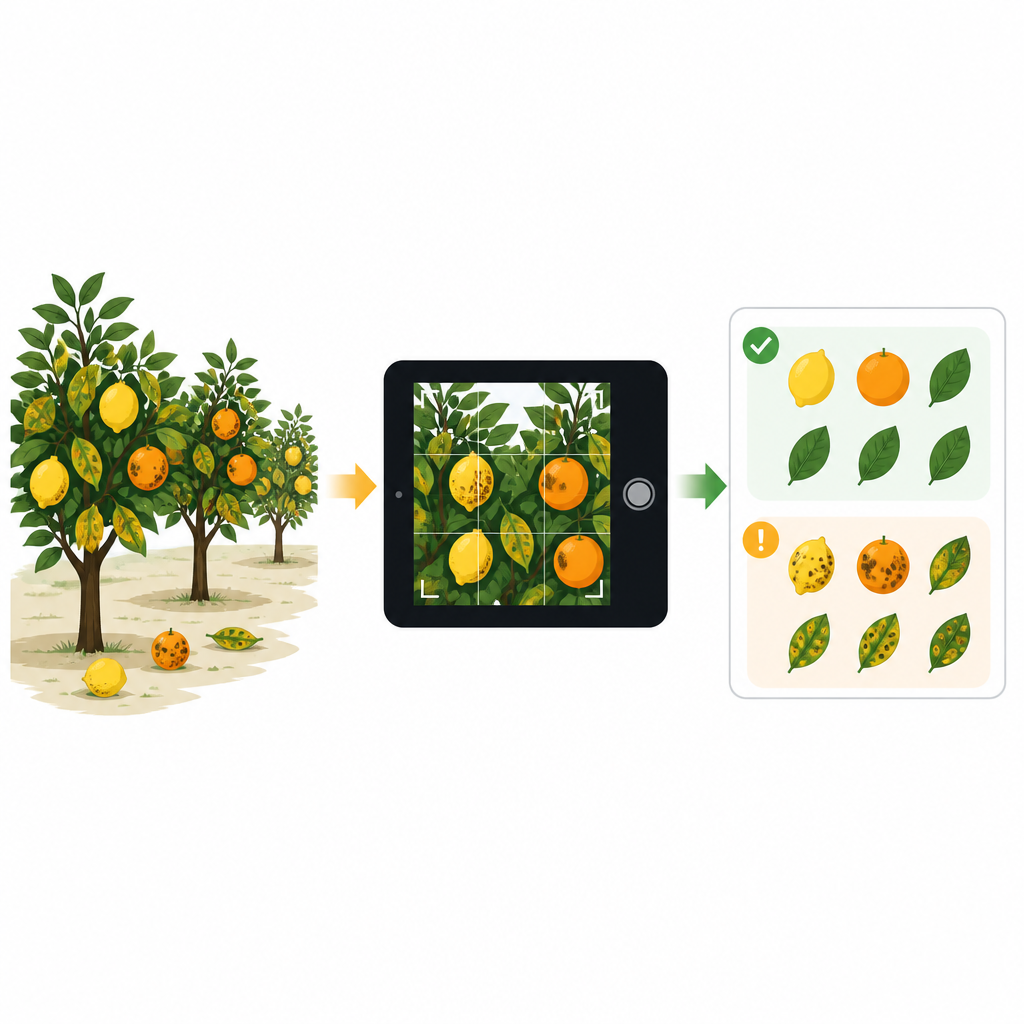
Citrus fruits like oranges and lemons brighten our kitchens and support global trade, but they are surprisingly vulnerable to hidden diseases that scar peels, weaken trees, and shrink harvests. Farmers often rely on slow, laborious visual checks to spot trouble, which means infections can spread before anyone notices. This study describes a computer vision system that learns from photos of citrus leaves and fruits to flag disease automatically and with very high accuracy, offering a practical way to protect yields and reduce waste.
How bad spots on fruit become a big problem
Citrus can suffer from several stubborn diseases, including canker, black spot, greening, and greasy spot. These infections can leave blemishes, cause fruit to drop early, and in severe cases wipe out large portions of an orchard. Because many symptoms start as small specks or subtle discoloration, even experienced workers can miss early warning signs, especially when managing vast farms. Missed or late detection leads directly to economic losses for growers and exporters, and can threaten the steady supply of vitamin-rich fruit that consumers expect year-round.
Teaching computers to read leaf and fruit photos
The researchers set out to replace slow manual checks with a camera-based system that can sort healthy from diseased citrus using ordinary images. They tested three kinds of computer models on a public dataset of nearly 760 pictures of citrus leaves and fruits: a basic machine learning method called K-Nearest Neighbours, a standard deep learning model known as a convolutional neural network, and an enhanced version of that network the authors call ICNN. Each model was trained to recognize visual patterns linked to different disease types or to healthy plants, using images resized and cleaned so that the computer could focus on meaningful details.
From raw pixels to telltale patterns
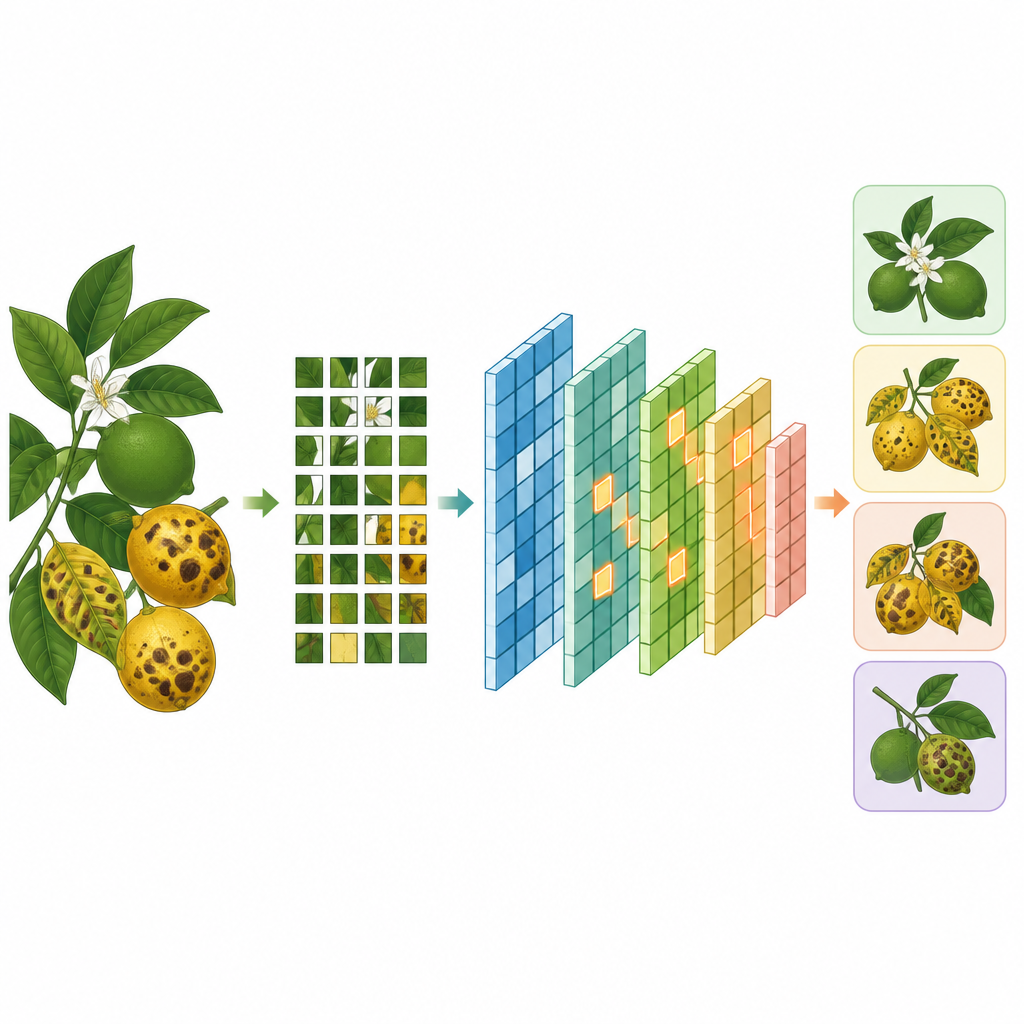
For the simpler machine learning approach, the team first had to handcraft numerical descriptions of each image. They measured aspects like how smooth or rough the leaf surface looked, how colors were distributed, and how much neighboring pixels differed in brightness. These 13 texture and color features formed a compact fingerprint for each sample, which the K-Nearest Neighbours method used to decide whether a new image resembled previously seen healthy or diseased examples. In contrast, the deep learning models skipped this manual step: they learned on their own which edges, spots, and color shifts mattered most, layer by layer, directly from the raw pictures.
What makes the improved network different
The ICNN model builds on standard image-recognition networks but adds several refinements designed for tricky plant images. It uses multiple sets of filters in early layers to capture both fine details, like tiny spots, and broader color patches across the leaf. Special attention modules nudge the network to focus more strongly on infected regions instead of plain background. Other components, such as dropout and batch normalization, help prevent the model from simply memorizing the training photos and instead generalize to new orchard conditions. The team also tackled imbalanced data by carefully resampling classes and adjusting the way errors were counted during training.
How well the smart sorter actually works
When the three approaches were put to the test, they showed clear differences. The basic K-Nearest Neighbours method achieved respectable but imperfect performance, with some misclassifications and sensitivity to noisy images. The standard convolutional network performed much better, correctly identifying nearly all samples. The enhanced ICNN went a step further, reaching about 99.7 percent accuracy across five rounds of cross-validation, with only one or two mistakes in hundreds of test images. Even against other well-known deep models such as ResNet and Inception, the ICNN slightly improved on accuracy while remaining efficient enough for practical use.
What this means for growers and consumers
To a non-specialist, the takeaway is straightforward: by learning to “read” subtle color and texture cues in photos of citrus plants, an improved deep learning system can flag disease early and reliably. If built into phone apps or farm monitoring tools, such a system could give farmers near-instant feedback from a quick snapshot, helping them treat problems sooner, protect yields, and reduce the need for costly expert visits. Although the current study relies on curated images and focuses on citrus only, it shows how smart image analysis can become an everyday aid in keeping fruit trees healthy and our supply of oranges and lemons more secure.
Citation: Arunapriya, R., Valli, S.P. Development of a spontaneous disease diagnosis tool by executing an enhanced convolutional neural network model for citrus fruits and leaves. Sci Rep 16, 15092 (2026). https://doi.org/10.1038/s41598-026-40896-7
Keywords: citrus disease, plant imaging, deep learning, fruit health, smart farming