Clear Sky Science · en
Reversible magnetic behavior in amorphous wires for precision sensing applications
Resettable metal wires for ultra-precise sensors
From smartphones to medical scanners, many modern devices quietly rely on tiny magnetic sensors. The study behind this article explores a special kind of metal wire that can have its magnetic behavior switched on demand and then reset, without damage. This “rewritable” property could help build sensors that stay accurate for years, even in demanding environments like cars, factories, or medical equipment.
Why these unusual wires matter
The researchers focus on hair-thin metal wires made from a blend of cobalt, iron, silicon, and boron. Unlike ordinary metal, these wires are amorphous, meaning their atoms are arranged more like a frozen liquid than a crystal. This structure gives them very soft magnetic behavior: they switch magnetization easily and respond sensitively to tiny magnetic fields. Such qualities are ideal for precision sensing, but only if their response can be carefully shaped and kept stable over time. A long-standing challenge has been to adjust their internal magnetic “easy directions” in a controlled way and, crucially, to undo those adjustments when needed.
Twisting magnetism with heat and pull
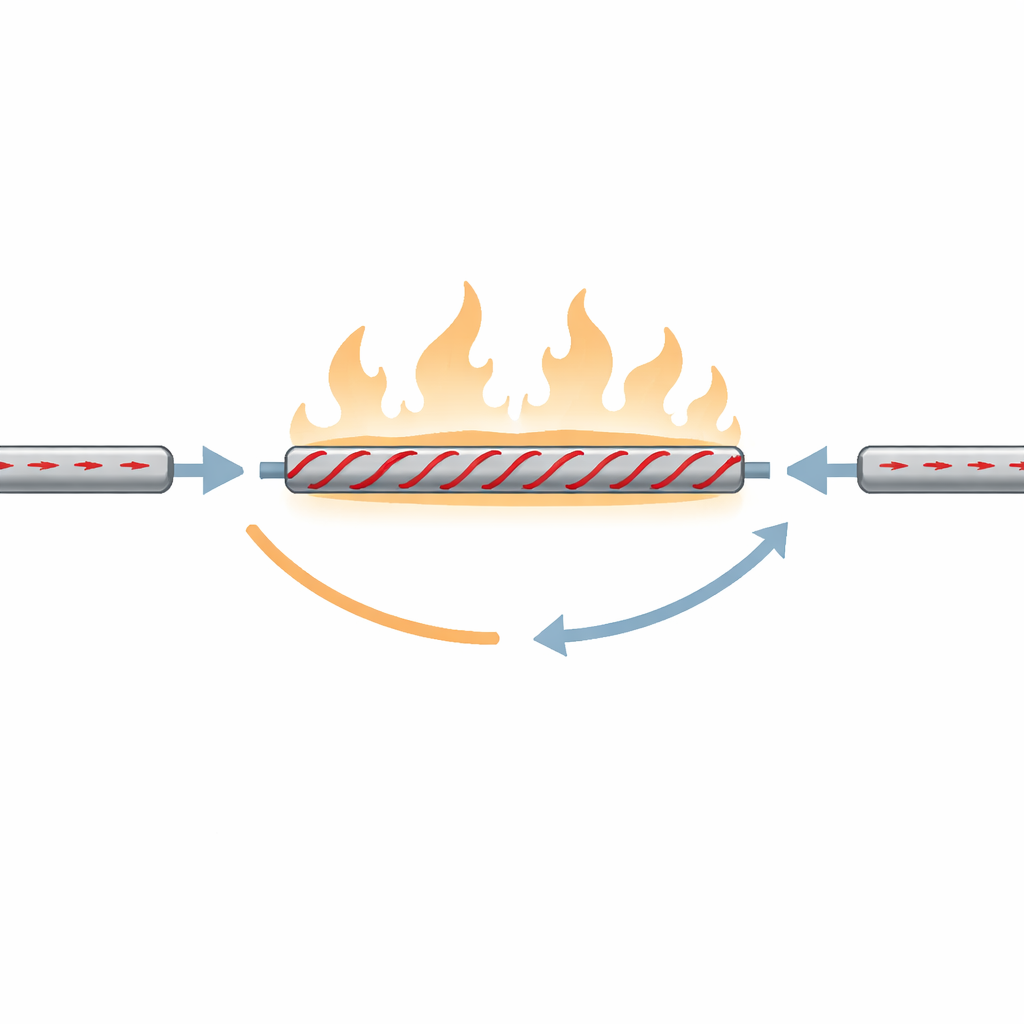
To reshape the magnetic behavior, the team uses a heat-and-stretch process known as stress annealing. They heat the wires close to the temperature where they would start to crystallize, while gently pulling on them along their length. Under these conditions, the preferred direction of magnetization inside the wire tilts into a helical pattern that winds around the wire rather than lying straight along it. Measurements of standard magnetic loops show that the wires now respond more gradually to applied fields and behave as if they had a strong sideways component to their magnetization. Microscope images based on the magneto-optical Kerr effect reveal that the surface magnetic domains really do adopt spiral-like patterns after this treatment.
Microscopic rearrangements, not permanent damage
What makes this work stand out is that the induced magnetic state is not permanent. After stress annealing, the researchers perform a second, gentler heat treatment at a lower temperature, this time without pulling on the wire. Remarkably, the magnetic curves and domain images nearly return to their original form. A key clue comes from measuring magnetostriction, which tracks how magnetism and mechanical strain are linked. During stress annealing, this quantity even changes sign, reflecting a major shift in how the material’s magnetism couples to internal stresses. After the relaxation step, it moves back toward its original value. High-resolution electron microscopy and calorimetry confirm that the wires largely remain amorphous and do not form significant permanent crystals, indicating that the changes are reversible rearrangements rather than irreversible damage.
How tiny clusters switch and switch back
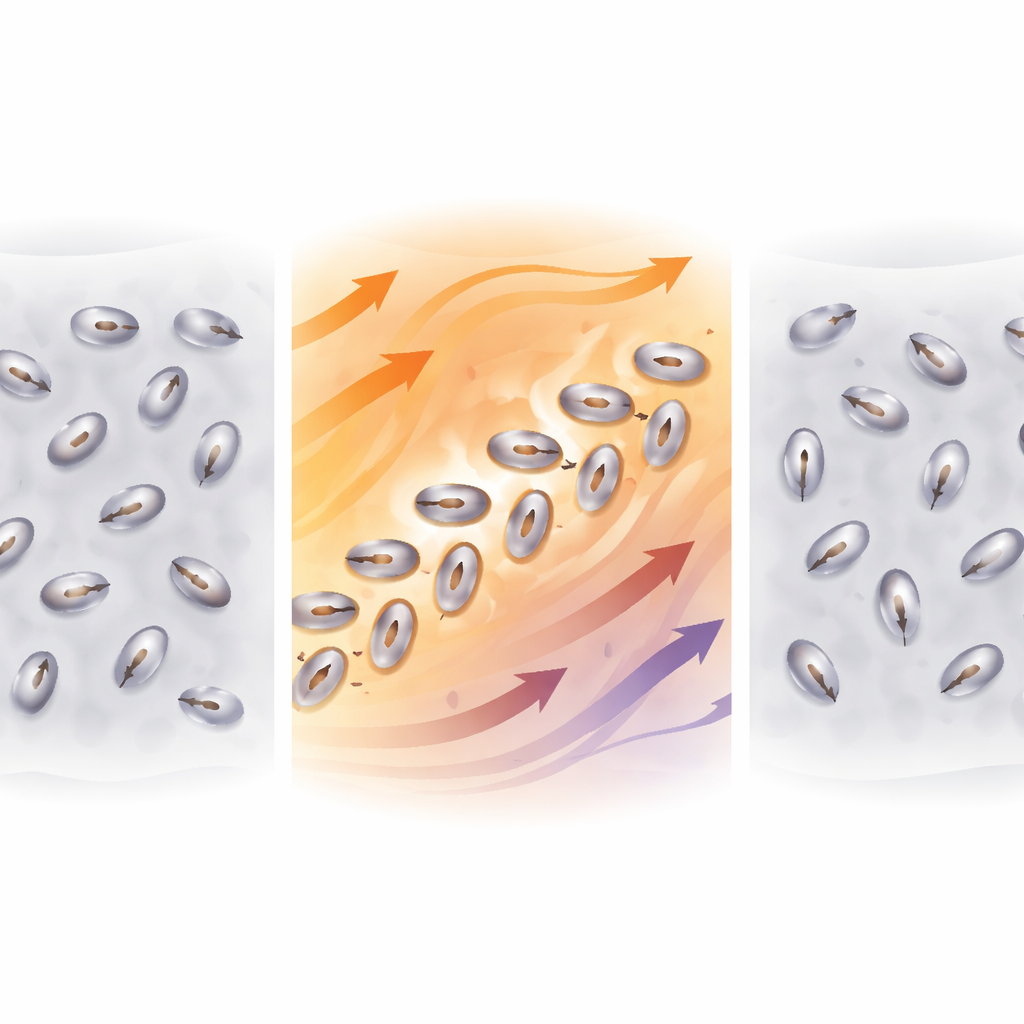
The authors propose that the secret lies in nanoscale clusters of iron and cobalt a few billionths of a meter across. In the as-made wire, these clusters sit in a mostly random orientation within the amorphous background, creating a weak built-in magnetic direction. When the wire is heated and stretched, the clusters can subtly rotate and line up in a preferred tilted orientation. This reorientation produces small internal strains that collectively act like a strong helical magnetic bias. Because the underlying atomic network lacks long-range order, it can accommodate these shifts without cracking or locking them in permanently. During the lower-temperature relaxation step, the extra energy that kept the clusters aligned is removed, and they can gradually drift back toward a more random arrangement, restoring the original magnetic behavior.
New options for stable, tunable sensing
The ability to tune and then reset the magnetic state of these wires has clear technological implications. Devices built from such materials could be shipped with one magnetic setting, adapted to a particular task by a brief heat-and-stretch step, and later recalibrated by a milder heat treatment without replacement. This opens possibilities for sensors that can change operating mode, recover from long-term drift, or be customized to different ranges of magnetic field, stress, or position. For readers, the key takeaway is that the study demonstrates a practical way to “program” and “erase” magnetic behavior inside tiny metal wires, paving the way for more reliable and adaptable precision sensors.
Citation: Óvári, TA., Lostun, M., Corodeanu, S. et al. Reversible magnetic behavior in amorphous wires for precision sensing applications. Sci Rep 16, 9885 (2026). https://doi.org/10.1038/s41598-026-40891-y
Keywords: magnetic sensors, amorphous wires, stress annealing, reversible magnetism, nanoscale clusters