Clear Sky Science · en
Experimental study on settling, transport, and packing mechanisms of proppants with different shapes in a physical model
Why the shape of tiny grains matters for big energy
Deep underground, engineers crack rocks to release trapped oil and gas, then prop those cracks open with sand-like grains called proppants. This study asks a deceptively simple question with big consequences: does the shape of those grains—whether round like beads or jagged like little pyramids—change how well fractures stay open and how easily fuel can flow? Using carefully 3D‑printed particles and transparent models, the researchers show that shape strongly controls how proppants fall, move, and pack inside fractures, and they offer new ways to predict that behavior.
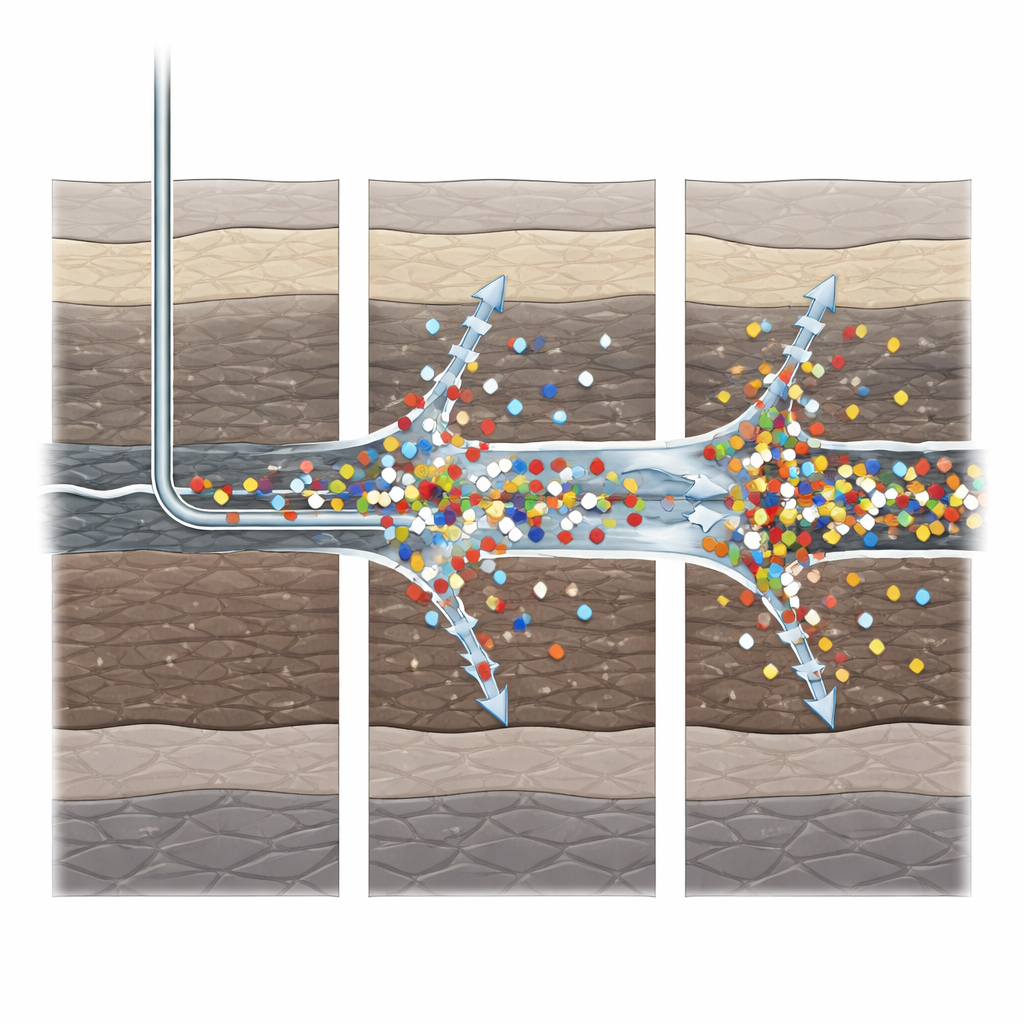
Breaking rocks and holding them open
Hydraulic fracturing has enabled large‑scale production of shale gas and coalbed methane by injecting pressurized fluid to crack the rock and then pumping in solid particles to keep those cracks from snapping shut. Traditionally, these proppants are nearly spherical grains of sand or ceramic. Spheres are easy to pump and study, so most research has focused on them. But real wells can suffer if too many particles settle out early, flow back to the surface, or pack so tightly that they choke off fluid flow. That has led to growing interest in non-spherical proppants—cylinders, rods, and more complex shapes—that might settle more slowly and leave more open space between grains.
Building custom grains and a transparent rock
To explore how geometry alone affects behavior, the team 3D‑printed six kinds of proppants: spheres, cubes, cuboids (brick-like), cylinders, tetrahedra (pyramid-like), and rhombohedra (tilted blocks). All had nearly the same material density and similar effective size, isolating shape as the key variable. They then created clear fracture models—narrow slots mimicking real cracks—and filled them with slickwater fluids of different thicknesses (viscosities). High‑speed cameras, laser‑based flow visualization, and tiny tracer particles let them track how each grain fell through still fluid, how it moved when pumped along a fracture, and how it finally piled up and packed. A separate setup measured how much empty space (porosity) remained when each shape was poured and saturated with water.
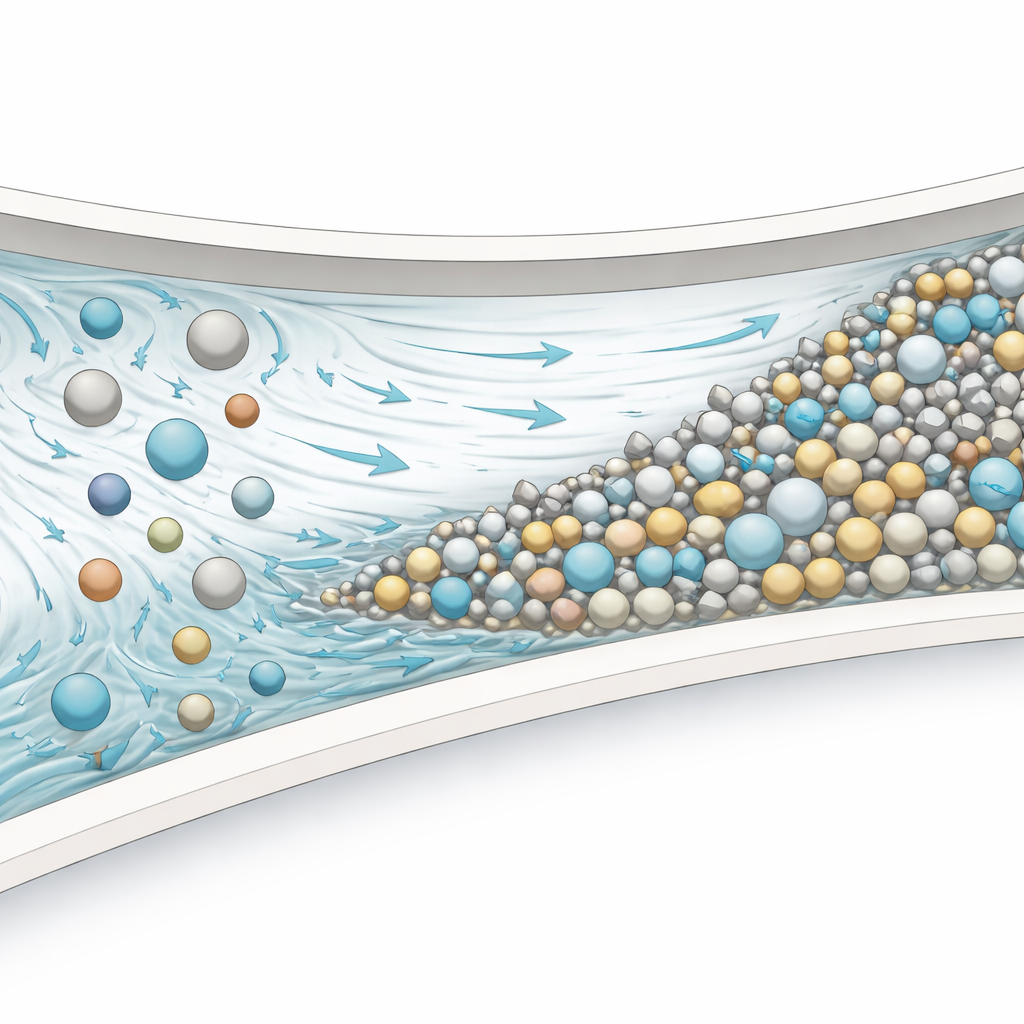
How odd shapes fall, move, and pile up
The experiments showed that under thin, low‑viscosity fluids, spherical grains sank fastest, while the more angular tetrahedra and rhombohedra settled slowest and tumbled more as they fell. Their sharp corners stirred the surrounding fluid and generated extra turbulence, which acted like a brake. As the fluid became thicker (more viscous), overall settling slowed for every shape and the differences between shapes shrank; the fluid’s resistance dominated over geometry. When proppants were pumped through the fracture models, all shapes went through similar stages—being carried in suspension, bouncing along, and finally creeping into place—but their final sand banks looked different. Angular rhombohedra spread more evenly along the fracture, with a shallower “dip” in the middle of the dune, indicating better horizontal transport, while tetrahedra and cubes formed steeper, more localized mounds.
Extra open space from jagged grains
Packing tests revealed a key advantage of irregular shapes. Tetrahedra and rhombohedra produced the highest porosities, around 40–45%, notably larger than spheres and cubes at roughly 35%. Their uneven faces and edges prevented tight, face‑to‑face contacts and forced looser arrangements with more connected voids, which should allow oil or gas to flow more easily through a proppant bed. Cylinders and cuboids fell in between. By contrast, more regular shapes tended to nest efficiently, leaving fewer flow pathways, even though they were easier to transport. To make these insights practical, the authors built six mathematical formulas—one for each shape—that link settling speed to fluid properties, particle size, density, and a “shape factor” describing how far a grain deviates from a perfect sphere.
What this means for future wells
For readers, the takeaway is that the tiny building blocks propping open fractures do not all behave alike. Round grains are simple and fast‑falling, but more jagged 3D‑printed shapes can stay suspended longer and pack in ways that leave more room for oil and gas to flow. The study shows that by deliberately choosing and designing particle shapes—and by using the new prediction models to forecast how they will settle—engineers could tune fracturing treatments for better long‑term productivity and reduced sand loss, offering a new design lever for cleaner and more efficient energy extraction.
Citation: Li, J., He, S., Wu, M. et al. Experimental study on settling, transport, and packing mechanisms of proppants with different shapes in a physical model. Sci Rep 16, 12406 (2026). https://doi.org/10.1038/s41598-026-40890-z
Keywords: hydraulic fracturing, proppant shape, particle settling, fracture conductivity, 3D printed particles