Clear Sky Science · en
Impact of pressure on the structural, Raman, superconducting, and normal state resistivity properties of Y5Rh6Sn18 quasi-skutterudite single crystal
Why squeezing crystals can change their powers
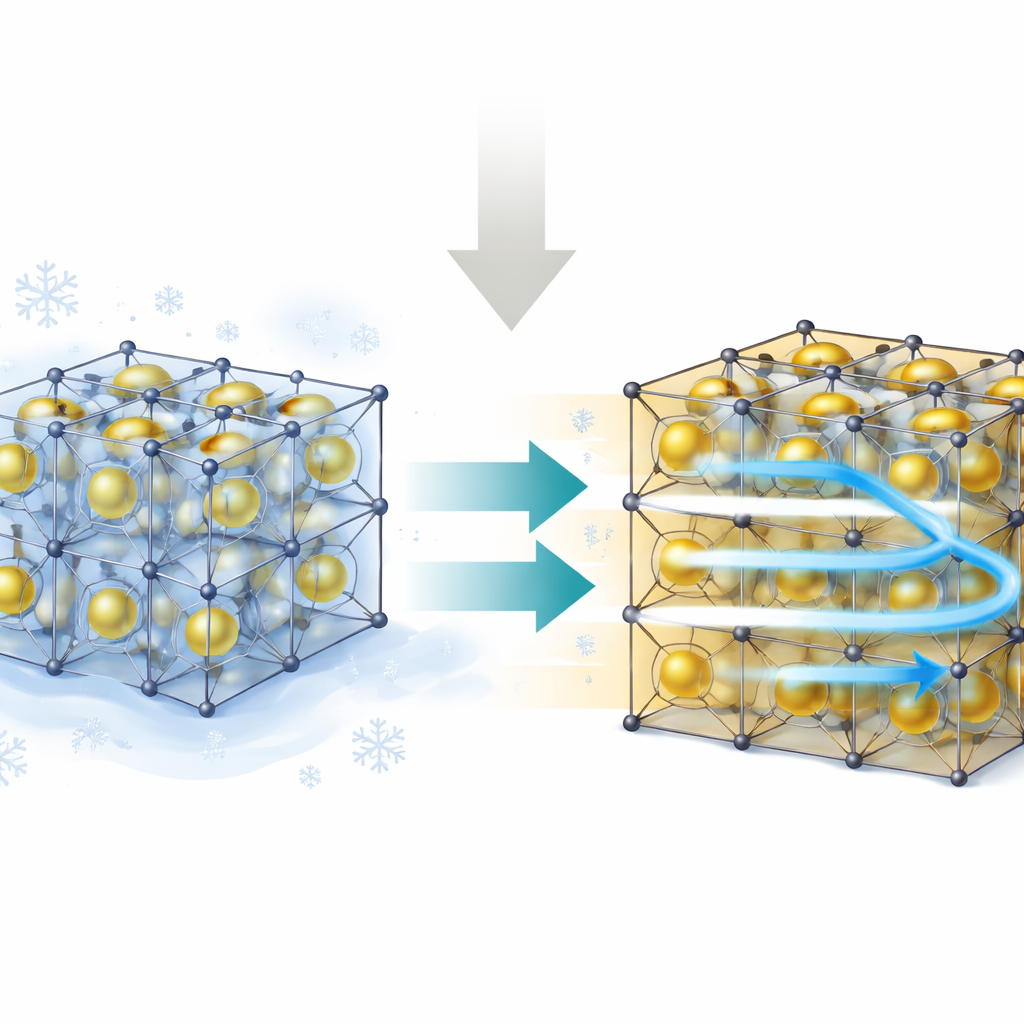
Superconductors are materials that can carry electricity with zero resistance, but they usually work only at extremely low temperatures. This study explores a little-known superconductor, a cage-like metal compound called Y5Rh6Sn18, to see how gently squeezing it with very high pressure changes both its internal structure and its ability to carry electric current without loss. Understanding this link between "squeezing" and performance could help guide the design of new, more efficient superconducting materials.
Cage-like metals with hidden potential
Y5Rh6Sn18 belongs to a family of intermetallic compounds in which heavy atoms sit inside spacious cages built from tin and rhodium. Different rare-earth atoms—yttrium (Y), lutetium (Lu), or scandium (Sc)—can occupy the central sites, and simply swapping one element for another subtly changes the size of the cages and the overall volume of the crystal. These changes strongly affect whether the material behaves more like a good metal or a poor one, and at what temperature it becomes superconducting. Among the three, Sc-based crystals, which pack the tightest, show the highest superconducting temperature and the most metal-like behavior, while Y-based crystals have the largest volume and the lowest transition temperature.
Probing structure, vibrations, and current under pressure
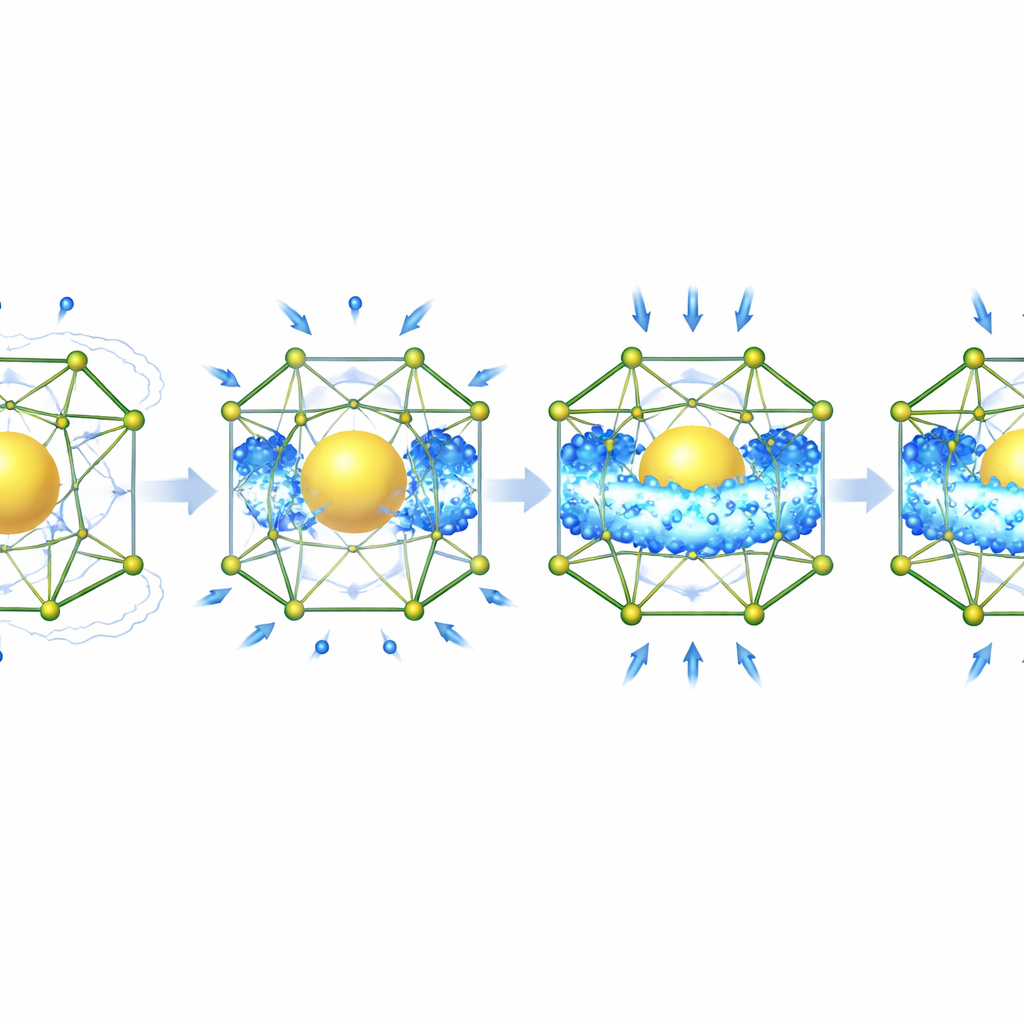
The researchers used three complementary techniques while gradually increasing pressure up to about 10 gigapascals—roughly 100,000 times atmospheric pressure. Synchrotron X-ray diffraction tracked how the atomic lattice shrinks and distorts; Raman spectroscopy followed how the atoms vibrate inside their cages; and electrical resistivity measurements revealed how easily electrons move and when superconductivity sets in. Throughout the entire pressure range, the overall crystal symmetry of Y5Rh6Sn18 stayed the same: the unit cell became smaller, but no new peaks appeared in either the diffraction or Raman data, which means there was no sudden structural phase transition hiding behind the changes in electrical behavior.
From a poor metal to a better conductor
At normal pressure, Y5Rh6Sn18 behaves like a so-called "bad metal": its electrical resistance increases slightly as temperature drops, a sign that electrons are strongly scattered by disorder and complex atomic motion. Yet, just above 3.5 kelvin, the resistance suddenly falls to zero as the material becomes superconducting. As the team turned up the pressure, resistance at low temperature dropped significantly, the ratio of high-temperature to low-temperature resistivity improved, and the energy barrier that electrons must overcome to move was sharply reduced. All these trends point to a steady evolution toward more conventional metallic behavior, where electrons move more freely and scattering is reduced.
A sweet spot before superconductivity weakens
The superconducting transition temperature of Y5Rh6Sn18 increases from about 3.6 kelvin at ambient pressure to a maximum of roughly 3.94 kelvin near 7.9 gigapascals. Beyond this point, further squeezing causes the transition temperature to slowly decline. Structural data reveal that around the same pressure, the crystal stops shrinking uniformly: the dimension along one axis starts to deviate from a simple smooth trend, indicating that the cages are being distorted in a directionally uneven way. First-principles electronic structure calculations mirror this behavior, showing that the number of electronic states available at the energy where conduction occurs grows with pressure up to around 10 gigapascals, then levels off or decreases slightly.
How gentle pressure tuning guides better superconductors
To a non-specialist, the main message is that superconductivity in these cage-like metals is delicately balanced between two competing effects of pressure. At first, squeezing the crystal brings atoms closer, increases the density of available electronic states, and improves how electrons pair up to move without resistance. Past a certain point, however, further compression distorts the cages and stiffens their vibrations in an uneven way, weakening the very interactions that support superconductivity. By comparing Y-based crystals with their Sc and Lu counterparts, the study shows that both chemical choice and physical pressure act as tuning knobs for the same underlying mechanism. This understanding offers a roadmap for engineering new superconducting materials by carefully controlling atomic size, cage geometry, and pressure.
Citation: Lingannan, G., Sundaramoorthy, M., Maran, T. et al. Impact of pressure on the structural, Raman, superconducting, and normal state resistivity properties of Y5Rh6Sn18 quasi-skutterudite single crystal. Sci Rep 16, 12933 (2026). https://doi.org/10.1038/s41598-026-40887-8
Keywords: superconductivity, high pressure, cage compounds, electronic structure, quantum materials