Clear Sky Science · en
Coastlines retreat tipping point under storm climate changes
Why coastal storms matter to everyday life
For millions of people who live, work, and vacation by the sea, sandy beaches are more than scenery: they are natural shields against waves and flooding. This study asks a pressing question for our warming world: as ocean storms grow stronger and sea level rises, is there a point at which beaches can no longer bounce back between storms and start to retreat for good? By blending decades of satellite images with records of wave conditions, the authors search for early warning signs of such a turning point along the world’s sandy coasts.
Reading the shoreline from space
Traditional beach studies often focus on a handful of well-instrumented locations, tracked carefully over years or decades. That level of detail is powerful but limited in coverage. Here, the authors flip the perspective: they use a global shoreline dataset built from Landsat satellite images between 1993 and 2016, combined with 60 years of wave “weather” from a major climate reanalysis. Although the satellite shoreline positions are only available about once a month and have some uncertainty, the team shows that, when many storms are analyzed together, these coarse measurements still carry a clear imprint of storm-driven erosion and subsequent recovery. They check their approach against precise field surveys at six beaches across several continents, finding that the regional satellite patterns reasonably match real-world observations.
Where storms hit hardest
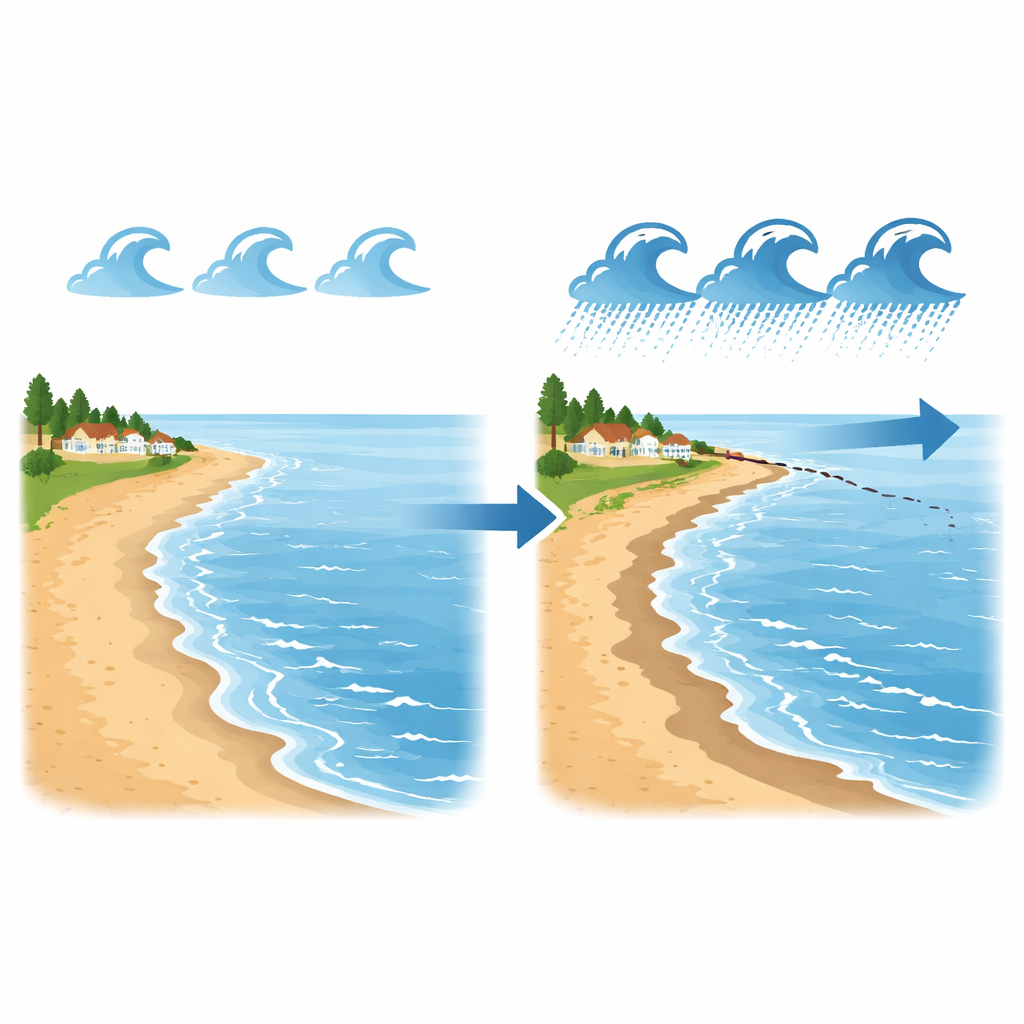
To understand how sensitive different coasts are to storms, the researchers first characterize the offshore wave climate. They go beyond simply counting big waves and instead examine how much storm waves stand out from typical conditions. From this they build a Coastal Storm Sensitivity index that blends storm height, background wave energy, and how often storms occur. Some semi-enclosed seas, such as the Mediterranean and Caribbean, emerge as highly sensitive: storms there are relatively rare, but when they do arrive they are far more energetic than the everyday wave climate and can strongly reshape beaches. In contrast, some open coasts that face frequent strong waves, like parts of western Europe and western North America, show lower sensitivity because their background conditions are already energetic, so storms are less of a sharp departure from the norm.
How fast beaches erode and recover
Using many individual events, the authors build “storm composites” that represent the typical pattern of wave height and shoreline position over a 60-day window around a storm. Globally, they find that a single storm commonly pulls the shoreline landward by a few meters, with larger retreats along major storm tracks off Chile, Namibia, and similar corridors. Crucially, they also estimate how long beaches usually take to recover from that hit. By relating post-storm wave energy to the observed pace of shoreline return, they derive a simple rule of thumb: higher average wave energy after a storm tends to speed up recovery. Intertropical coasts often regain their shape in under two weeks, while subtropical beaches show more varied recovery times of roughly two to four weeks. These broad patterns offer a first global picture of sandy shoreline resilience, even though individual sites can behave quite differently.
Spotting a tipping point in storm sequencing
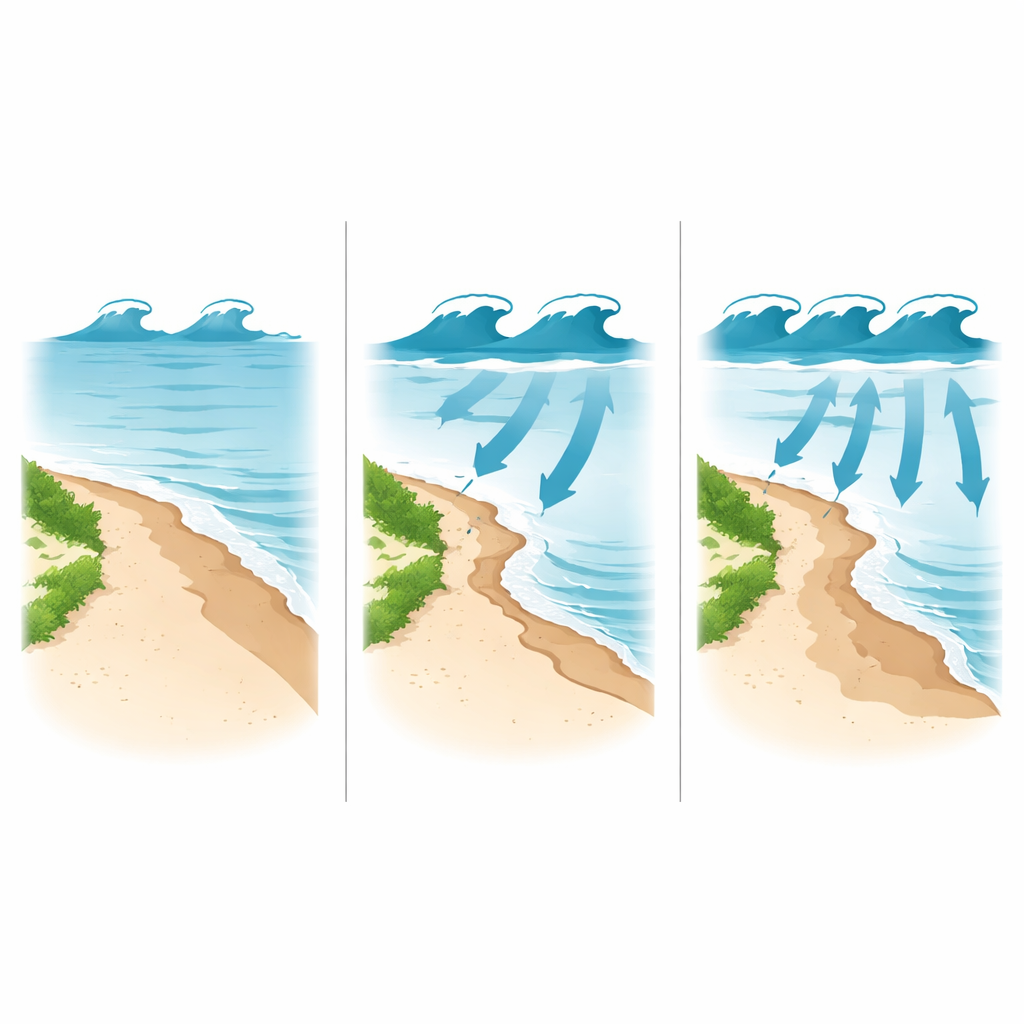
The heart of the study is the balance between how fast storms arrive and how fast beaches heal. The authors define a ratio between the typical time gap from one storm to the next and the characteristic recovery time of the shoreline. When the gap is longer than recovery time, beaches can largely reset between events and their evolution is dominated by slower, seasonal changes. When the gap shrinks below the recovery time, storm impacts begin to overlap: each new storm hits a beach that is still weakened by the previous one. In this storm-dominated regime, erosion can accumulate and the shoreline may trend steadily landward. By tracking this ratio over six decades, the study finds that about 2% of the sandy coastline they analyze has already shifted from seasonal to storm-dominated behavior, particularly along parts of the Americas, Southeast Asia, and several enclosed seas. Climate model projections suggest that, under both low and high emission scenarios, many of these hotspots are likely to move further into the storm-dominated zone by the end of the century.
What this means for coasts and planning
The authors emphasize that their tipping point is not a precise forecast for any single beach. Local factors such as sand supply, coastal shape, human engineering, and rising sea level all matter, and the satellite record is still relatively short. Instead, the work provides a global “early-warning map” showing where storm clustering is most likely to outrun natural recovery. For planners and communities, these regions are prime candidates for more detailed monitoring and adaptation, from improved dune management to reconsidering where we build. The central message is clear in lay terms: as storms grow more frequent or intense, some beaches may lose the breathing space they need to recover, turning once-stable shorelines into coasts that retreat step by step with each new storm.
Citation: Aparicio, M., Almar, R., Lacaze, L. et al. Coastlines retreat tipping point under storm climate changes. Sci Rep 16, 10311 (2026). https://doi.org/10.1038/s41598-026-40886-9
Keywords: coastal erosion, storm impacts, shoreline change, climate change, satellite monitoring