Clear Sky Science · en
Effect of cerium oxide on physical, structural, and spectroscopic properties of tellurium-borate glasses for cool greenish light emitting devices
Glass That Glows a Cool Green
Light‑emitting devices, from phone screens to smart lighting, depend on materials that turn electricity or high‑energy light into colors our eyes enjoy. This study explores a new kind of glass that glows with a cool greenish light when a small amount of the element cerium is added, aiming at future use in energy‑efficient lamps, optical fibers, and other optoelectronic gadgets.
Building a Special Kind of Glass
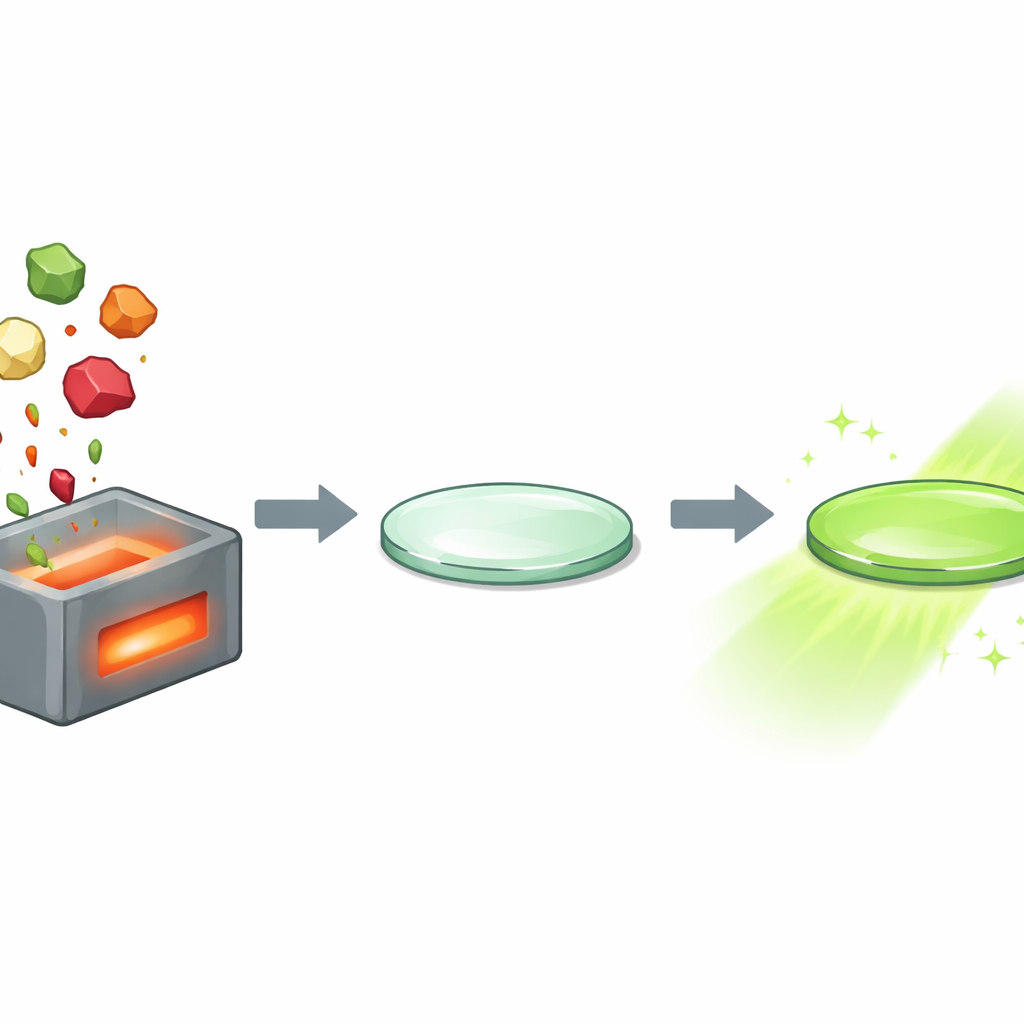
The researchers started with a mixture of common glass‑forming oxides: boron oxide, tellurium oxide, and sodium oxide. By melting these powders together and quickly cooling the melt, they produced clear, non‑crystalline pieces of glass. Into this base recipe they gradually mixed in small doses of cerium oxide, creating a family of samples with increasing cerium content. X‑ray tests confirmed that all samples remained glassy rather than forming crystals, which is important for making uniform optical components.
Peeking Inside the Glass Network
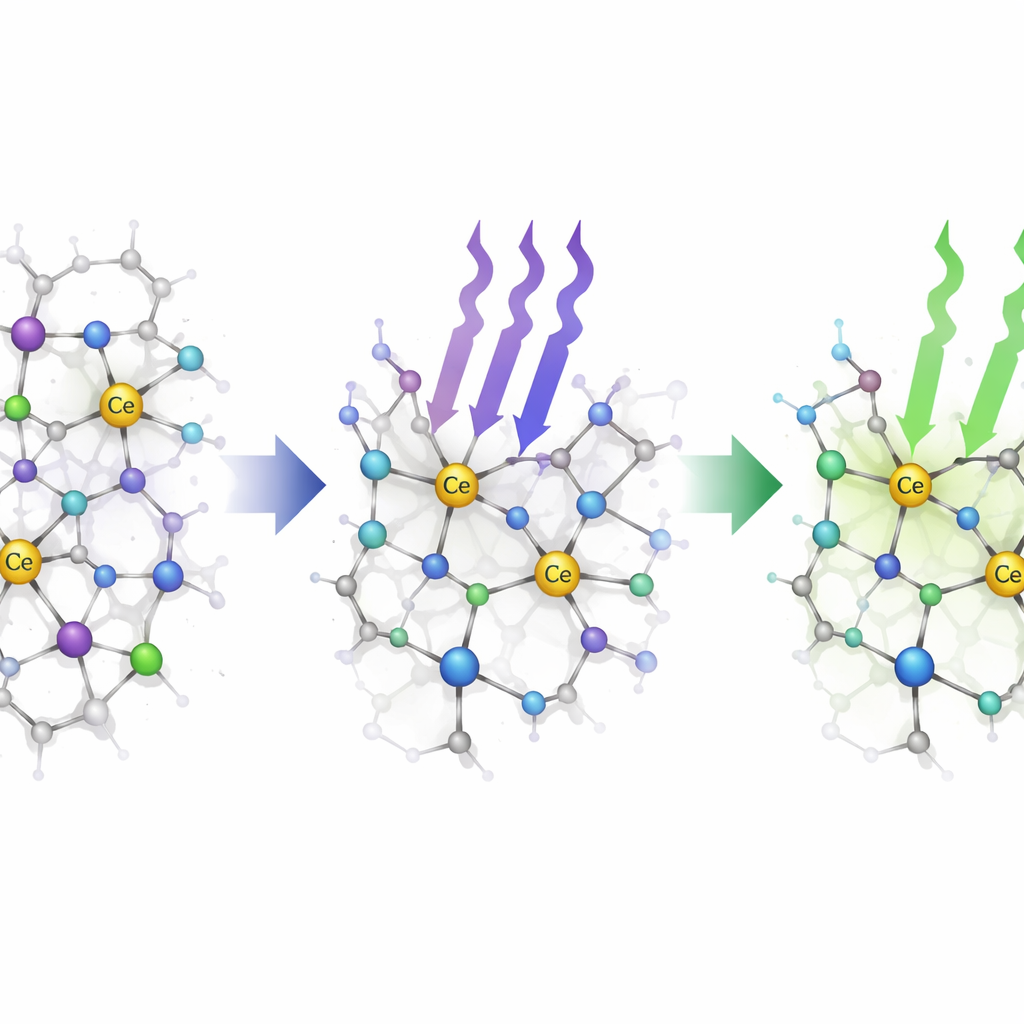
To understand how cerium changes the glass from the inside, the team used infrared spectroscopy, a method that reads how atoms vibrate when light passes through. They found that the glass network is built from borate and tellurite building blocks, and that adding cerium subtly rearranges these units. In particular, it increases the number of “loose” oxygen atoms that are bonded to only one neighboring atom instead of two. These changes soften the network, lower the glass density, and increase the space per atom, which in turn affects how easily the electrons inside can move and respond to light.
Shaping How Light Moves Through
The scientists then measured how the glasses absorb ultraviolet and visible light. From these measurements, they estimated the energy needed for electrons in the material to jump between states, as well as the glass’s refractive index—how strongly it bends light. As cerium content changed, so did the optical band gaps and refractive index, revealing a fine balance between a more open structure and stronger electronic interactions. The glasses showed relatively high refractive indices and suitable numerical aperture values, meaning they can guide light efficiently enough to be considered for optical fiber cores and other guiding components.
From Invisible Excitation to Visible Green
The most striking behavior appeared when the cerium‑doped glasses were excited with higher‑energy light. Electrons in cerium ions were pushed to an excited state and then relaxed, releasing their excess energy as visible photons. Instead of giving sharp colored lines, the glasses emitted a broad band centered around a green wavelength, producing a cool greenish glow. By tuning the cerium content, the team found an optimal composition where the brightness peaked before dropping off due to interactions between too many neighboring cerium ions. Color measurements placed the emitted light in the green‑to‑yellowish region, with correlated color temperatures above 5000 K—values associated with cool, daylight‑like tones.
Why This Matters for Future Lighting
In everyday terms, this work shows that a carefully adjusted recipe of oxides and a pinch of cerium can turn an ordinary‑looking piece of glass into a compact, durable green light source. Because the same material also has favorable properties for bending and guiding light, it could serve double duty inside devices—both carrying signals and generating light. Among the tested samples, the glass with a moderate amount of cerium offered the strongest, coolest green glow, making it a promising candidate for next‑generation light‑emitting and optoelectronic devices.
Citation: Shiva Kumar, B.N., Vinay, D. & Devaraja, C. Effect of cerium oxide on physical, structural, and spectroscopic properties of tellurium-borate glasses for cool greenish light emitting devices. Sci Rep 16, 9859 (2026). https://doi.org/10.1038/s41598-026-40883-y
Keywords: green light emitting glass, cerium doped glass, borate tellurite optics, optoelectronic materials, cool white lighting components